
- Collection type
- Object
- Description
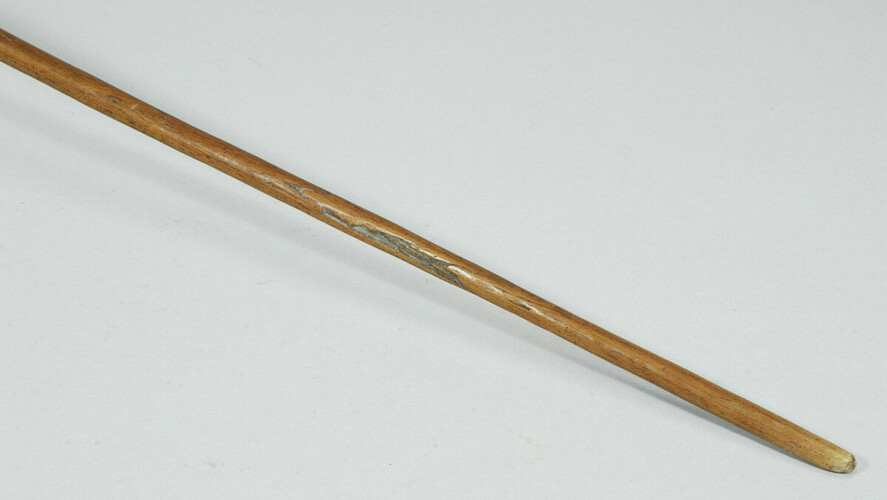
- Fragment of wooden staff, decorated with incised leaf-shaped motifs with the raised areas blackened for contrast [RTS 1/10/2004].
- Long description
- Fragment of a narrow staff with circular section, made from a length of lightweight, segmented wooden branch with four swollen joints preserved. This is currently a yellowish brown colour (Pantone 730C). The staff has been roughly cut down at either end, perhaps by Seligman to make the object smaller for transportation, as it was apparantly the pattern that he was interested in rather than the form. It is currently less than half its original length, which was said to be 6 or 7 feet. The surface has been decorated with a series of incised patterns, arranged in three broad bands that cover the narrower part of the body between the jointed segments. Each band is composed of a repeated vertical motif that may represent either a leaf or a shield, arranged in 3 horizontal rows with 3 such motifs in each. Each of these rows is arranged to overlap slightly with the one below. The motif itself has a lentoid outline, divided down the centre with a vertical line and flanked by a zigzag on either side. In addition, the central band of decoration is framed by parallel lines around the circumference of the staff at either end - 9 on one side, 5 on the other, with a single set of 4 parallel lines also around the base of the band below. Over the surface of the staff, all the raised parts of the design - those around the incised lines - have been artificially blackened, probably through burning (Pantone black 4C). This has been done to the area between each leaf-shaped element, and to the raised triangular segments on either side of each internal zigzag, creating a 'dog-tooth' effect. The wood around each segmented joint has been left its natural colour, except for the centre of each joint which has been burnt on alternating sides of the staff. This blackening has worn off in places. The stick has a weight of 73.4 grams, and is 868 mm long, with a diameter of 15.6 mm at the swollen joints, and 13 mm at the narrower sections between [RTS 1/10/2004].
- Geographical reference
- Bahr el Jebel Eastern Equatoria
- Person
- Field collector Charles Gabriel Seligman
- Field collector Brenda Zara Seligman
- PRM source Charles Gabriel Seligman
- Date / Period
- Date made: Before 03/1922
- Date collected
- January to March 1922
- Acquisition information
- Donated: 1922
- Materials and processes
- Material Wood Plant, Process Carved, Process Decorated, Process Incised, Process Burnt
- Dimensions
- Diameter: max 15.6 mm, Length 868 mm, Weight 73.4 g
- Object numbers
- Accession number: 1922.25.4
- Research and responses
Although the term 'Upper Nile' is now used to refer to a modern administrative district, covering a stretch of the Bahr el Abiad from Geigar to Malakal, and the Sobat River to Nasir, at the time this object was collected the term was used differently. Up until 1981, it was the name of a province that covered the districts now known as Upper Nile, Jonglei, Wahda and part of el Buheyrat. It may also have been used to describe the Bahr el Abiad and/or Bahr el Jebel rivers [RTS 12/11/2003].
Further items to explore
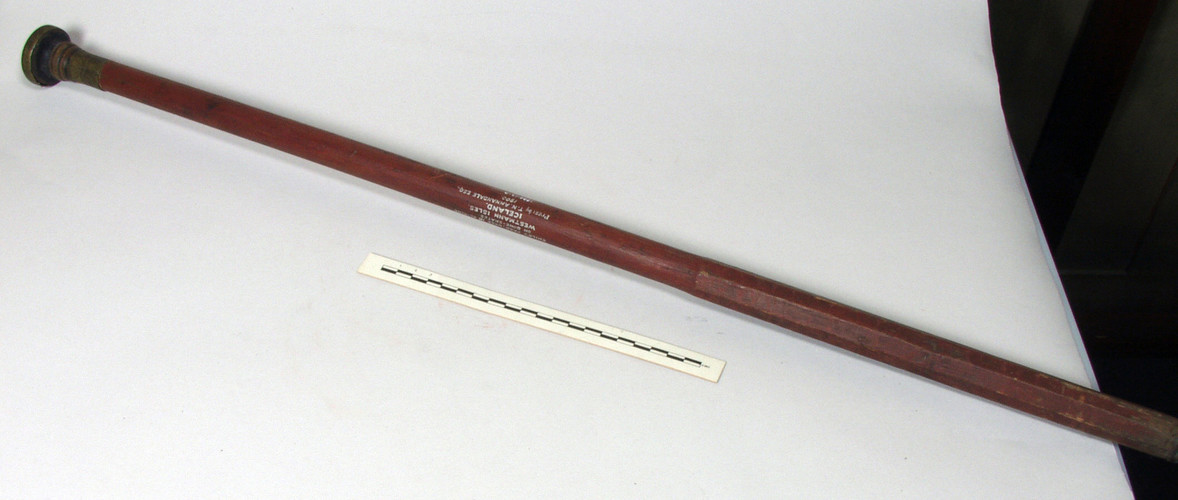 1900.13.3Child's prod-stick used when sliding on the ice on bone skates.1900.13.3
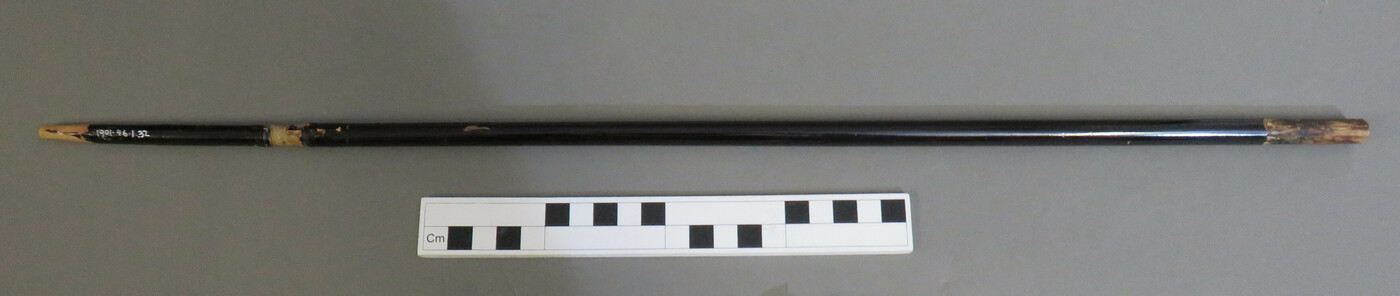 1901.46.1.32Wooden lacquered stick for banner, part of complete suit of Japanese armour. [PRA [OPS move] 24/8/2017]1901.46.1.32
 1942.13.1728Iron staff. [EH [OPS move] 31/7/2017]1942.13.1728
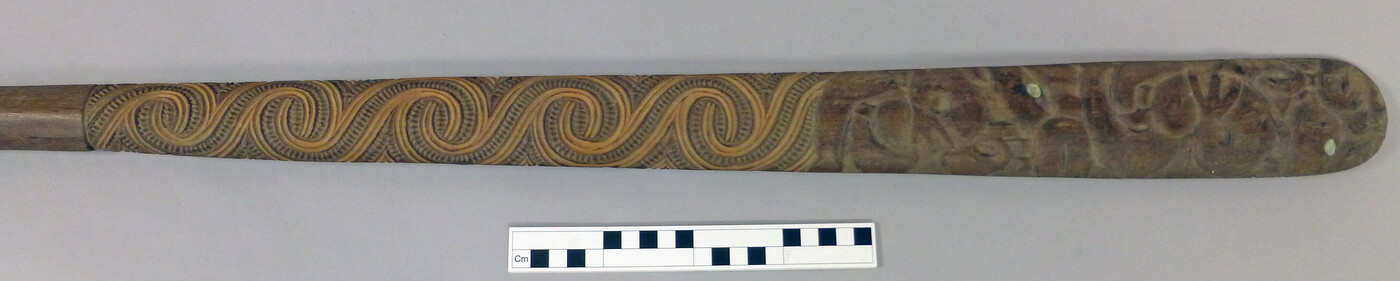 1939.12.46Chief’s staff, carved with scrolling motifs and a human face. Inlaid with circular pieces of haliotis shell. [SM 21/11/2008]1939.12.46
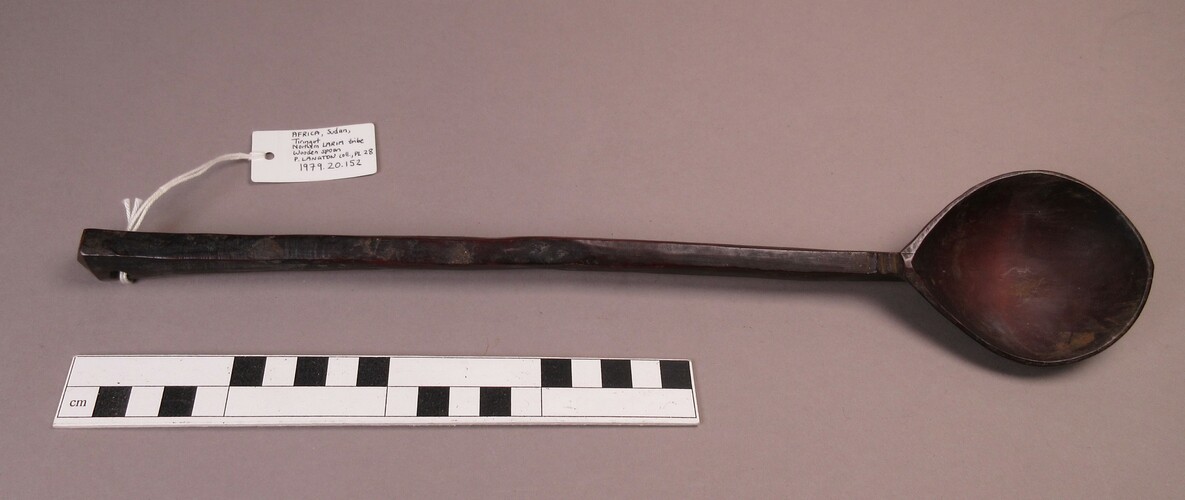 1979.20.152Reddish brown wooden spoon with pierced handle and serrated decoration above shallow bowl [RTS 21/6/2004].1979.20.152
 1934.8.132.7Angular quadrilateral piece of gourd, used as potter's tool for making patterns [RTS 18/10/2004].1934.8.132.7
 1936.10.2Spear with hard wooden point set into a long wooden shaft, with the junction covered by a hide sheath [RTS 3/1/2005].1936.10.2