
- Collection type
- Object
- Description
- Frechen stoneware Bartmann (aka 'Bellarmine', 'Greybeard') jug. [JC 7 11 2008, 26 9 2013]
- Long description
- Frechen stoneware Bartmann (aka 'Bellarmine', 'Greybeard') jug. The vessel has a brown salt glaze. It has a bulbous body and tapers to a narrow neck and narrow base. The jug has a handle between the shoulder and neck. The front of the vessel is impressed an image of a bearded man and a smaller oval floral image. [MJD 16/10/2013]
- Geographical reference
- England Oxfordshire Oxford
- Date / Period
- Date made: 1600-1699
- Date collected
- By 1911
- Acquisition information
- Donated: 1911
- Dimensions
- Diameter: max 125 mm, Height: max 217 mm
- Object numbers
- Accession number: 1911.29.95
- Research and responses
Dan Hicks advises that [some of] these jugs were used as apotropaic devices ('witch bottles'), in part through an association with the human body and its contents. They were placed under walls, under hearths, and in similar locations. The classic reference work on such practices is The Archaeology of Ritual and Magic, by Ralph Merrifiel, London: Batsford (1987). (See also his earlier study 'The Use of Bellarmines as Witch Bottles', in Guildhall Miscellany, no. 3 (February 1954), pp. 3-15.) The use of Bartmann jugs in this way continued at least into the mid 18th century, but similar practices with other vessels continued in England into the 20th century. The practice was especially common in south-east England (see 'The Archaeology of Counter-Witchcraft and Popular Magic', by Brian Hoggard, in Beyond the Witch Trials: Witchcraft and Magic in Enlightenment Europe, edited by Owen Davies and Willem de Blécourt, Manchester: Manchester University Press (2004), pp. 167-186). [AS 02/06/2009; JC 26 9 2013]
This image of this pot was studied by Maureen Mellor, archaeological ceramic specialist and tutor at Oxford University Department for Continuing Education, on 23 September 2014. She noted the pot was salt glazed stoneware. Maureen gave a time period for the pot as 17th century. [MJD 23/09/2014]
Further items to explore
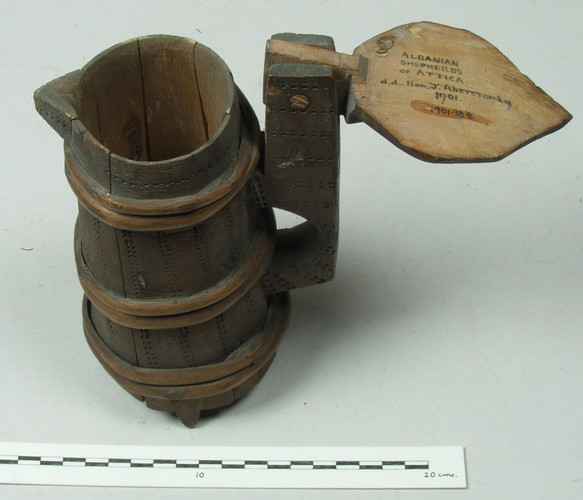 1901.38.8'Jug with hinged cover, of wood, built up barrel wise and bound with wooden bands, wooden handle carved from one of the staves.' Decorated with rows of incised dots. [ZM 'DCF 2004-2006 What's Upstairs?' 9/12/2004]1901.38.8
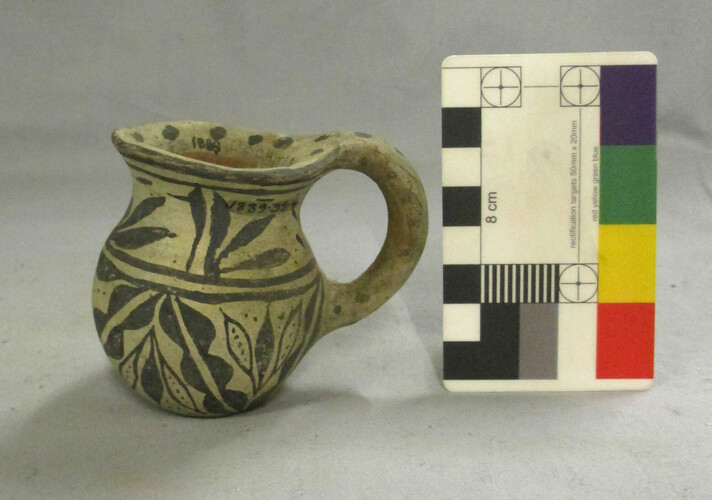 1889.39.4Red ware jug with a flat base, bulbous body, flared neck and out turned rim or lip. [ASh [OPS move] 04/04/2016]1889.39.4
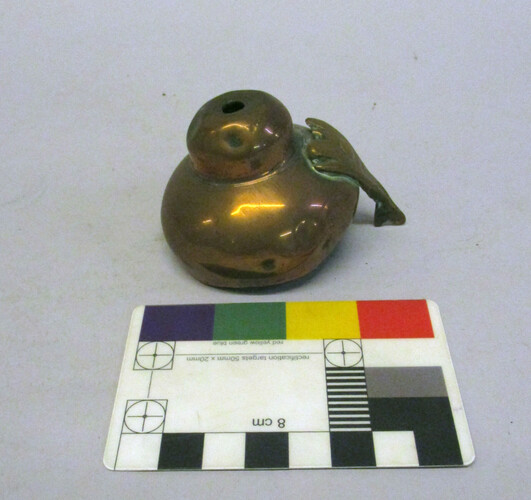 1965.11.28.2Hinged lid for copper jug. For all three parts see 1965.11.28 .1 - 1965.11.28 .3 [RM [OPS move] 25/7/2016]1965.11.28.2
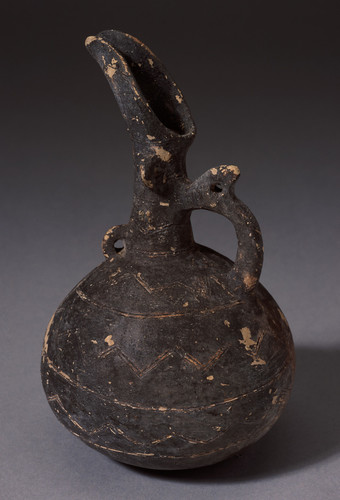 1884.38.17Pottery jug of black slip ware. [MOBB [OPS move] 26/04/2016]1884.38.17