
- Collection type
- Object
- Description
- Red pottery bowl with bow-shaped rim, short neck, high rounded shoulder and flat base; decorated with incised, impressed, and modelled designs [RTS 12/11/2004].
- Long description
- Handmade pottery bowl, with walls of irregular thickness; possibly coil made. This has been shaped from a well levigated clay with numerous small to large gold-coloured mica inclusions, fired a mottled pinkish brown colour (Pantone 7515C) with patches and dots of dark brown (Pantone black 7C) over the surfaces inside and out. The exterior has been burnished. The vessel is circular in plan view, and has an everted rim, the top of which has been tooled to have a flat surface. The rim slopes down in a straight line to a flattish inner lip. The outside edge of the rim slopes down convexely, giving it a bow-shaped profile, to a short inset neck with concave sides; the sides then flare out to a rounded shoulder, and down and in to a narrow flat base. Both the inner lip, and the narrow rim top have been tooled to form a series of concentric grooves, with 2 similar grooves around the side edge of the rim. Below this the rim is decorated with a narrow incised line, then a horizontal row of impressed dots, above a broad band of oblique parallel rows of impressed squares, finished off by a single row of the same element at its base. The concave neck itself has been left plain, but framed at its top and base by raised bands of impressed dots. Below this, the upper shoulder has a band that has been tooled to stand out from the surface slightly. This has been divided up into a series of rectangular panels, each covered with tightly spaced oblique hatching made of impressed squares, and framed by double lines made with the same tool on all sides. Between these panels, the surface of the pot has been modelled to create a row of vertical flutes, defined by short vertical lines cut into the surface. There are four sections of 7 flutes each, then a short section with only 2 flutes. Below this band, the lower part of the shoulder is decorated with a horizontal row of impressed squares, overlaid in parts with larger circular depressions. From this, five vertical dividing bands extend down the sides of the vessel to its base. These are defined by double rows of impressed squares down either side, then filled with alternating squares of horizontal parallel grooves and blocks of impressed squares; lower down the sides, the grooved sections stop and the areas between the impressed blocks are left undecorated. The spacing of these different motifs vary around the vessel. The areas between these vertical dividing bands are filled with a design made up of a shallow pendant semicircle with a broader semicircular band concentric around it, each defined by a single row of impressed squares around the edge and filled with closely spaced crosshatched rows of impressed squares. The impressed circles in the top band correspond with the edges of these semicircular motifs. The underside of the base has been decorated with a series of concentric grooves, from the outside edge inwards; these do not continue to the centre of the base, which has been left blank. The base interior has been decorated with similar grooves, but in this case, they continue to cover the central area. This vessel has been decorated using at least 3 types of tools. One is capable of producing broad, concave shallow grooves, applied with a minimum of turning of the vessel body, as they are not very regular; the second produces shallow circular depressions, and the third has an angular, square leading edge, applied either at an angle, creating a straight line or almost wedge-shaped mark, or from directly above, creating a square depression. The bowl is complete and intact, and has a weight of 774.8 grams. It has a height of 127 mm, which varies across the vessel as it is handmade and not completely regular. The rim has a diameter of 190 by 186 mm, while the mouth is 178 by 175 mm across; the shoulder measures 192 mm in diameter, and the base is 77 mm wide [RTS 12/11/2004].
- Geographical reference
- Cultural groups
- Zande
- Date / Period
- Date made: Before 1930
- Date collected
- 1927 - 1930
- Acquisition information
- Donated: 1931
- Materials and processes
- Material Pottery, Process Handbuilt, Process Fire-Hardened, Process Decorated, Process Impressed, Process Incised, Process Burnished, Process Coiled
- Dimensions
- Diameter: max 192 mm shoulder, Height 127 mm, Diameter: max 190 mm rim, Diameter 77 mm base, Weight 774.8 g
- Object numbers
- Accession number: 1931.66.2
- Research and responses
For a brief discussion of the works in the PRM’s collection associated with the Zande potter Mbitim (1930.86.42, 1930.86.43, 1930.86.44, 1931.66.2, 1931.66.3, 1934.8.132.7, 1934.8.132.8, 1934.8.133, 1934.8.134 [illustrated], 1934.8.135 [illustrated], 1950.12.117, 1950.12.118, 1996.53.1), as well as the tools associated with him (1934.8.132.1, 1934.8.132.2, 1934.8.132.3 [illustrated], 1934.8.132.4 [illustrated], 1934.8.132.5 [illustrated], 1934.8.132.6 [illustrated], 1934.8.132.7 [illustrated], 1934.8.132.8), see ‘An Artist of Exceptional Skill: The Zande Potter Mbitim’, by Rachael Sparks, in The Friends of the Pitt Rivers Museum, Oxford, Newsletter, no. 55 (March 2006), p. 10.
For further information about Mbitim and discussion of his work in museum collections (including the PRM), see ‘The Potter of Li Rangu’, by Inbal Livne, in Pieces of a Nation: South Sudanese Heritage and Museum Collections, edited by Zoe Cormack and Cherry Leonardi (Leiden: Sidestone Press, 2021), pp. 135–141, 202–203.
This bowl was probably collected by Evans-Pritchard himself during his fieldwork amongst the Zande, which took place during 1927, part of 1928 and 1929 and for several months during 1930. He does not mention its local name. For other Zande bowls in the collection see 1930.86.42-44; for anthropomorphic jars, see 1934.8.134 and 1950.12.117-8; for bookends, see 1934.8.135 and 1996.53.1. All are made in comparable style out of a similar fabric, and are comparable to pieces produced by the potter Mbitim, who operated a workshop at Li Rangu in the 1930's, and was filmed by Percy Horace Gordon Powell-Cotton (see Mrs Powell Cotton, "Village Handicrafts in the Sudan", Man 34 (112), pp 90-91). Confirmed examples of his work may be found at the Cleveland Museum of Art (1996.301-302) and the British Museum (1934.3-8.27 and 1931.3-21.48). The Pitt Rivers Museum holds several tools and clay samples from his workshop (see 1934.8.132).
Larken discusses Zande customs regarding the collection and working of clay. Clay is usually found on the banks of a stream, and prepared by pounding it in a mortar before shaping it by hand. Tools are limited to pieces of gourd or a rounded pebble for smoothing; decoration is applied by something simple, such as a short stick bound with cord. He describes two kinds of vessels that are made, one with a low collar around the mouth, and another with a bow-shaped neck (see 1931.66.2-3). The smaller pots are said to be used for cooking meat, the larger ones for water or making bakinde; other pots are for brewing beer, while long-necked varieties are used for washing the face and hands - this last type may have a head adorning the neck. Each type has its own Zande name. Decoration often covers the whole surface. Larken goes on to describe the firing and finishing: "When dry, pots are turned upside down and baked in the open, only certain kinds of wood being suitable for the fire. While still red-hot, they are splashed with water in which bark of the ndili tree has been soaked, in order to blacken them. A black polish is sometimes given to the smooth surfaces, by means of graphite grains, which are mixed with water and a little powdered ironstone, painted on the clay and gently but continually rubbed into it with a polishing-pebble before the pot is fired". The resulting vessel is not very strong, and only slightly porous, if at all; broad leaves may be used for a lid, if required (P.M. Larken, 1927, "Impressions of the Azande", Sudan Notes and Records X, pp 129-131). According to Evans-Pritchard, all Zande potters were male (Evans-Pritchard 1971, The Azande, p. 95).
Another characteristic of Zande pottery is that it is frequently mixed with small flecks of mica, which naturally occurs in beds throughout the region, known as hilidiwe, meaning 'slough of the moon' (P.M. Larken, 1926, "An Account of the Zande", Sudan Notes and Records IX no. 1, p. 4). Schweinfurth noted the presence of mica in both Bongo and Zande pottery, which he suggested made their wares very brittle. He believed this mix to be naturally occurring and that potters did not know how to remove it from their fabrics: "... [Zande potters] have no idea of the method of giving their clay a proper consistency by washing out the particles of mica and by adding a small quantity of sand" (G. Schweinfurth, 1873, In the Heart of Africa Volume I, p. 292; Volume II, p. 25). This mica may well have been left in the clay deliberately, as it gives the vessels an attractive sparkle, and does not seem to have impaired the plasticity of the material, as the detailed modelling of several Zande vessels demonstrates
Evans-Pritchard suggests that pottery is "... an art of the Ambomu, who made certain types of pottery... used for carrying water, ablutions, brewing beer, boiling oil, roasting and boiling met, etc. On the whole it was asserted that small-mouthed pots were Mbomu and that designs with larger mouths came from the south, especially from the Mangbetu." (E.E. Evans-Pritchard, 1971, The Azande, p. 95) [RTS 24/8/2005].
- Associated publications
- Pieces of a Nation: South Sudanese Heritage and Museum Collections, Editor: Zoe Cormack; Editor: Cherry Leonardi, 2021
Further items to explore
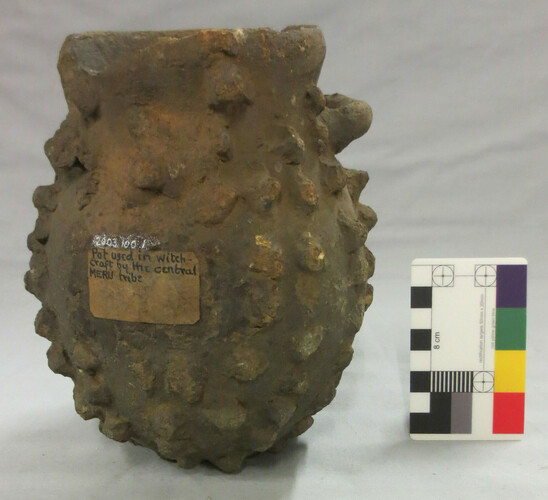 2003.100.1Pottery bowl with rounded base and short, slightly flared neck. Covered on the outside with vertical rows of nodules. Used in witchcraft. [JP 6/6/2003]2003.100.1
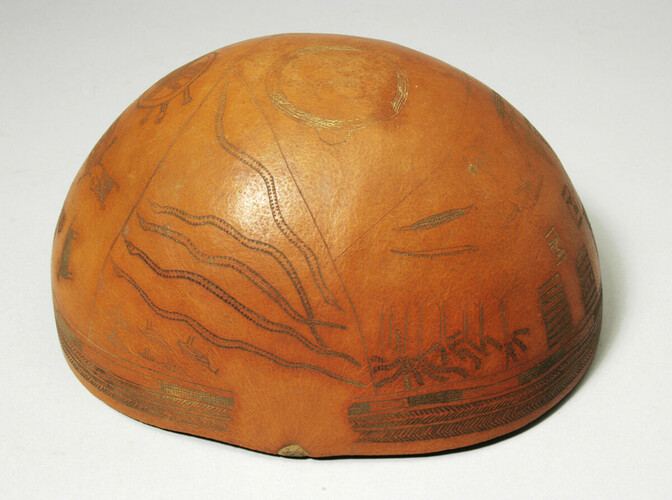 1936.10.80Hemispherical gourd bowl with incised and inlaid decoration depicting fishing and hunting scenes [RTS 18/8/2005].1936.10.80
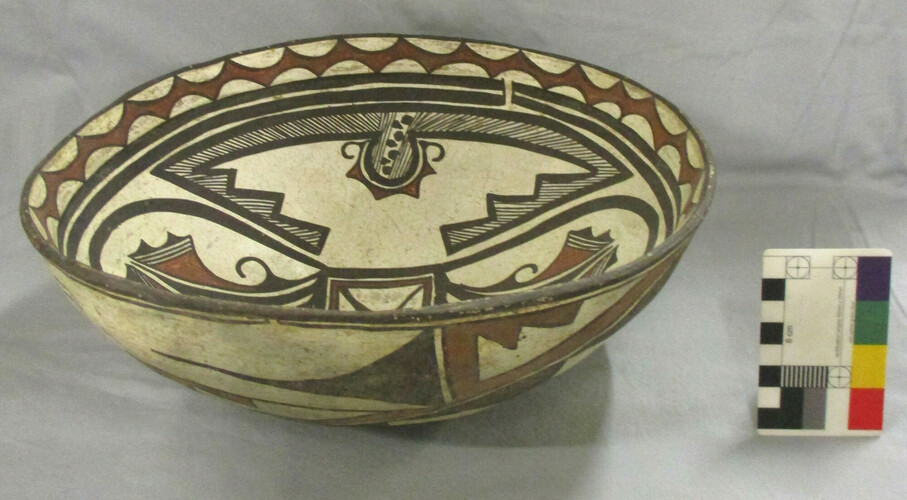 1896.54.10Ceramic bowl with rounded sides and slightly wavy rim, and flat bottom. [MOBB [OPS move] 05/04/2016]1896.54.10
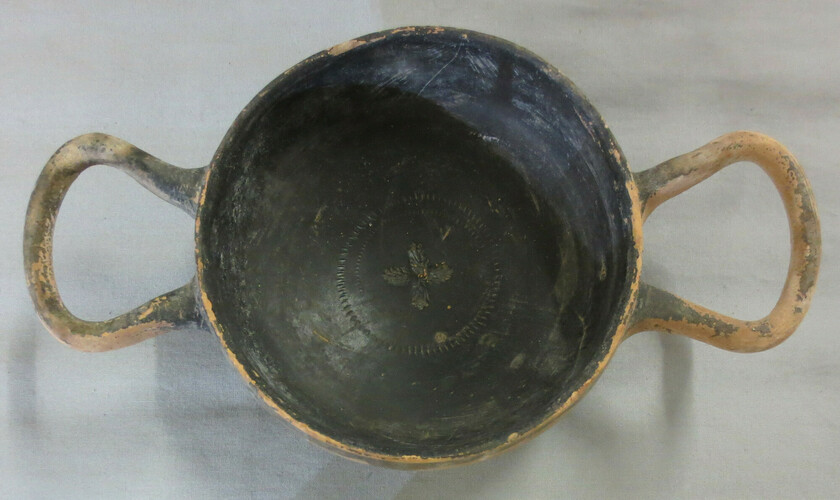 1884.37.76Shallow bowl with foot and transverse obliquely-set handle. This object is painted black. [MOBB [OPS move] 08/02/2016]1884.37.76
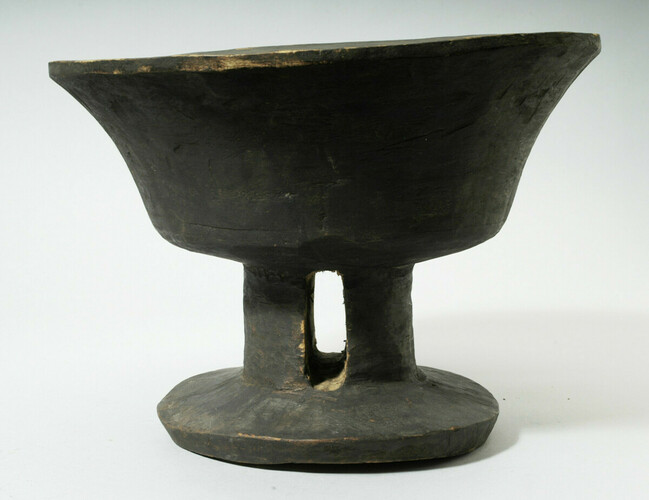 1948.2.135Deep everted wooden bowl on short cylindrical fenestrated pedestal foot with splaying base, stained black on the exterior [RTS 13/4/2005].1948.2.135
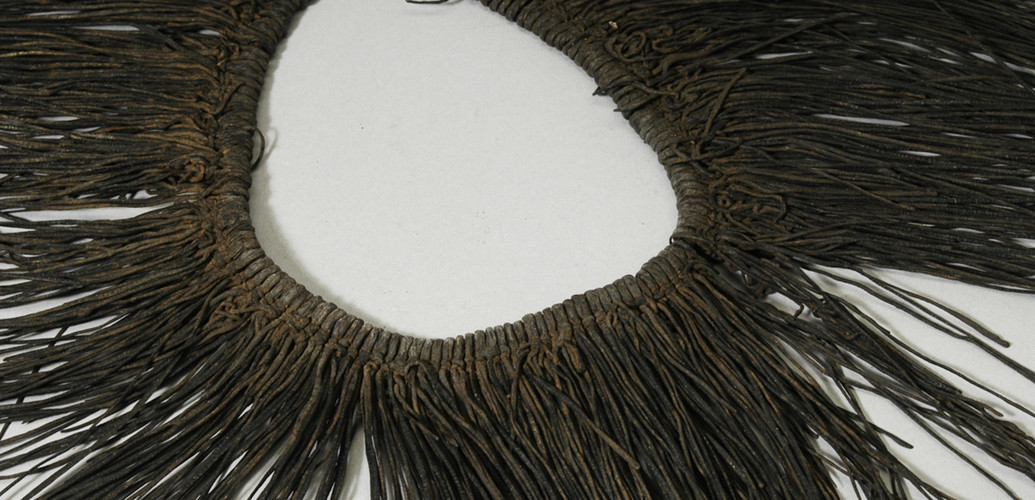 1903.16.111Fringe apron made of hide strips, worn by a woman [RTS 16/9/2005].1903.16.111
 1979.20.196Reddish brown wooden spoon with pierced handle, pointed at end, and shallow bowl, tied to 1979.20.195 and 197 by hide thongs [RTS 21/6/2004].1979.20.196
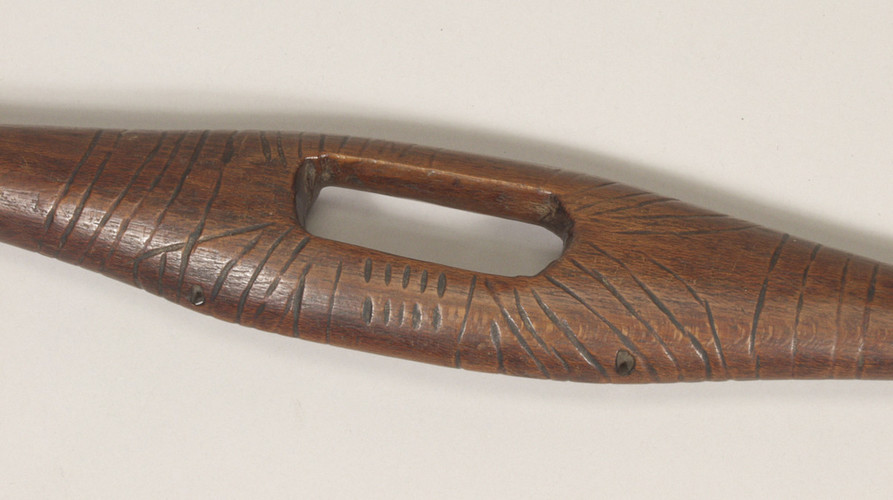 1931.66.13Decorated wooden dance stick in a form derived from a parrying shield [RTS 24/2/2004].1931.66.13