
- Collection type
- Object
- Description
- Pottery lamp of brown ware, slipped black. [MOBB [OPS move] 2/12/2016]
- Long description
- Pottery lamp of brown ware, slipped black. Pear shape with slightly projecting nozzle. Flat bottom with rounded sides and concave top. The central filling hole is surrounded by a ridge which is then surrounded by a higher ridge from which four thin vertical ridges project and the hind quarters and legs of a frog. Between each of the vertical ridges and between the vertical ridges and the frog legs are areas of incised cross-hatching. The channel that runs the length of the wick nozzle is full of horizontal ridges. There are diagonal ridges with incised diagonal lines, on either side of the wick nozzle, both on the top and and on the bottom of the lamp. There is also a maker's mark on the bottom. [MOBB [OPS move] 2/12/2016]
- Person
- Field collector William Matthew Flinders Petrie
- PRM source Committee of the Egypt Exploration Fund
- Date / Period
- Archaeological period: Roman
- Date collected
- 1903 - 1904
- Acquisition information
- Donated: 1904
- Materials and processes
- Material Pottery, Process Decorated, Process Incised, Process Coiled Handbuilt
- Dimensions
- Height: max 34 mm, Width: max 69 mm, Length: max 82 mm
- Object numbers
- Accession number: 1904.35.5
- Research and responses
In the supplement to the excavation report by Petrie (1905) Roman Ehnasya, Petrie notes that the lamps were acquired from several sources in addition to the excavation in order to produce his corpus. E.g. see p.4. of the supplement: "As the excavations of the houses at Ehnasya yielded many lamps which could be fairly dated, it seemed worth while to attempt a corpus of Romano-Egyptian lamps. The material consisted of the dated examples from houses, undated from excavations, lamps found by the sebakh diggers and bought by our party, and lamps bought from dealers at Medinet el Fayum. I have not distinguished between these various groups, as it is clear that the great majority were made at some distance and brought by trade to these towns, so that they might as well be found in one place as in another close by." Therefore, the lamps in the Pitt Rivers might not necessarily be from the excavation. [AS 12/09/2012]
This lamp is identical to E.65 shown on pl. LXVIV of Petrie, W.M.F. 1905. Roman Ehnasya (Herakleopolis Magna). London: Egypt Exploration Fund. [AS 30/10/2012]
The provenance is probably Ehnasya el-Medina, a village at the mouth of the Fayum located just above the ancient site of Herakleopolis Magna, excavated by Petrie from 1903-4; see W.M.F. Petrie, 1904, Ehnasya [RTS 8/7/2004].
- Associated publications
- Petrie, W.M.F. 1905. Ehnasya. London: Egypt Exploration Fund. [AS 15/06/2012] Petrie, W.M.F. 1905. Roman Ehnasya (Herakleopolis Magna). London: Egypt Exploration Fund. See pages 5-7. [AS 26/06/2012]
Further items to explore
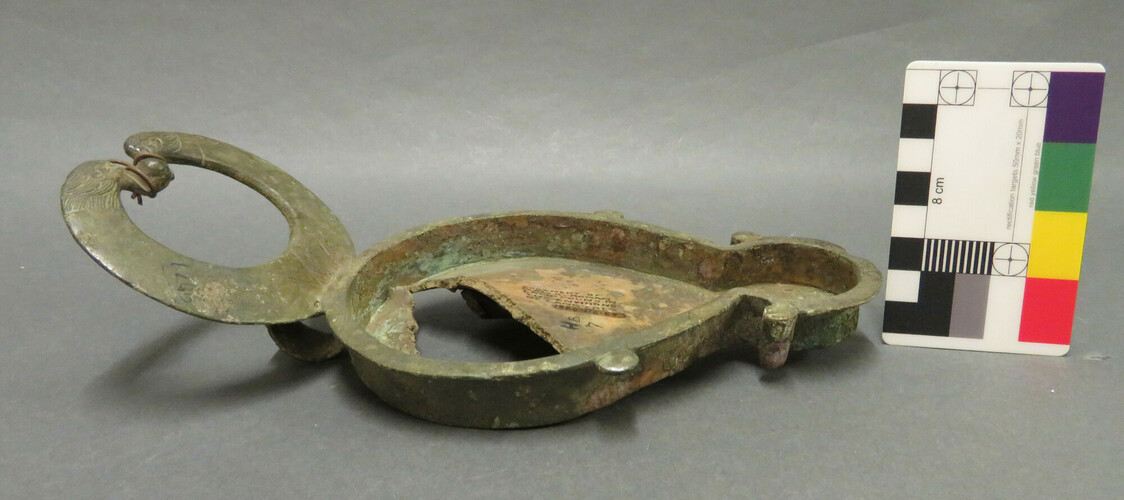 1884.116.69Lamp of bronze. Ovoid saucer lamp with rounded wick nozzle and flat rim. Circular loop decorated with two birds at the back, above the handle. [BA [OPS move] 19/4/2017]1884.116.69
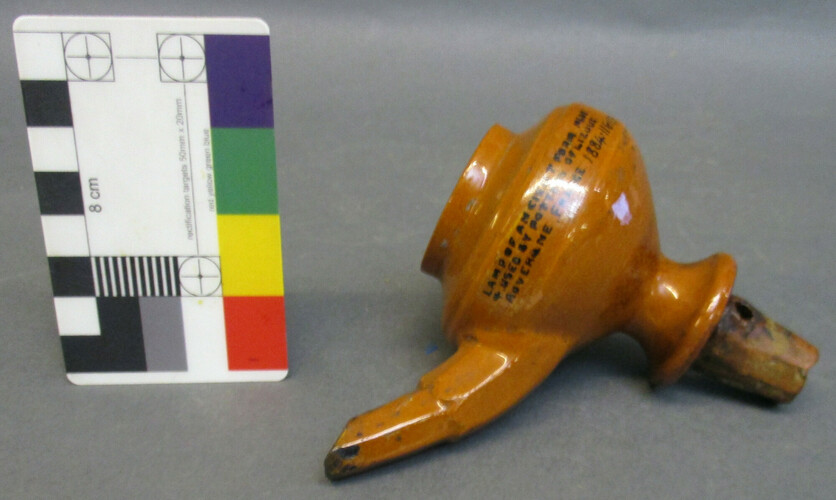 1884.116.117Glazed orange-red pottery lamp. [MOBB [OPS move] 21/12/2016]1884.116.117
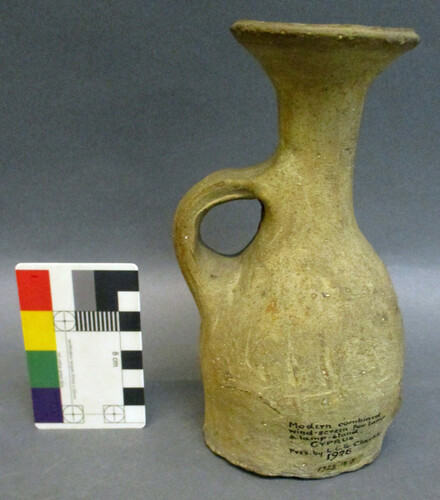 1928.18.5Pottery lamp-stand of red ware. [MOBB [OPS move] 6/12/2016]1928.18.5
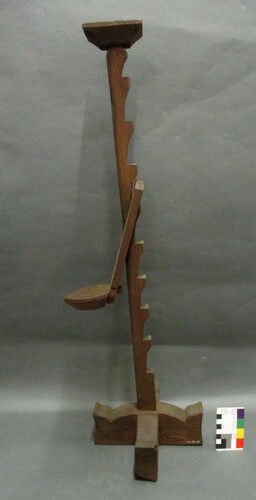 1932.89.183Tall lamp stand of teak. Square lamp saucer atop a notched or toothed pillar. A pointed oval saucer at the end of a rectangular block which moves freely along the pillar and rests on the notches. X shaped base. [MOBB [OPS move] 19/6/2017]1932.89.183