
- Collection type
- Object
- Description
- Curved wooden slat for supporting fabric structure of tent. (see 1884.1.3)
- Long description
- Curved wooden slat for supporting fabric structure of tent. (see 1884.1.3). There is a small rectangular hole. There are six smaller holes at one end through which twisted fibre has been threaded forming three loops. There is larger hole at the on end of the slat.
- Geographical reference
- Cultural groups
- Saami
- Person
- Maker Lars Haetta
- Field collector Unknown Collector
- PRM source Augustus Henry Lane Fox Pitt Rivers founding collection
- Date / Period
- Date made: Before 1874
- Date collected
- Prior to 1874
- Acquisition information
- Donated: 1884
- Materials and processes
- Material Wood Plant, Material Plant Fibre, Process Perforated, Process Twisted, Process Knotted
- Dimensions
- Length x Width 425 x 10 mm
- Object numbers
- Accession number: 1884.1.3.7 PR Cat other PR nos: 2933
- Research and responses
There is an unconfirmed [now confirmed] report that this is the work of Lars Haetta (1834–1896), a Norwegian Sami reindeer herder, political prisoner, wood carver and Bible translator. See, for example, 'A Christmas Curiosity' a blog dated 20 December 2013 on the website of the Horniman Museum in London: http://www.horniman.ac.uk/get_involved/blog/a-christmas-curiosity-jorbba-gisa . [JC 2 2 2017]
Barbara Sjoholm, author of "From Lapland to Sápmi: Collecting and Returning Sámi Craft and Culture", highlights that there is a similar tent model currently in the Norwegian Museum of Cultural History, Oslo. It has the number NFSA.3744 and can be viewed online here: https://digitaltmuseum.no/011023296027/telt-modell.
Sjoholm's research has shown that whilst imprisoned Hætta made two sets of Sámi models, probably 160 in all, as educational tools for professors J.A. Friis and Ludwig Daa. Daa gave a number of the models to Robert Latham, ostensibly for the Crystal Palace Museum exhibits. Latham gave Daa objects in exchange for the new Ethnographic Museum in Oslo. Silje Mathisen Opdahl’s “A record of ethnographic objects procured for the Crystal Palace exhibition in Sydenham,” (2019) provided details about Ludwig Daa’s connection with Robert Latham and the Crystal Palace Exhibition, as well as the early years of the Ethnographic Museum in Oslo. Sjoholm's research also used a history in Norwegian of the University of Oslo’s Ethnographic Museum by director Yngvar Nielsen: Universitetets ethnografiske Samlinger 1857–1907, (1907) where he discusses Ludwig Daa’s travels to England and the Continent in order buy and trade exotic objects. On pages 35-36 he discusses then-director of the museum Ludwig Daa’s visit to England in 1864. With him Daa carried Sámi objects to exchange for ethnographic artefacts from around the world. In London he made the acquaintance of “Mr. Wareham” who dealt in curiosities and did business with him. A William Wareham is listed as a possible dealer who dealt with Pitt Rivers: https://web.prm.ox.ac.uk/rpr/index.php/article-index/12-articles/139-dealers-and-auctioneers.html. He is another way that the Sámi models made by Hætta could have become part of the Pitt Rivers Museum collection, rather than coming through Robert Latham and the Crystal Palace exhibit.
Anne May Olli (director of RiddoDuottarMuseat), Johan Ashlak (Ailo) Hætta (head of the museum's branch in Kautokeino), and Anna Mossolova (MSCA postdoctoral fellow at Museum of Cultural History, University of Oslo) digitally reviewed some objects in the Pitt Rivers collection which may have been made by Lars Hætta during the time he was imprisoned in Oslo (1856–1867) for participation in the Kautokeino rebellion. Anne May and Ailo looked at this tent online and confirmed it is definitely the work of Lars Hætta. Hætta objects are usually very distinctive thanks to the handwritten labels in Sámi and Norwegian made by Hætta himself, such as those on this tent.
Search terms: Dwelling, Food and Drink, Reproduction, Model, Furniture Dwelling, Vessel, Tent, Food Accessory, Cooking Vessel
Further items to explore
 2009.150.9.45Wooden roof strut for model nomadic tent. For the other wooden roof struts see [2009.150.9 .1 - 44], and for the other constituent parts of the tent see [2009.150 .1 - 31]. [CW [OPS Move] 26/6/2017]2009.150.9.45
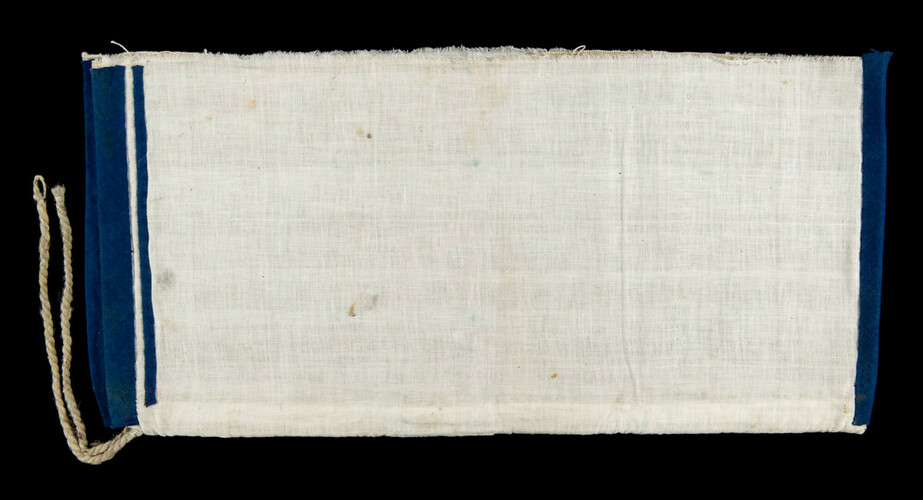 2009.150.11Outside cover, one of two [see 2009.150.11 for the other] for frame for model tent [See 2009.150 .1-.31 for all parts of tent]. [FC 10/11/2009]2009.150.11
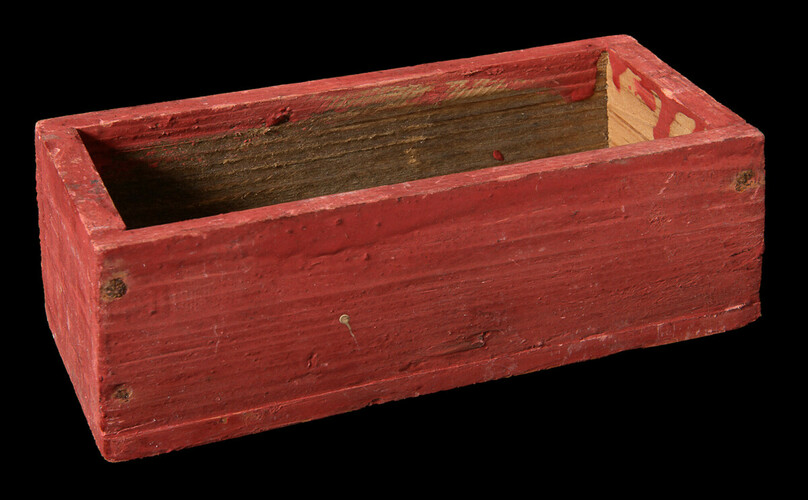 2009.150.29Fuel box for model nomadic tent. [See 2009.150 .1-.31 for all parts of tent]. [FC 10/11/2009]2009.150.29
 1884.1.3.2Linen fabric for model tent. (see 1884.1.3)1884.1.3.2
 1952.1.14Base of antler and part of brow-tine of a male reindeer. [DCF Court Team 5/12/2002]1952.1.14
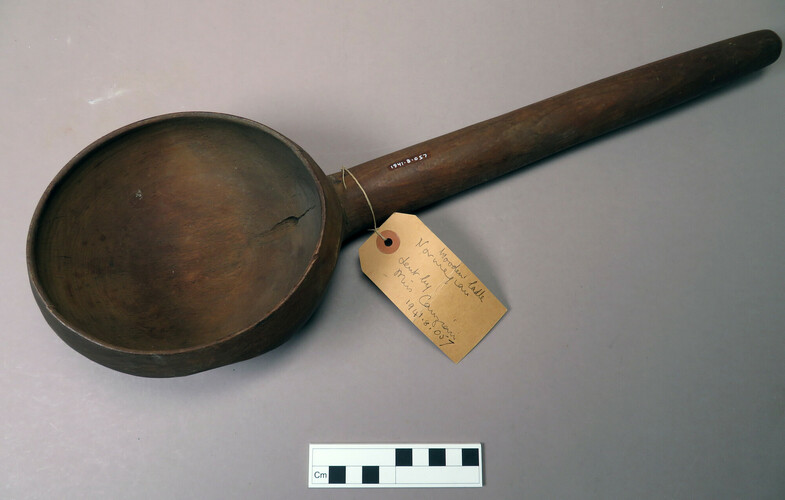 1941.8.057Deep wooden ladle. [El.B 'DCF 2004-2006 What's Upstairs?' 17/3/2006]1941.8.057
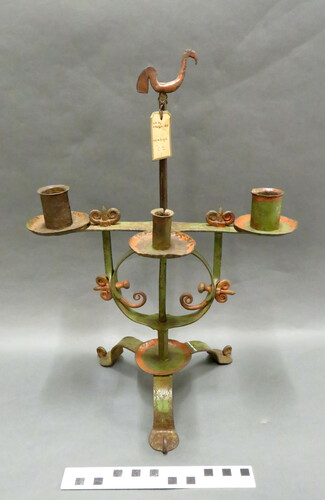 1932.88.1044Tripod for church candlestick with three candle sockets (one smaller than the other two); central pillar topped with coloured bird. [MOBB [OPS move] 5/4/2017]1932.88.1044
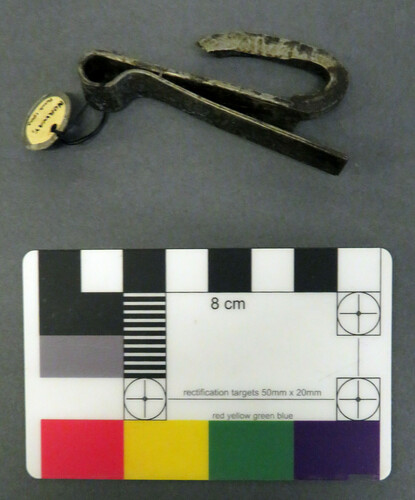 1938.35.624Fire steel. Flat length of metal bent into an acute angle with circular bend. At one end of the lengths there is a narrowed, curved hook. [BS [OPS move] 4/9/2017]1938.35.624