
- Collection type
- Object
- Description
- Spear thrower. Made of plant fibre.
- Long description
- Spear thrower consisting of a semi-circular length of plaited and woven plant fibres decorated with what appears to be bat hair. The thrower has a loop of plaited coarse grass-like fibres at one end, which is bound with wrapped coiling around a cord of a finer plant fibre. This area of coiling is decorated with four tassels using the same wrapped coiling process. The binding and tassels appear to have been decorated with bat hair. The body of the spear thrower is an eight-stranded square plait of the same coarse fibre used in the loop section. This plait appears to have been knotted at the very end of the plait and then covered with a looped cover in an hourglass pattern (?) using a cord similar in fibre and thickness to the one used to bind the loop at the top of the object. This cover leaves the very top of the plaited knot exposed. [Emma Schmitt (Conservation Intern); JU 29/07/2013]
- Geographical reference
- Grande Terre North Province Poéubo commune Balad district
- Person
- Field collector Johann Reinhold Forster
- Field collector Georg Forster
- PRM source Ashmolean Museum, University of Oxford
- Date / Period
- Date made: Before 13/09/1774
- Date collected
- Between 4 and 13 September 1774
- Acquisition information
- Transferred: 19/04/1886
- Materials and processes
- Material Plant Fibre, Material Animal Hair, Process Plaited, Process Woven
- Dimensions
- Length: max 220 mm
- Object numbers
- Accession number: 1886.1.1678 Other numbers: Forster 160
- Research and responses
A loose note in Peter Gathercole's hand dated 27 September 1970 concerning this and 1886.1.1677 (from Vanuatu) reads: 'These beckets are not catalogued at all. For this reason I think they are [the] ones in the Forster catalogue (Nos 147 and 160). I don't know yet which is which. (Note now in RDF: 1886.1.1677.) [NMM 24 1 1997; JC 21 12 1999]
This and the other possible Forster spearthrower, 1886.1.1677, were re-examined in March 1997 by Peter Gathercole and Nicolette Meister and an attempt was made to identify which was which. To do so they drew on the account of Anders Sparrman, who was also on Cook's second voyage, who stated that the spear-slings of New Caledonia were 'of better quality, and more elegantly knitted, with hairs of bats worked in' (see page 17 of A. Sparrman's Ethnographical Collection from James Cook's 2nd Expedition (1772-1775), by J. Söderström (The Ethnographical Museum of Sweden, Stockholm (Statens Etnografiska Museum), new series, Publication, No. 6), (Stockholm: Bokförlags Aktiebolaget Thule, 1939)). The two objects were then examined by C. A. Norris of the Oxford University Museum of Natural History. He confirmed that 1886.1.1678 had hair woven into the fibres and that 'the hair appears to be rufous in colouration, which would tend to support the theory that it comes from a fruit bat (genus Pteropus is a possibility) rather than a pig' (see his note in RDF: 1886.1.1678). It was thus decided that 1886.1.1677 is Forster 147 from Malakula and that 1886.1.1678 is Forster 160 from New Caledonia. [NMM 24 1 1997; JC 21 12 1999]
- Associated publications
- Listed according to the 'Forster list' numbering system in 'From the Islands of the South Seas 1773–4: An Exhibition of a Collection Made on Capn. Cook's Second Voyage of Discovery by J. R. Forster—A Short Guide (Oxford: Pitt Rivers Museum, no date [1970]). The text from the 'Forster' manuscript is followed by the following notes: 'Missing'. [NMM 24 1 1997; JC 21 12 1999] Listed as number 2 under ‘New Caledonia...Spear Throwers’ on page 244 of 'Artificial Curiosities': Being an Exposition of Native Manufactures Collected on the Three Pacific Voyages of Captain James Cook, R.N. at the Bernice Pauahi Bishop Museum, January 18, 1978 - August 31, 1978 on the Occasion of the Bicentennial of the European Discovery of the Hawaiian Islands by Captain Cook – January 18, 1778 (Bernice P. Bishop Museum Special Publication 65), by Adrienne L. Kaeppler (Honolulu: Bishop Museum Press, 1978): 'Spear thrower, Oxford (160). Missing. Evidence: Forster collection. Literature: Gathercole, n.d. (1970).' [JC 21 12 1999] Published as part of the Forster Collection on a dedicated website at www.prm.ox.ac.uk/forster (from February 2001). [JC 7 7 2005] For an account of the history of the collection of which this is part, see 'The Cook-Voyage Collections at Oxford, 1772–1775', by Jeremy Coote, in Jeremy Coote (ed.), Cook-Voyage Collections of 'Artificial Curiosities' in Britain and Ireland, 1771–2015 (MEG Occasional Paper No. 5), Oxford: Museum Ethnographers Group (2015), pp. 74–122. (Copy in RDF: Researchers: Jeremy Coote (Cook-Voyage Collections).) [JC 9 6 2016] Illustrated in colour (PRM digital image 000011680) as Figure 7.3 on page 94 of 'Haphazard Histories: Tracing Kanak Collections in UK Museums', by Julie Adams, in Pacific Presences 2: Oceanic Art and European Museums (Pacific Presences series, 4b), edited by Lucie Carreau, Alison Clark, Alana Jelinek, Erna Lilje, and Nicholas Thomas (Leiden: Sidestone Press, 2018), pp.91–105, 433–34. Caption (same page): ‘Figure 7.3. A spear thrower collecte in Balade, New Caledonia, in September 1774 during Captain Cook’s second voyage. 1886.1.1678. Copyright Pitt Rivers Museum, University of Oxford’. Discussed in detail on pages 94–5 in a section entitled ‘A spear thrower collected on Cook’s voyage’: ‘Among the objects attributed to Cook’s second voyage in Oxford is a finely-made spear thrower (Figure 7.3). The main body of the object consists of a thick eight-ply square plait made from plant fibre. It is looped at one end, where the spear would have been inserted and below this hang a number of decorative coiled cords ornamented with strands of flying fox fur. The flying fox, New Caledonia’s only endemic mammal, has a patch of orange/red fur on its upper body that was traditionally incorporated into many prestigious Kanak objects. / In September 1774, Cook landed at Balade, on the northeast coast of New Caledonia’s main island. As this was the ship’s only landing site and Cook’s only visit to New Caledonia, it can be assumed that this spear thrower is from the Balade region and was collected between 4 and 13 September 1774. According to Cook, the locals were “a strong robust active well made people, Courteous and friendly and not in the least addicted to pelfering [sic]’. In the days following their arrival, the Resolution’s crew were introduced to a local chief whose name they recorded as Teabooma. Cook referred to him as “my friend” in his journal and seemed anxious to please him, deciding [94/95] to cement their friendship by honouring Teabooma with a gift of two Polynesian dogs he had been given in Tahiti. It took some effort to persuade Teabooma that he was meant to keep the animals. Once he was finally convinced, however, Cook wrote that he could “hardly contain himself for joy”. In return, the local people gifted and traded various items, the nature of which Cook described in his journal as being: “arms such as Clubs, darts &ca…’. / Nicholas Thomas has commented upon the striking difference between Cook voyage collections from Polynesia (which include a vast array of artefact types, from the everyday to the prestigious), and those amassed in Melanesia, which are predominantly made up of weapons. He suggests that weapons and small items such as pan-pipes, which also feature in collections, are the sorts of objects that men would have carried with them when away from their villages. This limited range of artefacts, he argues, is evidence that encounters in Melanesian contexts were more guarded than in Polynesia, with ships’ crews being strategically kept away from domestic environments and village life. Certainly, the surviving Kanak artefacts from Cook’s voyage in the PRM would seem to support this argument as they consist of: six sling stones and a bag in which to carry them; three clubs; two hair combs and the spear thrower discussed here. That said, a straightforward mapping of European typologies of objects onto Indigenous categories can be misleading. For example, some Kanak clubs were decorated with prestigious materials, including flying fox fur, shells and barkcloth. Similarly, certain spears had intricately incised faces incorporated onto their shafts. These features blur the boundaries between the utilitarian and the ceremonial and, according to Roger Boulay, testify to their function as something more than weapons. He argues for a more nuanced consideration of such items, one that recognizes them as “objects of prestige”. The Cook voyage spear thrower discussed here is a case in point, with its delicate flying fox fur decoration evidence that it was probably reserved for ceremonial use. In light of the reciprocal nature of traditional exchanges in the Pacific, it is perhaps plausible to suggest that this valuable spear thrower might have belonged to Cook’s acquaintance, the chief Teabooma, and was gifted in response to the presentation of the Tahitian dogs. In which case, far from being an opportunistically traded artefact of encounter, this small spear thrower might be reimagined as material evidence of the first efforts at mutual understanding and friendship between Kanak and Europeans.’ (Offprint of chapter in RDF.) [JC 25 1 2019]
Search terms: Weapon, Spear-thrower
Further items to explore
 2007.40.5.4Throwing board for harpoon [.1]. It is made of wood and edged in bone, and decorated with six carved bone swimming seals on the upper side. [VS [OPS move] 6/9/2018]2007.40.5.4
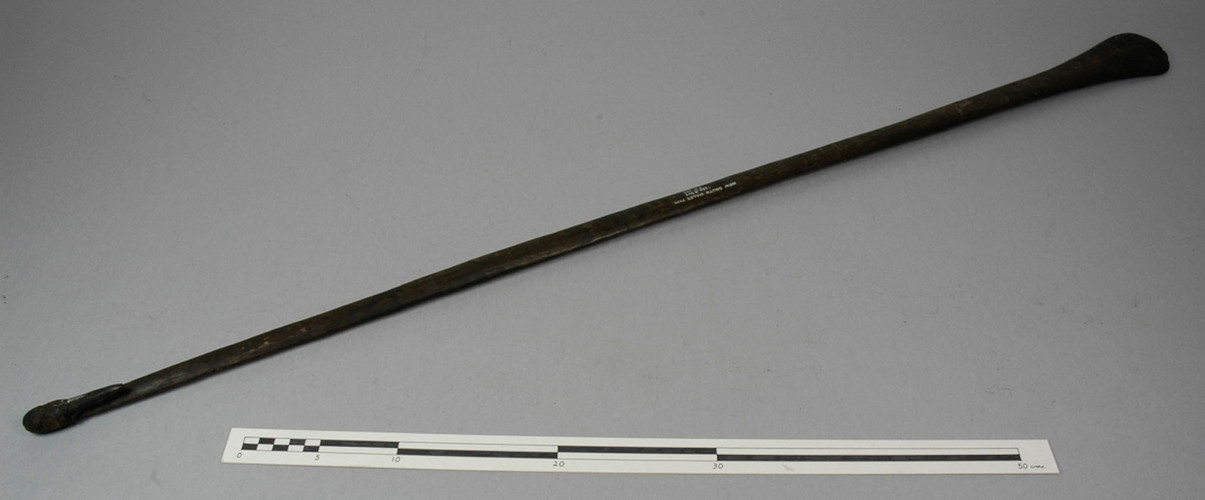 1884.19.345Spear thrower with spatula style handle. [ZM 17/10/2005]1884.19.345
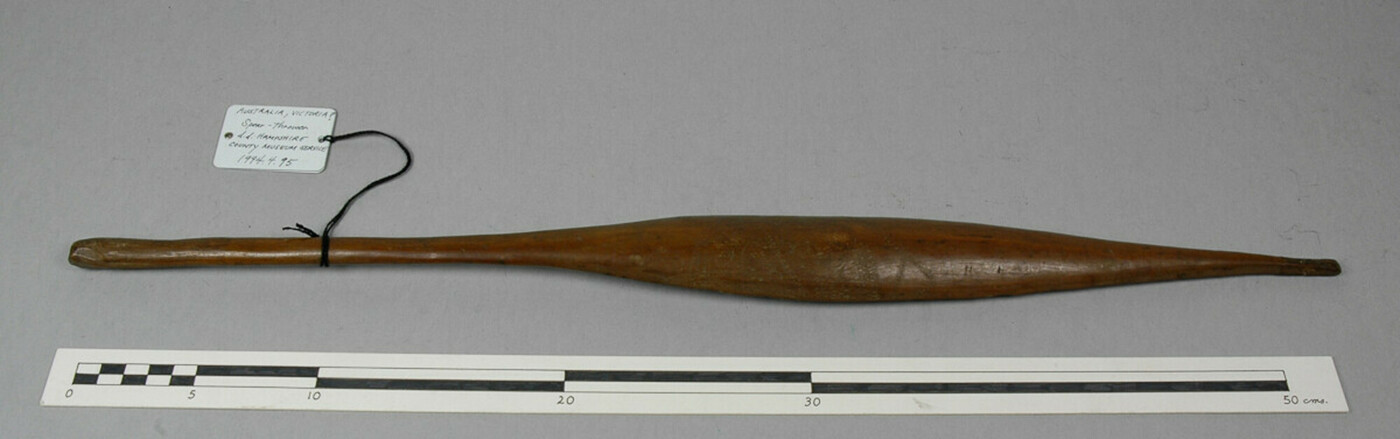 1994.4.95Small spear-thrower with flat blade and handle in the round, design incised on both sides. [ZM 21/10/2005]1994.4.95
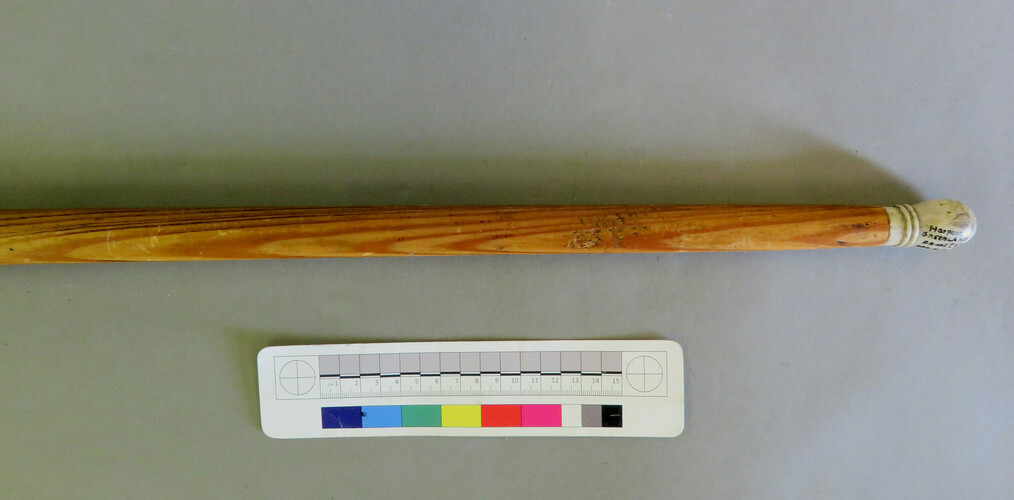 1884.81.9.3.1Long harpoon, unak, with wooden shaft and bone point attached by loose thongs: with bone terminals and ring at butt and top respectively. [MdeA 20/11/2001]1884.81.9.3.1
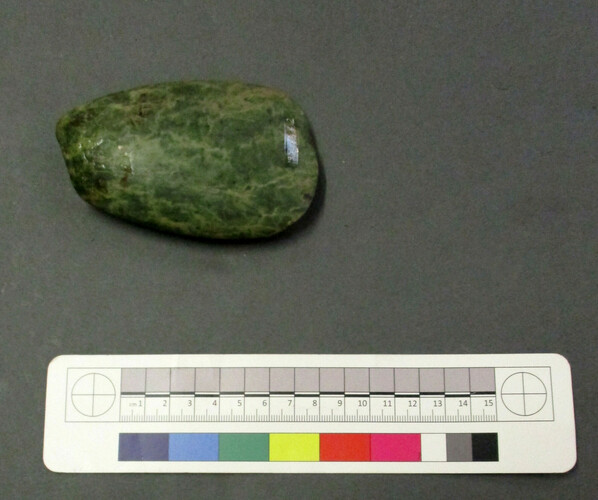 1928.68.6.2Polished nephrite adze blade. For the wooden adze see 1928.68.6 .1. [CW [OPS Move] 17/1/2017]1928.68.6.2
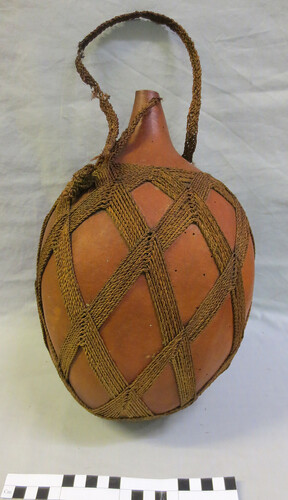 1933.38.36Gourd vessel in a coconut fibre sling with a carrying handle.1933.38.36
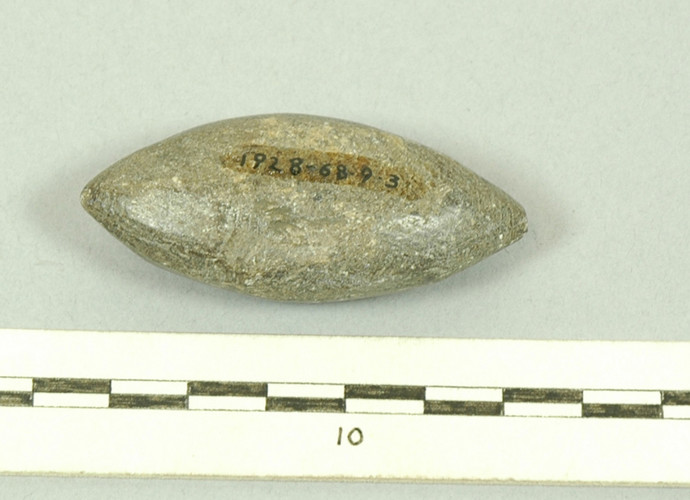 1928.68.9.3Steatite sling-stone with pointed ends. [El.B 12/2/2007]1928.68.9.3
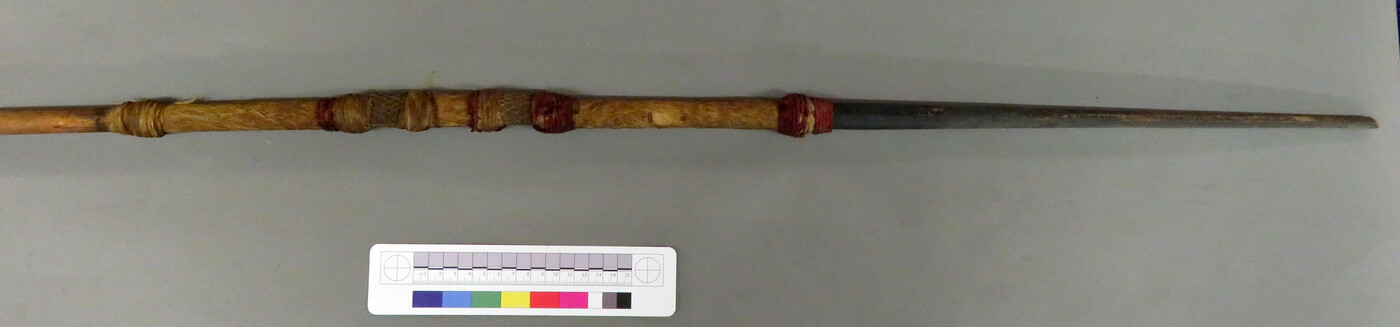 1891.27.3Spear made of stained wood tapered at both ends. [PH [OPS move] 18/6/2018]1891.27.3