
- Collection type
- Object
- Description
- Necklet made from a narrow leather strip with aluminium or tin segments sewn onto one side [RTS 29/3/2004].
- Long description
- Narrow hide strip, tapering to either end. The animal hair has largely been removed from the surface, but at one end two long twisted strands of what seems to be hair have been twined together to form a thin cord. This divides into two strands 70 mm from the end, and was probably used for fastening the necklet into place. There are 26 rectangular pieces of a light silver coloured metal sewn onto one side of this strip; the metal is either aluminium or tin. Each segment has been hammered so that it has a convex back, with holes punched through the metal at either end; this was done from the underside, leaving a raised collar around each hole on its upper surface. The segments have been attached using long stitches that go through each hole, and run down the centre of the strip, using cotton thread. The necklet appears to be esstentially complete, although the divided ends are fraying, and a metal segment has become detached at one end. The hide is yellowish brown in colour (Pantone 7509C) and the metal a shiny, uncorroded metallic gray (Pantone 420C). The strip is 660 mm long, 5.5 mm wide and 2 mm thick; a typical metal segment measures 10 x 6 x 1 mm [RTS 29/3/2004].
- Cultural groups
- Dinka
- Date / Period
- Date made: Before 1903
- Date collected
- By 1903
- Acquisition information
- Donated: 1903
- Materials and processes
- Material Animal Hide Skin, Material Animal Hair, Material Aluminium Metal, Material Tin Metal, Material Cotton Seed Fibre Yarn Plant, Process Hammered, Process Perforated, Process Stitched, Process Twisted
- Dimensions
- Length 660 mm, Thick: max 2 mm strip, Width: max 5.5 mm strip, Width: max 6 mm each metal segment, Length: max 10 mm each metal segment
- Object numbers
- Accession number: 1903.16.120
- Research and responses
Throughout the twentieth century the term ‘White Nile’ has been used to denote an administrative district immediately south of Khartoum. However at the time this object was collected the term was also used more losely to refer to the Bahr el Abiad and Bahr el Jebel rivers, or the areas immediately around them, and association with the Dinka suggests this is probably the case here [RTS 28/11/2003].
Search terms: Ornament, Cordage, Neck Ornament
Further items to explore
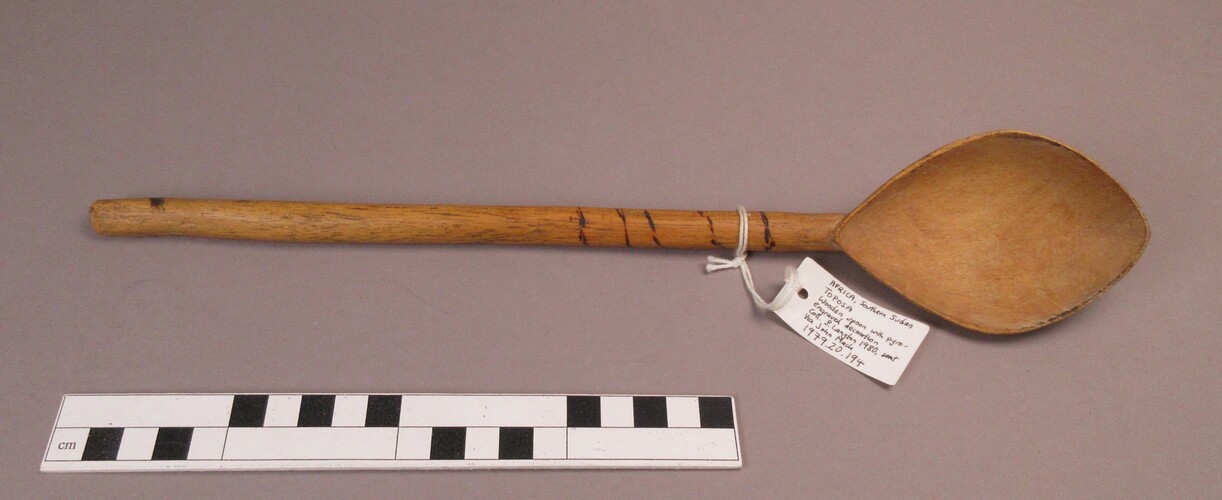 1979.20.194Light yellowish brown wooden spoon with pyroengraved line spiralling around lower handle and shallow bowl [RTS 21/6/2004].1979.20.194
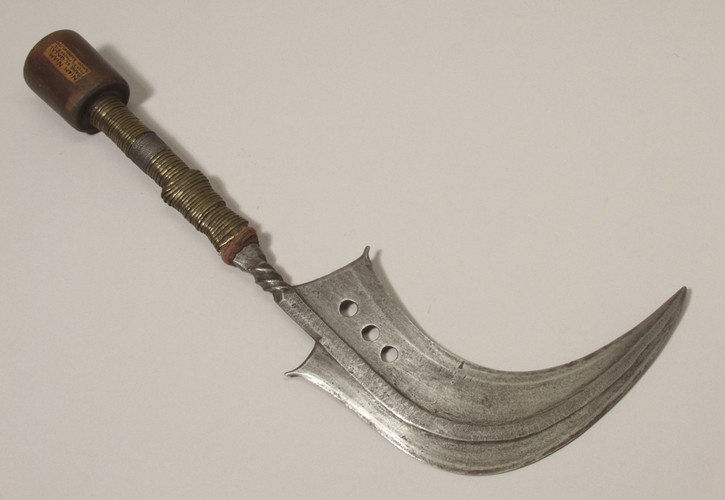 1917.25.27Knife with curved, two edged iron blade and a cylindrical wooden handle [RTS 14/4/2004].1917.25.27
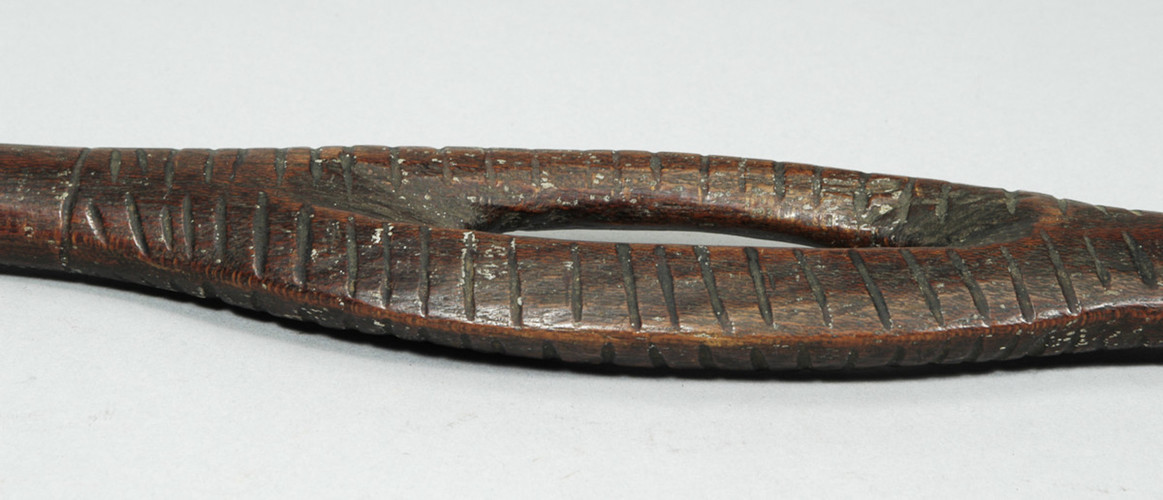 1931.66.12Decorated wooden dance stick in a form derived from a parrying shield, with oval hand grip at centre [RTS 13/1/2005]1931.66.12
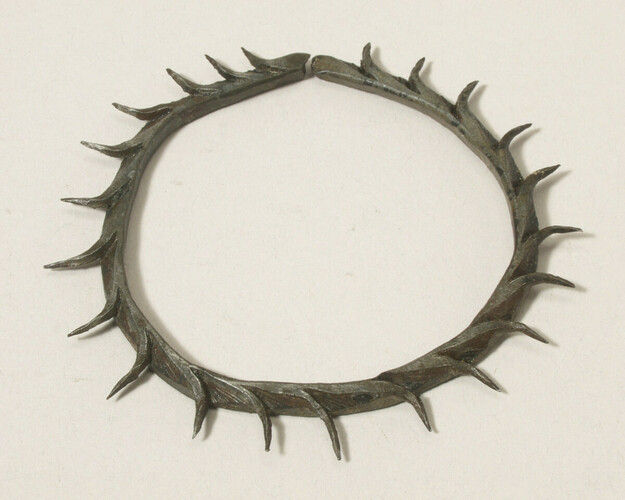 1936.10.14Iron armlet with sharp spikes around the edge, used for wrestling fights [RTS 23/3/2004].1936.10.14