
- Collection type
- Object
- Description
- Carved wooden cult figure with two human faces on pedestal.
- Geographical reference
- Southern Nigeria Niger Delta Rivers State Bonny
- Date / Period
- Date made: Before 1888
- Date collected
- 6 August 1888
- Acquisition information
- Donated: 1902
- Materials and processes
- Material Wood Plant, Process Carved
- Dimensions
- Height: max 450 mm, Width: max 251 mm
- Object numbers
- Accession number: 1902.9.31
- Research and responses
For an account by the donor of a visit to Bonny in 1888, including a brief discussion of the 'skull temple', see pages 27-30 of My Visit to West Africa (Gleaners' Union Tracts, Series A, no. 1), by the Rev. W. Allan, M.A. (London: Church Missionary Society 1889). (A copy of this booklet was transferred from the RDF for 1902.9 to the Balfour Library on 26 May 2009; a photocopy of the relevant pages being retained in the RDF for 1902.9.31-.45.) [JC 27 5 2009]
The following is a transcription of a manuscript by Archdeacon Crowther entitled ‘Facts of the Ikuba - skull house, from the mouth of natives’ forwarded to the Museum by the Reverend William Allan with a letter dated 19 January 1902 to an unspecified recipient at the University Museum / Pitt Rivers Museum, presumably Henry Balfour. The manuscript was previously held in the RDF for collection 1902.9 and is now held in the Allan Papers in the PRM Manuscript Collections as item 2b Transcribed by Elin Bornemann and Jeremy Coote in June 2009: 'Facts of the Ikuba-skull house, from the mouth of natives. / The Ikuba is a house about 40 ft long by 20 broad, built many years ago, in the middle of the town of Bonny, in which the national god was placed for worship. / The reptile iguana was the object of worship; and these reptiles in former years were to be seen at every corner of the streets fearing no man, & crawling into houses, none daring to molest them. Some poor slaves have been put to death for accidentally killing an iguana, & a man of note was fined 60 puncheons of oil many many years ago for killing one. / This house called Ikuba was built specially for the worship of this god; besides the frequent offerings of sacrifices of fowls, yam & oil, the skull of every victim captured in war, or of any miscreant was to be brought to the Ikuba, & this being a practice some say over 100 years ago, the accumulation of skulls was great. / When we first established ourselves at Bonny in 1865, the house was thatched with bamboo leaves, but soon after, corrugated galvanised iron sheets were put on the roof & sides. In the centre of the house was erected an altar of mud about 6 ft. in length, 4 ft. broad, & about 3 ft. high, — in the centre of this altar there is a hole about 8 inches in circumference, into which tombo (palm wine), rum & other spirits are poured, to invoke the dead fathers. Around this hole are formed decanters, tumblers, & wine glasses, a raised platform about 1 foot from the ground is built of mud before this altar, on which were placed 2 cast brass images of the iguana made I am told in Birmingham, & bought for enormous sums of puncheons of oil from the former supercargoes trading then in the river. There are also 2 carved ivory tusks bought from the interior Aron country the pantheon of the Ibo country. These ivory tusks have holes & are blown on certain events which will be stated as we go on. These tusks are objects of great veneration, & the spirits of the fathers are believed to be in them, & when blown they are said to be the voice of the departed fathers. / In case of any swearing, the blood of the fowl or goat is to be sprinkled on them, & the dead fathers invoked; and in the case of any swearing between delegates of 2 contending countries, nothing less than human blood is to be sprinkled, & that means a human sacrifice, the flesh to be eaten by the juju-priests & the skull put in the house. Again, should any one be guilty of criminal act, & he succeeds to brake [sic] his chains run to the Ikuba, & blow either of these ivory tusks, that person is free from death or any further imprisonment, the sound produced then is said to indicate | the | “forgiveness of the fathers”. / Rude images surround this altar, drums, native gongs & bells | & plates, mugs [?] &c. | complete the surroundings. Throughout the interior body of the building years ago, you see nothing but the ghastly sight of skulls strung closely together in rows right up the ceiling of [sic] roof & sides, so that no post or stick is visible, only an array of skulls, — even the door & window ceils [sic; sills] are lined with skulls to the outside frames, recent skulls & bones are piled on shelves or on the ground ready to be strung up. / It is said of the late King Dappa William Pepple, that he was so well up with the history of the skulls of captured victims in that house that he can point out to you that this is the skull of the King of Andony, — this, of that country King & chiefs, this, of an Ibo warrior, &c. — the priest who keeps the house is also [?] an adept in pointing out important ones also; — so that the Ikuba is a traditional record of the victories gained by Bonny over the surrounding places. / Whenever there is no war, & the time comes for Ikuba worship (the time of eating new yam about October), the priest & his attendants generally | waylay | people in the dusk of the evening or early in the morning, by hiding themselves in the bush now happily cleared away by Gospel power, between the Mission & town, & many innocent men, women & children have been clubbed, taken to the Ikuba, their flesh cooked & eaten, & skulls placed among the others. No skull is to be there whose flesh had not been eaten, even when brought from war in the state of putrifaction [sic]. / The Ikuba | head | priest, (now a church adherent) is never to be crossed or passed on the right side or you pay a fine, every one knows this at Bonny & generally give him a wide berth, — he is not to cut his hair, & is always to have on one of those trade wooly caps in shape like a night-cap, & not to take it off even if he enters a king or chief’s house & not to shake any one’s hand. / On his refusing to be any longer an Ikuba priest, many did not believe him, till one Saturday, he had his hair shaved off clean, held [?] took his cap to the riverside & threw it in the river, & on returning to the home & to the mission, he purposely took the right side of those coming to him, & the left of those going before him, took hold of their hands & shook them saying uka gula, uka owu do kwara dokwa i.e. “palaver set, that palaver is smashed” meaning that the law is broken & he is no more a juju man of Ikuba; he came to the Mission we strengthened his heart from the Scriptures & by prayer & he returned home happy. On the next day Sunday, he took his seat at Church, & ever since has been attending pretty regularly except when ill & distant from home. / He was at Church when you gave your address on your visit last year, & missed seeing you after Church | service |, because they had to hurry home on account of the tide. / These are some of the facts made known to us about this house; & will you kindly not make it public in writing for such papers get out to supercargoes here, & those not favourably disposed to us make great use of them to incite the natives against us, so abusing them & giving them bad names in England. The natives remark that no power on earth could have taken away, or even approached the house to take away any of these idols now voluntarily given up, but the power of the Gospel. / For reports & letters on Iguana & Ikuba the skull house / See “Gleaner” 1867. / See “Ch: Missry. Intelligencer”, the Bhps’ letter May 5th 1866, latter part. / See A new “Record” with bright yellow cover edited by Mr Henry Venn in 1867 containing my account of the destruction of the Iguanas & a sketch I made then of the heaps at the market place — only a few numbers of this “Record” came out. / See “Church Missry. Intell.:” Destruction of Iguanas — July 1867 page 223, letter of Bishop Crowther. / See “Annual letter” of Rev. J. Boyle 1887-88 on the Ikuba priest as a Church adherent. / D. C. Crowther. / Mission Station / Bonny / Mar: 7th 1889. / To Rev. W. Allan M.A. / [????] / London.' [JC 12 6 2009]
For an account of the rebuilding of the ikuba shrine by the high priest Jaja in the 1860s, see page 73 of The Missionary Impact on Modern Nigeria, 1842-1914: A Political and Social Analysis (Ibadan History Series), by E. A. Ayandele (London: Longmans, 1966). (Copy in RDF for 1902.9.) [JC 20 4 2012]
- Associated publications
- Reference: Finding the Forgotten: Locating Transatlantic Slavery in The Pitt Rivers Museum Collection, Main author: Jane Webster, 2025, Page: 118
- Listed as number 79 on page 11 of Art from the Guinea Coast (Pitt Rivers Museum, Illustrated Catalogue No. 1), Oxford: Pitt Rivers Museum (1965): 'NIGERIA Eastern Region ... 79. Ancestor memorial "osisi duen", taken from the ikuba ("skull temple") at Bonny when it was destroyed in 1888. Kalabari Ijo tribe (1902.9.31.) (44 cm.)'. Also illustrated in black and white in unnumbered plate XXII. (For details of exhibition, see under 'Display History'.) [JC 12 9 2013] Illustrated in the flyer for 'Liminal Visions, Elusive Objects: Lecture Series, 2006-2007' of the Department of Art History, University of Delaware, in association with the lecture 'Captive Audience: Theorizing Art and Slavery in Late 18th and 19th Century Near Coastal West and Central Africa' to be given by Ikem Okoye on Thursday 2 November 2006 in Willard Hall. (Photocopy in RDF.) [JC 9 10 2019]
Search terms: Figure, Religion, Commemoration, Religious Object
Further items to explore
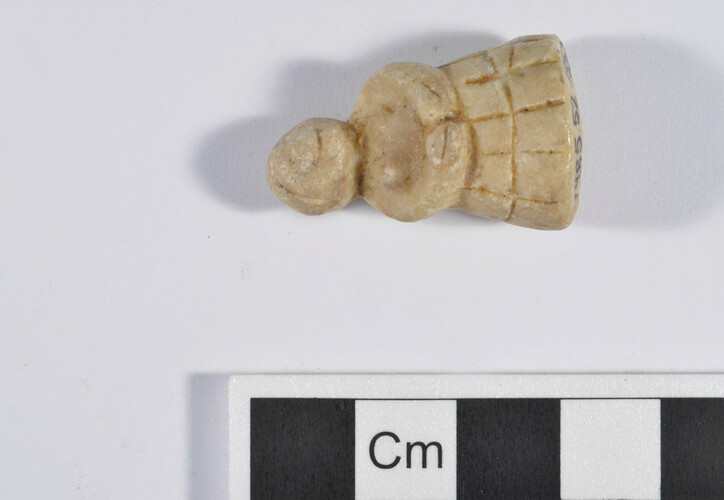 1985.52.1857Amulet, female figure carved from ?soapstone, depicted with the hands held in front of the body and breasts. [RB 13/06/2012]1985.52.1857
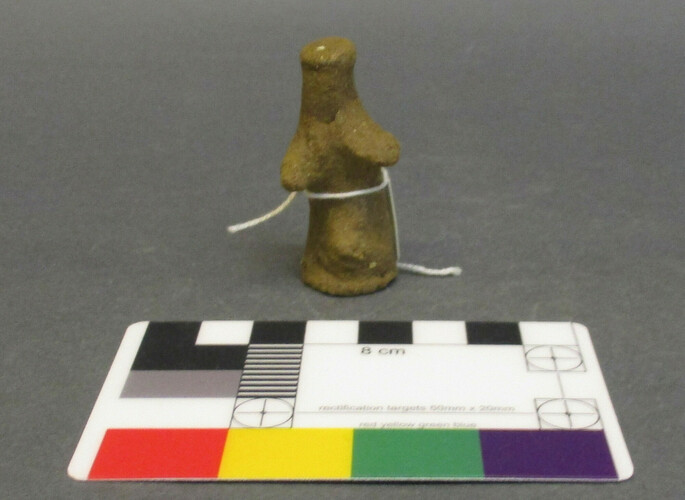 1958.11.2.141Mkaramo clay figure. Cylindrical figure, with little distinction between the head and body. The figure has no legs, with a flared, flat, circular base. There are two prominent, triangular projections representing breasts or arms, a a slight, rounded projection near the base, possibly representing the navel. No facial details, but expands slightly at the top of the head to form a ridge, possibly representing hair. [IL [OPS Move] 2/5/2017]1958.11.2.141
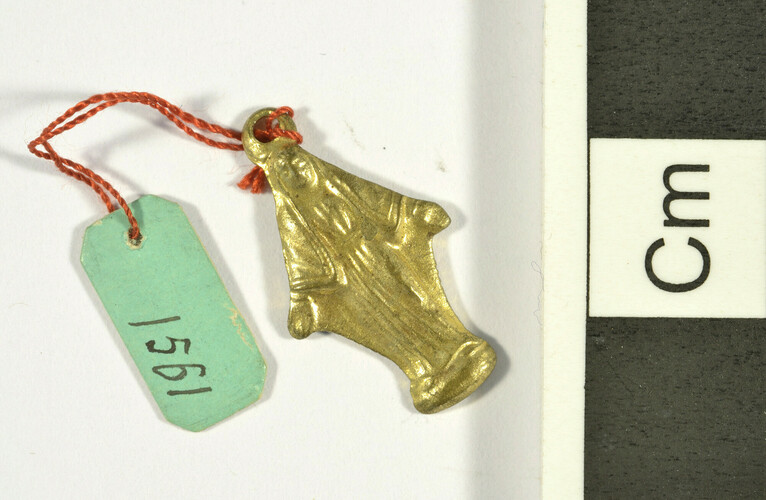 1985.52.813Amulet, a figure of the Virgin Mary, cast in metal, and perforated for suspension. [RB 11/04/2012]1985.52.813
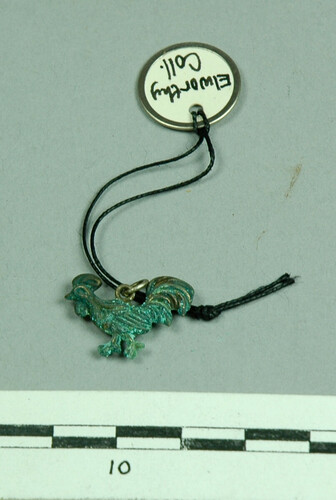 1968.13.474Amulet in the shape of a cockerel, made of copper alloy. [El.B 28/10/2008]1968.13.474
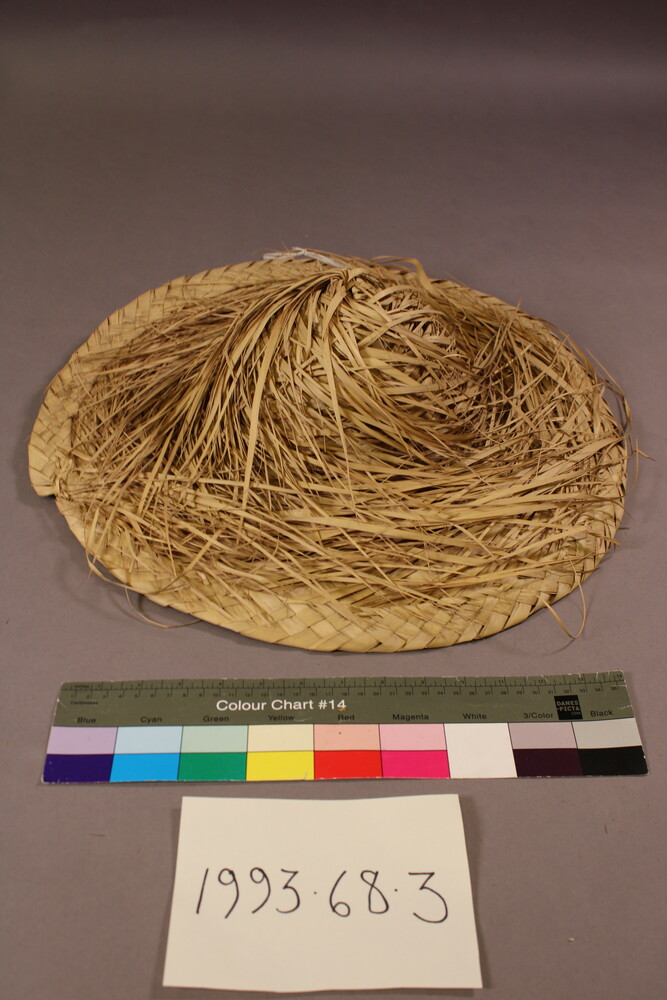 1993.68.3Plaited palm-leaf hat with broad brim and loose fibre on top.1993.68.3
 1972.24.182.6Six beads. Red stone barrel shaped beads strung onto a length of cotton or yarn. Many are cracked with some surface loss present and polished to a high sheen. Attached to a board alongside 1972.24.182 .1 - .8 [ASh [OPS move] 30/11/2016]1972.24.182.6
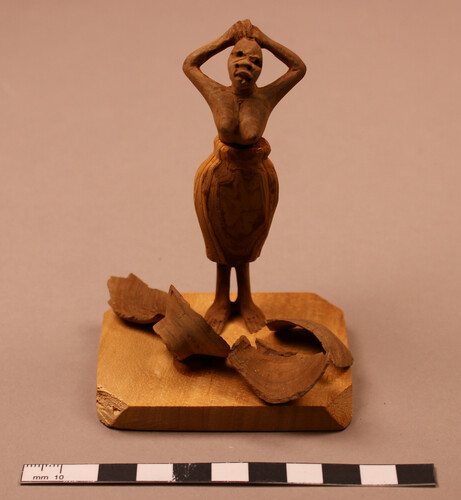 1988.33.3Thorn carving of woman with broken pot.1988.33.3
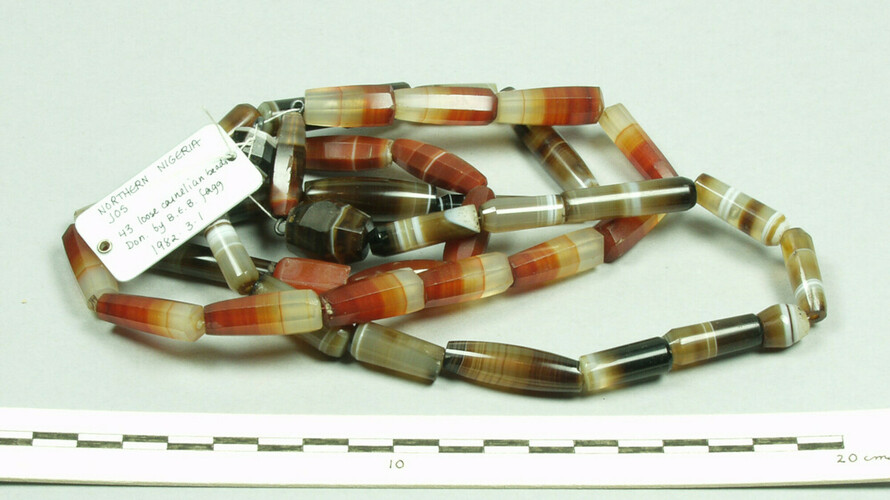 1982.3.1String of 43 carnelian beads of various shapes, sizes and colours (transparent to orange and transparent to brown); 2 have metal loops for attachments. [N.B. 'DCF 2004-2006 What's Upstairs?' 28/6/2005]1982.3.1