
- Collection type
- Object
- Description
- Woman's woollen belt woven in striped dark brown and white.
- Long description
- Woman's woollen belt with a warp-faced ground-cloth comprising alternating wide dark brown stripes and thinner natural off-white stripes. The three dark brown stripes have a zipper-like pattern of transverse off-white lines. At both ends the warps have been plaited to form four tassels, gathered together to form a point which is attached to a twisted woollen cord – brown at one end, white at the other.
- Geographical reference
- Cultural groups
- Mam
- Date / Period
- Date made: By November 1985
- Date collected
- Purchased November 1985
- Acquisition information
- Donated: 19 June 2023
- Materials and processes
- Material Wool Textile Animal, Process Woven, Process Plaited, Process Twisted
- Dimensions
- Length x Width 2190 x 80 mm
- Object numbers
- Accession number: 2023.37.21 Other numbers: SRP 20
- Research and responses
Information supplied by the collector/donor Krystyna Deuss:
The municipality of Colotenango includes not only the lower lying lands around the town but also hamlets in the high Cuchumatán mountains to the north at altitudes of over 2,000 metres.
The township of San Rafael Petzal used to belong to Colotenango before 1890, so people there use the same dress. However, changes in dress styles have been slower in San Rafael than in Colotenango and in the late 1980s there were several men still dressed in white with traditional home woven sashes (2023.37.18) and su’tes (2023.37.22).
There is no difference in design between male and female sashes (2023.37.19, 2023.37.20), or in the red striped and brocaded su’tes (2023.37.23). However, the oldest sash and su’te in my Colotenango collection came from Diego Sales, an old man in San Rafael Petzal. The ground cloth of both items was woven by his wife in solid red German rayon, either without or with barely distinguishable orange stripes (2023.37.18, 2023.37.22). There is a difference in how men and women wear their su’tes and sashes. Women tie their sashes at the back and use their su’tes to carry shopping, cover their baskets, or shield their heads from the sun. Men tie their sashes in front, sometimes tucking the ends out of sight, and wear their su’tes slung over one or both shoulders.
Older women from mountain hamlets remembered using black and white woollen sashes in the 1930s and 40s. By the 1980s these type of sashes were still being used by women living in the mountains above San Rafael Petzal and San Sebastián Huehuetenango, but no longer in Colotenango town (2023.37.21).
See Related Documents File for more detail. [JMC 26/11/2024]
Search terms: Clothing Textile, Clothing, Textile, Belt
Further items to explore
 1928.69.851Rich man's cloth of red and pale and dark indigo stripes1928.69.851
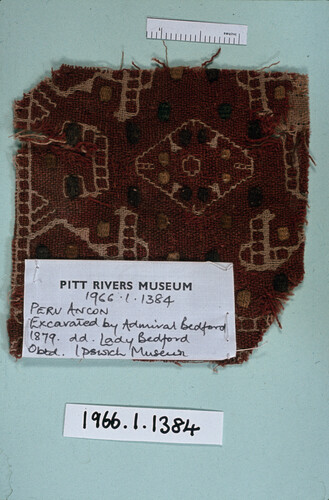 1966.1.1384Textile fragment1966.1.1384
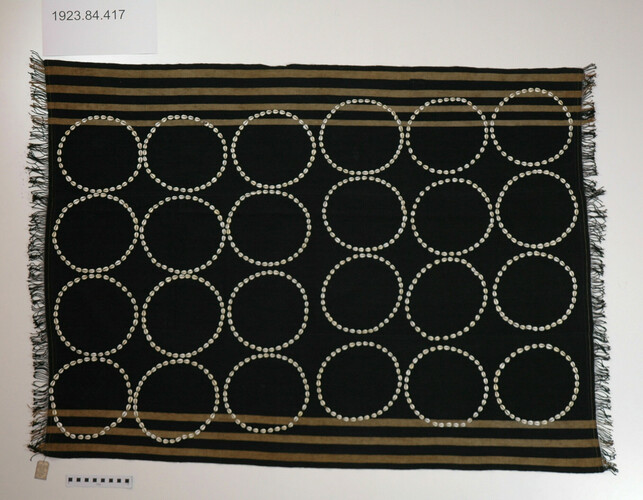 1923.84.417Warrior's shawl of tightly hand woven black cotton yarn made from three panels, ornamented with cowries shells in circles. Patch of local repair along one of the long edges of the textile. [FB 19/10/2012]1923.84.417
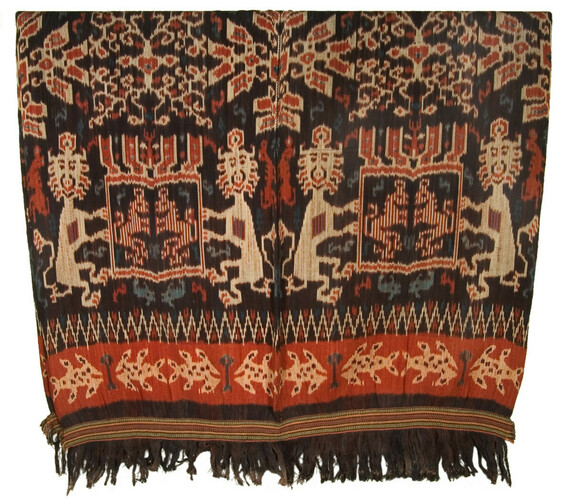 2003.69.52Large orange, brown, blue and cream ikat textile made in two lengths and stitched together in the middle, with twined border and fringe at either end. [JP 14/5/2003]2003.69.52
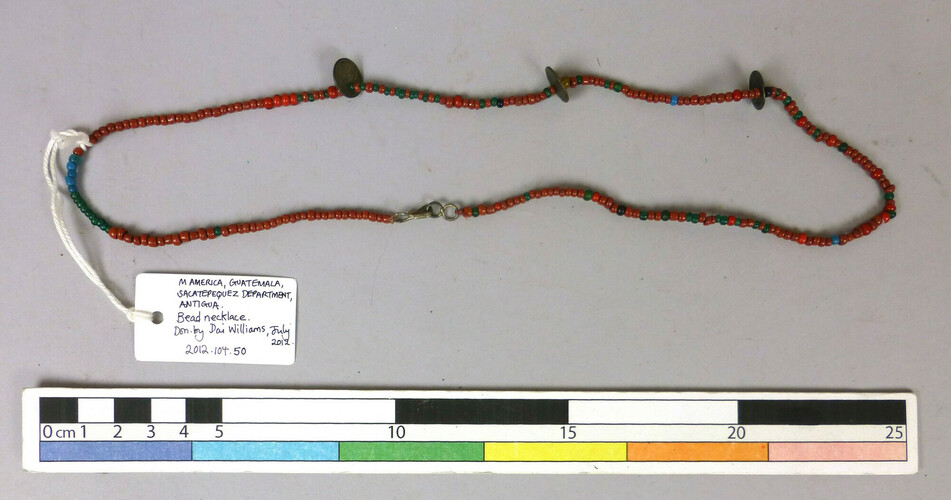 2012.104.50String of glass seed beads. Most of the beads are red with green beads and blue beads at random intervals. [FB 01/04/2014]2012.104.50
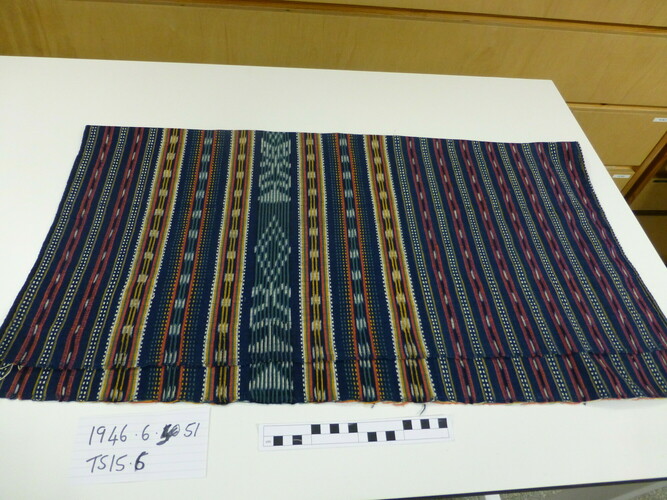 1946.6.51Specimen of cloth1946.6.51
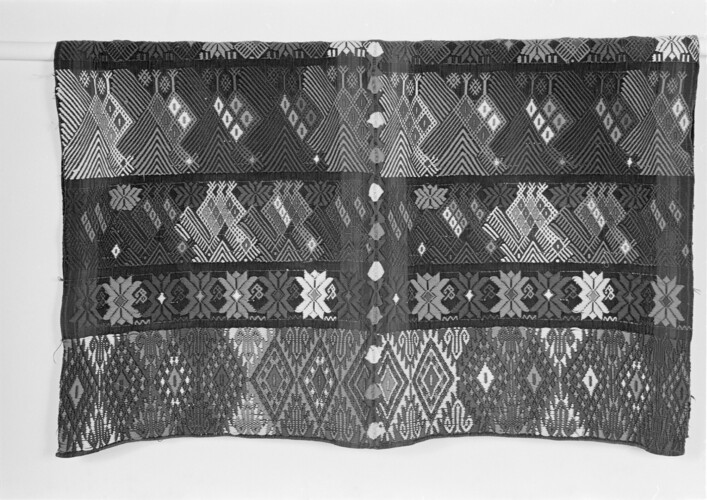 1989.27.2Large cloth made of two textiles stitched together with a decorative seam1989.27.2
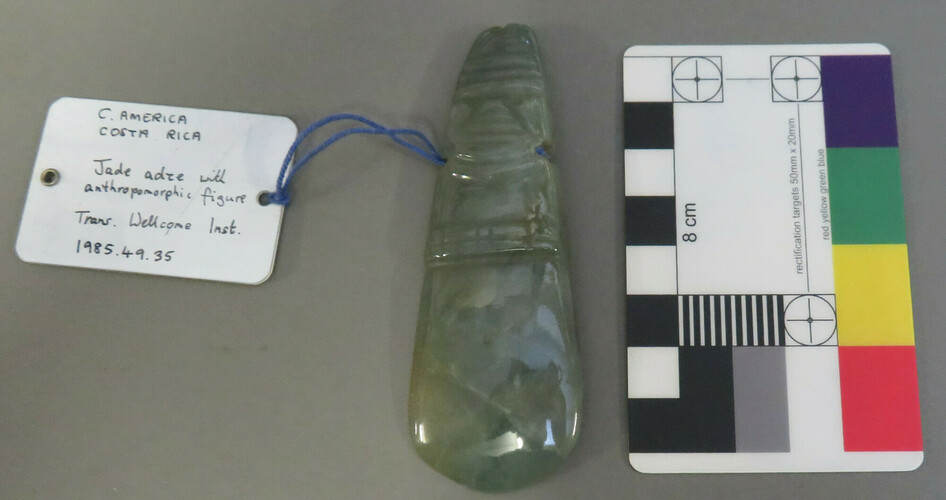 1985.49.35Amulet, a polished green jadeite stone adze surmounted with carved anthropomorphic figure wearing a conical hat. Transversely perforated. [EH [OPS move] 1/11/2017]1985.49.35