
- Collection type
- Object
- Description
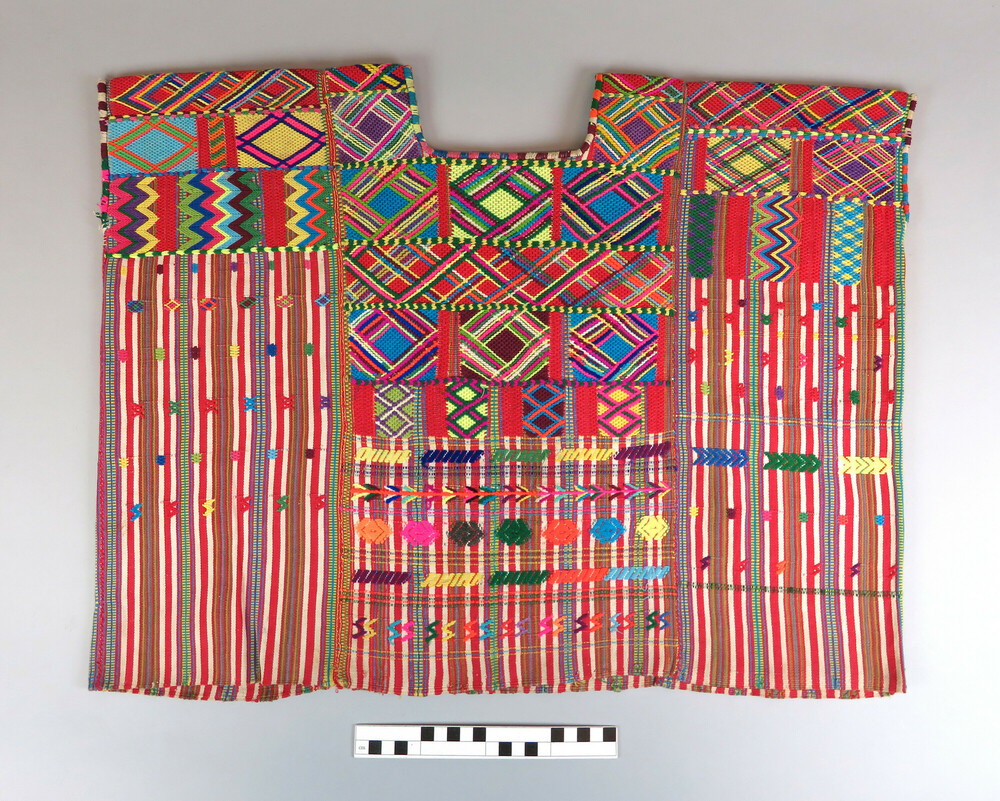
- Festive huipil of red and white striped cotton with brocaded patterns in red, green, yellow, purple and blue.
- Long description
- Festive huipil constructed from two panels of warp-faced cotton fabric in red and white stripes. The yoke and shoulders are decorated with single-faced supplementary weft brocaded designs, predominantly repeated chevron designs in possibly red 'aleman' thread. Zigzag and diamond motifs are worked in double-faced brocading in yellow, green, dark blue and purple mercerised cotton. The square neckline and armholes are trimmed with blanket stitch in red, yellow, green and blue mercerised cotton.
- Geographical reference
- Cultural groups
- Mam
- Person
- Maker Unknown Maker
- Field collector Krystyna Deuss
- PRM source Krystyna Deuss
- Other owner Florencia
- Date / Period
- Date made: 1955 to 1965
- Date collected
- Purchased between 1977 and 1980
- Acquisition information
- Donated: 19 June 2023
- Materials and processes
- Material Cotton Textile Plant, Material Cotton Yarn Plant, Process Woven, Process Supplementary Weft Woven, Process Stitched, Process Brocaded Woven
- Dimensions
- Height x Width 540 x 1020 mm
- Object numbers
- Accession number: 2023.37.7 Other numbers: C 17
- Research and responses
Information supplied by the collector/donor Krystyna Deuss:
The municipality of Colotenango includes not only the lower lying lands around the town but also hamlets in the high Cuchumatán mountains to the north at altitudes of over 2,000 metres. In the 1980s many young women of that area developed an idiosyncratic dress style of their own, see 2023.37.1, a huipil from the hamlet of Canoguitas, near San Pedro Necta.
The township of San Rafael Petzal used to belong to Colotenango before 1890, so people there use the same dress. However, changes in dress styles have been slower in San Rafael than in Colotenango and in the late 1980s there were several men still dressed in white with traditional home woven sashes (2023.37.18) and su’tes (2023.37.22). Many older women were still wearing simple striped huipiles (2023.37.2) and navy skirts (2023.37.12). These simple huipiles were very wide and longer than the norm and were worn bundled up at the back.
My informants in Colotenango and San Rafael concurred that in president Ubico’s reign (1931-1944) times were hard and wages were very low, so only the wealthy could afford to buy red yarns. Therefore, huipiles and su’tes were mainly white with occasional red stripes, and skirts were plain navy-blue cotton or of black wool. Skirts in this area were also woven on hip-strap looms. Under President Arbenz better wages were paid and so the Maya could afford to use red yarns in their weavings. Even San Rafael Petzal’s ornate festive huipiles from the 1960s tended to be wider than those of Colotenango (2023.37.3).
In Colotenango the women I spoke to all agreed that by the 1950s huipiles with red brocading were the norm and that skirts had red stripes as well as brocaded motifs, but far less at that time than what had become fashionable in the 1970s (2023.37.13). The ornate, so-called traditional Colotenango huipiles which were regularly brocaded with the prized red rayon from Germany called “alemán” (imported between the mid-1950s and -60s) as well as quality mercerized cottons, were often saved for best wear i.e., for church, market days and festivals. These were normally made from three panels (2023.37.3, 2023.37.4). Usually a simpler, so-called ‘kitchen’ huipil is worn in the house and constructed of only two panels (2023.37.5, 2023.37.6).
The inhabitants of surrounding hamlets often wove festive huipiles with different designs from those used in Colotenango town (2023.37.7) and sometimes used a two-faced brocading technique.
See Related Documents File for more detail. [JMC 22/11/2024]
Search terms: Clothing Textile, Clothing, Textile, Blouse
Further items to explore
 2023.37.8Huipil of red and white striped cotton fabric decorated with supplementary weft brocaded motifs in various colours.2023.37.8
 1932.76.16.1Wooden bow, no string attached. [ASh [OPS move] 26/7/2017]1932.76.16.1
 1951.11.180.71Miniature pottery vessel, cream-coloured plate with brown decoration [N.B. 'DCF 2004-2006 What's Upstairs?' 9/3/2005]1951.11.180.71
 2012.104.30Blouse, huipil, decorated with large, bright, abstract motifs. [FB 05/03/2014]2012.104.30