
- Collection type
- Object
- Description
- ‘Magatama’, comma-shaped Japanese blue bead with a large head with a short and small body, found in a graveyard. [ZM 29/08/2008; Fumiko Ohinata, Japanese Archaeology Project 1996-2000]
- Long description
- ‘Magatama’, comma-shaped Japanese blue bead, found in a graveyard. Worn as pendant or beads (around the neck or waist) and possibly used as a monetary token. Semi-translucent blue glass. A large head with a short and small body. The tail end chipped. [Fumiko Ohinata, Japanese Archaeology Project 1996-2000]
- Geographical reference
- Nansei-shoto Islands Amami-shoto Islands Kikai-jima Island & Sakishima-shoto Islands Miyako-jima Island
- Cultural groups
- Japanese
- Date / Period
- Date made: Before 600?, uncertain
- Date collected
- July & September 1904
- Acquisition information
- Donated: 02/1907
- Materials and processes
- Material Glass, Process Perforated
- Dimensions
- Width: max 18 mm, Length: max 22 mm, Depth: max 6 mm, Weight 2.1 g
- Object numbers
- Accession number: 1907.3.1 Other numbers: JAC 465
- Research and responses
Note that some of the Japanese items are marked as being obtained by J. Cole Hartland and donated via his brother Edwin Sidney. It seems hard to believe that the other items from Japan were not also obtained by J. Cole Hartland. Note that there is no evidence to date that Edwin Sidney Hartland ever visited Japan [AP 16/2/2009]
The Kiu Liu Islands are now known as the Nansei-shoto Islands. “From as early as 1000 BC until the 6th century AD, Japanese jewelry primarily consisted of comma-shaped objects - not usually more than an inch in length - carved initially of green jade and eventually of glass. Called magatama, these beads or pendants were sometimes pierced to be strung in a necklace. The symbolic meaning of the magatama, which were often placed in tombs, can only be guessed at.” [Encyclopædia Britannia Online; “Jewelery”] [CF 30/11/99]
Listed and described as JAC464 on pages 131 - 132 of the unpublished draft typescript 'The Japanese Archaeology Collections at the Pitt Rivers Museum, University of Oxford', by Fumiko Ohinata and Jeremy Coote (dated 2002): ‘Magatama ... Magatama is a comma shaped and polished bead with a small perforated hole and is most common during the Kofun period and they are frequently found from burial contexts. Typical magatama beads of the Kofun period has a smooth c-shaped body with a relatively small head. The root of magatama beads goes as far back as the Final Jomon period as beads with a pronounced head (with or without engravings on the head) and an i-shaped body have been known ... Magatama beads are known to have worn not on its own but several of them together in conjunction with other kinds of clay or stone round beads ... The examples of magatama beads in the Pitt Rivers Museum described below are made of glass and they are probably ethnographical materials [1907.3.1 - .5]. The exception to this is an object 1884.140.67 which likely to belong to the Kofun period ... JAC 465 2.2×1.8×0.6 cm / 2.1 g / Semi-translucent blue glass / A large head with a short and small body. The tail end chipped. / PRM 1907.3.1.' (Copy of typescript in RDF: Researchers: Ohinata and Coote). [MN 23/03/2010]
Search terms: Ornament, Bead, Religion, Currency, Death, Neck Ornament, Pendant, Waist Ornament, Grave Good, Token, Amulet
Further items to explore
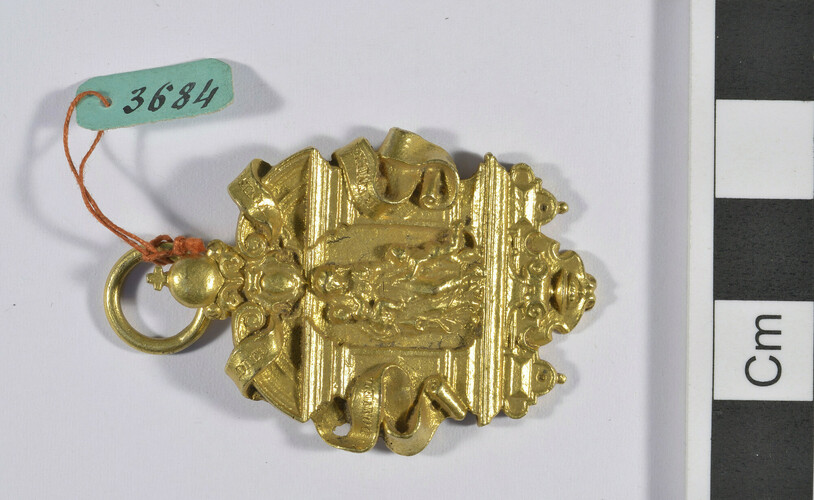 1985.52.1748Amulet, metal pendant with figures in an archway, and the words 'DIEU VOUS LE DONNEZ RENDRA[?]' on a banner, with a loop for suspension. [RB 07/06/2012]1985.52.1748
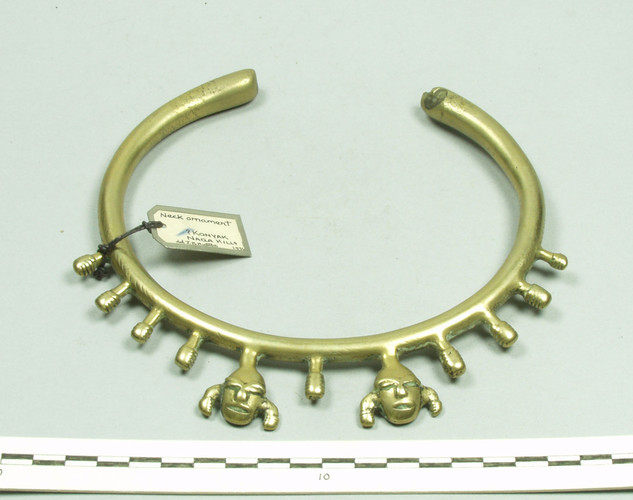 1923.85.698Brass neck ornament, consisting of a penannular ring with 2 small human heads with big ear pendants, and 9 striated knobs projecting radially from the outer curve. [N.B. 'DCF 2004-2006 What's Upstairs?' 22/6/2005]1923.85.698
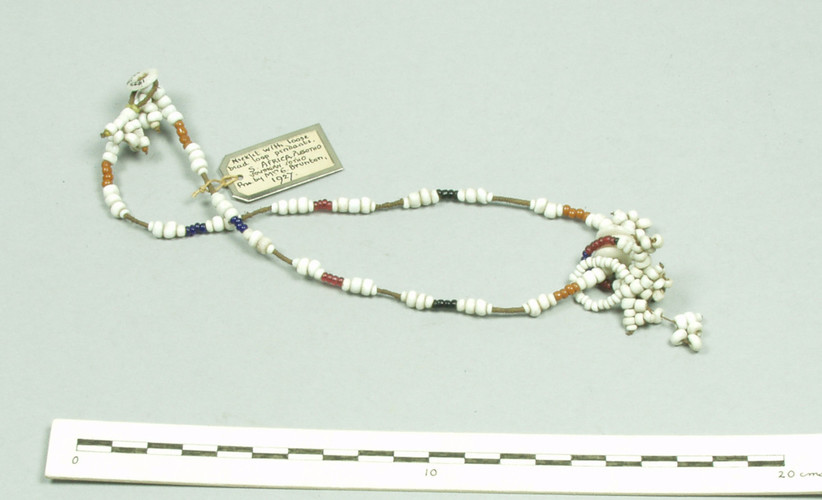 1927.37.14Necklet of beads and string sections, hung with two floating pendants, with section of four buttons in the middle and additional button at clasp [L.Ph 'DCF 2004-2006 What's Upstairs?' 8/7/2005]1927.37.14
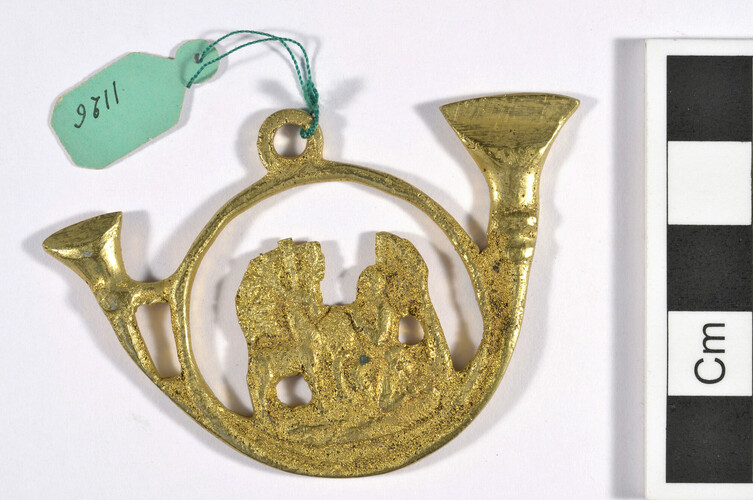 1985.52.598Amulet, metal pendant in the shape of a bugle horn, with a figure of St. Hubert and a stag in the centre, and a loop for suspension. [RB 23/03/2012]1985.52.598
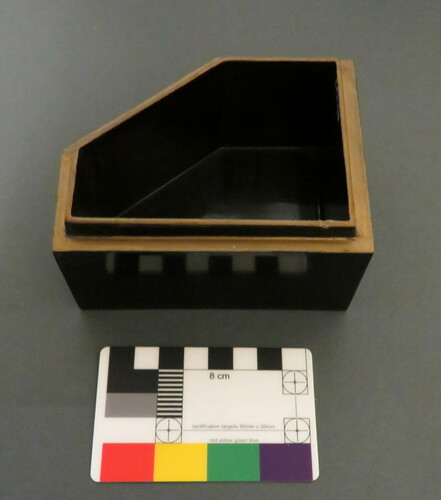 1992.8.3.7Five-sided box base, compartment of a lacquered gaming box set. The box base is plain black lacquer-ware, with a gold rim. For the lid for this box see [1992.8.3 .8]. The box contained 182 shells of assorted sizes and two pieces of resin, see [1992.8.3 .31]. [CW [OPS Move] 22/3/2017]1992.8.3.7
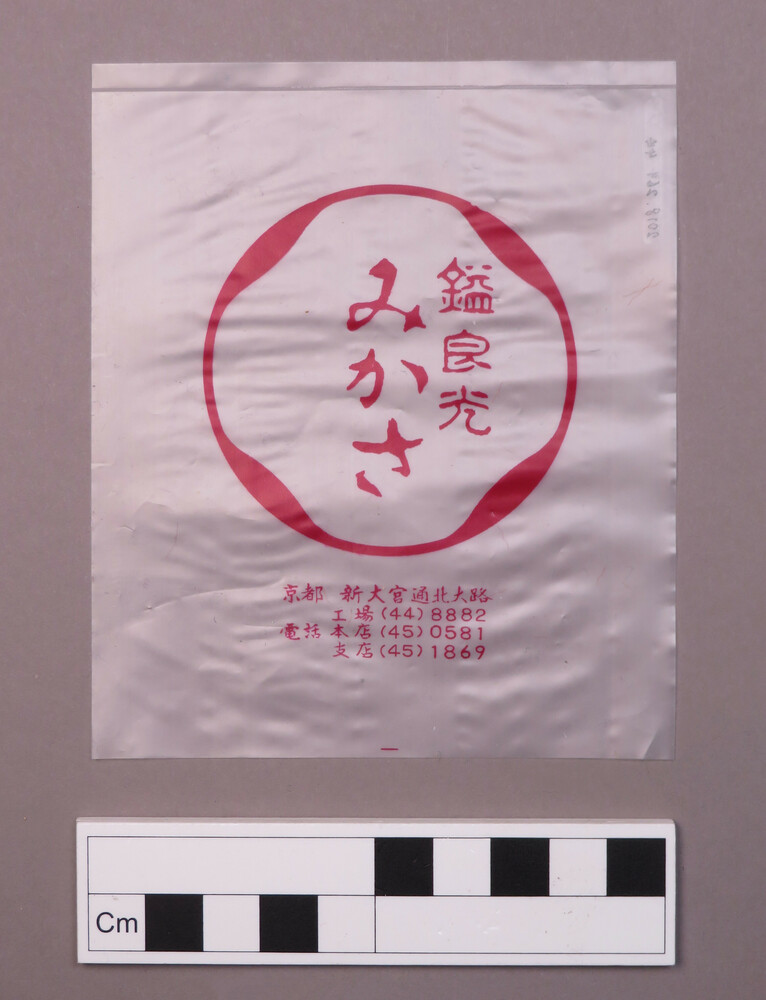 2018.269.44Transparent plastic pouch with Japanese characters and design printed on one side in the centre in red ink, with opening on one side. 2018.269.44
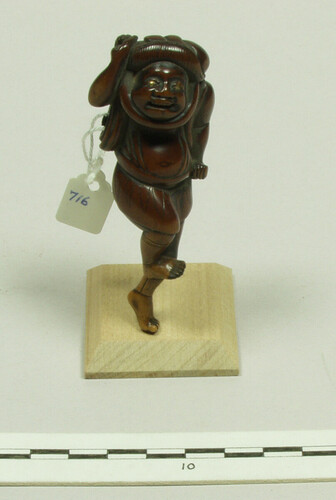 1980.34.716Balancing toggle probably of cherry wood and box wood, in form of a figure of a wrestler balancing on his left toes. [El.B 'DCF 2004-2006 What's Upstairs?' 12/4/2005]1980.34.716
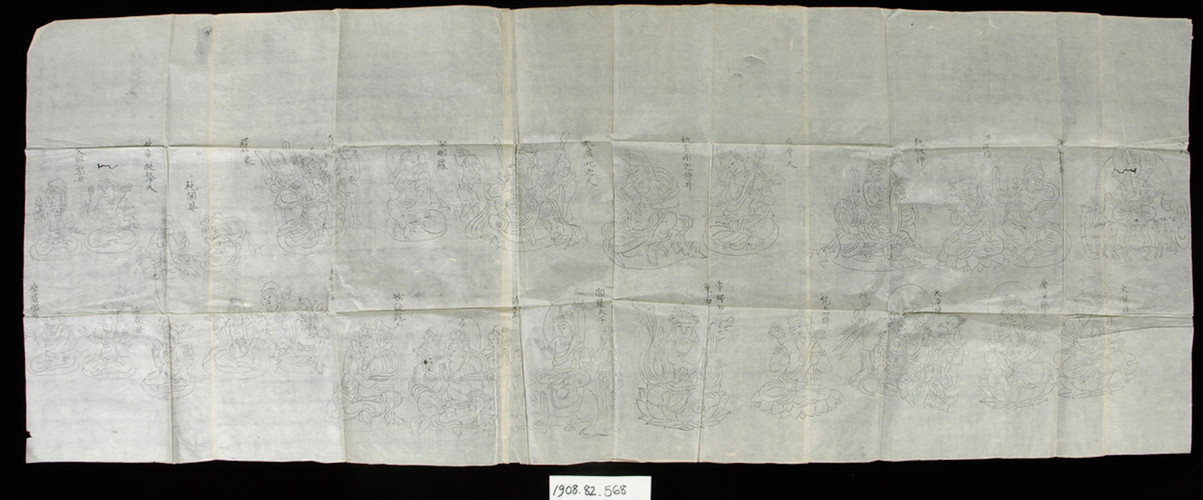 1908.82.568Copy of Buddhist painting depicting several deities with inscriptions. [SM 06/10/2008]1908.82.568