
- Collection type
- Object
- Description
- Pottery nozzle for bellows [SM (Verve) 19/03/2014]
- Geographical reference
- Cultural groups
- Kikuyu
- Date / Period
- Date made: Before 1913
- Date collected
- By 1913
- Acquisition information
- Donated: 1913
- Materials and processes
- Material Pottery, Process Fire-Hardened, Process Handbuilt
- Dimensions
- Width: max 91 mm, Length: max 200 mm
- Object numbers
- Accession number: 1913.5.5
- Research and responses
In 2020 the Pitt Rivers Museum was a partner in the project lead by the Horniman Museum 'Rethinking Relationships and Building Trust around African Collections' The project commissioned community researchers from Africa to develop new practice around Kenyan and Nigerian collections at the Horniman, the Pitt Rivers Museum, the Cambridge University Museum of Archaeology and Anthropology and the World Museum in Liverpool. These comments are from community researcher Njeri Gachihi: "This is a blacksmith’s tool as rightly identified. Amongst the Agikuyu a man who was a blacksmith was usually also a smelter. Men who were blacksmith’s and smelters were called aturi and their apprentices were called ahuruti (bellow workers) often sons of the blacksmiths or anyone else who had paid the apprenticeship fee of 30 goats and sheep and 10 stall-fattened animals. The craft was not prohibited but was expensive to learn and this explains why it was limited to certain families. Even a son of a smith had to pay a small fee to his father to enter into the profession which was highly coveted. Unlike present day schooling, an apprentice was entitled to a portion of the yield and hence could easily pay his fees over the period of learning. The raw material was iron ore commonly called Murram (muthanga) mined by the apprentice of the smith and smelter using miundwa and minyago (crowbars and digging sticks). The ore blocks were then broken up with a big hammer (kiriha kia ngundi) then sorted leaving only those that were visibly rich in iron. This was then hammered into powder, wrapped in dry banana barks (magoto) and made into little bundles ready for smelting. Each apprentice received a proportion of pig-iron obtained from his lot or ore, and this he could sell as they are or get the smith to make them up into swords and spears and sell those instead.
The smelting furnace was called (nyungu) cooking pot and was arranged so as to be suggestive of the female genitalia. At either end of the hearth and at the lower level was fixed a 1foot long clay nozzle (ngerũa) for the bellows tapering a little towards the point where the edge was molded, suggesting a human pennis. Each of the two nozzles was pegged down to keep it firm while in use and to each nozzle was fized a pair of bellows(miura/muura) and each of the bellow was of a piece of a well brayed triangular goatskin. This was folded and sewn along the sides so as to form a cone, onto which was fitted a carved hollow wooden nozzle. These wooden nozzles of the two bellows were then put at either end into the wide mouth of the clay nozzle. The blast from both the bellows at one end of the furnace kept up a constant flow of air to the furnace. Two apprentices worked the bellows on either side of the furnace, the first was the owner of the ore and the other the one whose ore would be smelted the following day. They worked under the direction of the smith, who added charcoal from time to time. To extract it, the smith used his tongs (miihato), first pulling out the lump then beating it with his hammer and cutting it into two
The charcoal used was from specific trees and a goat was slaughtered as a sacrifice whenever the fire was first lit and roasted on the furnace.
The pieces were cooled in water and the smith took the bigger share, giving the apprentice a third of the total iron produced. If in certain cases the batch produced no satisfactory iron but a nganga, it was thrown away and the owner of the ore was asked to make a sacrifice and the furnace was said to have been sterile (thata).
Every smith worked naked and only covered his genitalia with a bunch of leaves.
There is sufficient prove that in the mind of the Agikuyu, the furnace was the female and the bellows were male, the iron that came to the furnace a birth resulting from the contact of the male and female part and this symbolism is found in other Bantu tribes across Africa.
Some regions amongst the Agikuyu are named after smelting and blacksmith e.g., Kiaruhiu (a place of making knives), Itura Miro (a place of making digging sticks and crowbars). Despite the trade disappearing, the names of these villages still stand." [FB 5/1/2021]
Search terms: Tool, Fire, Metallurgy, Pottery, Bellows
Further items to explore
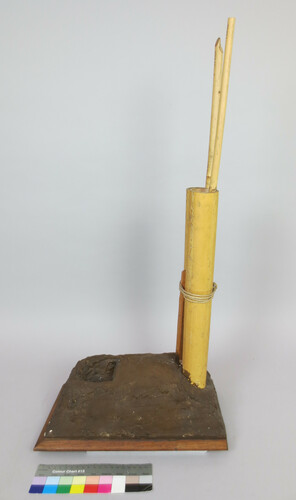 1923.84.8.1Model of vertical paired cylinder bellows. The model comprises a pair of vertical bamboo cylinders set into a plaster and wood base. The plaster is painted brown and the two bamboo cylinders are tied together with string. Two smaller bamboo cylinders are embedded inside the plaster. For the pistons see 1923.84.8 .2-.3 [AB [OPS Move] 20/2/2017]1923.84.8.1
 1923.84.8.2Model of vertical cylinder bellows piston. At one end a circular piece of bamboo is tied on with string. Pieces of feather have been attached to this section of the pistons. However, only the quills and a very small amount of feather remain. For the bellows see 1923.84.8 .1, for the other piston see 1923.84.8 .3 [AB [OPS Move] 20/2/2017]1923.84.8.2
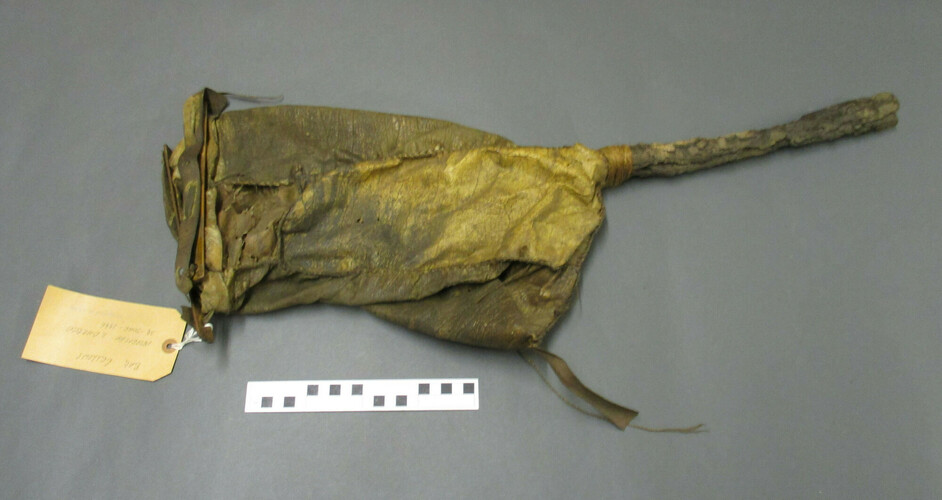 2017.69.1Bag bellows made from animal skin stitched together and attached to wooden stick. [FB 23/3/2017]2017.69.1
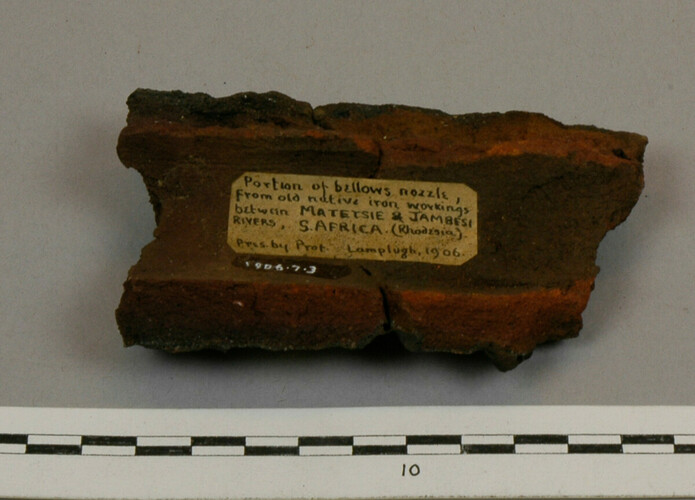 1906.7.3Piece of pottery bellows nozzle. [El.B 27/11/2007]1906.7.3
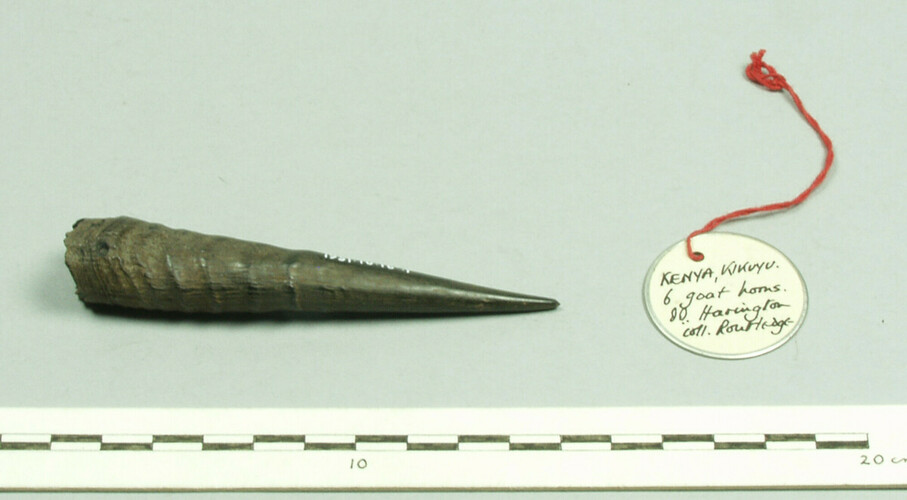 1951.10.16.16 small goat horns [.1 - .6]; straight, conical dark brown/ black horns with ridges at their open ends, kept together in a cream cotton bag [.7]. [EC 'DCF 2004-2006 What's Upstairs?' 2/12/2005]1951.10.16.1
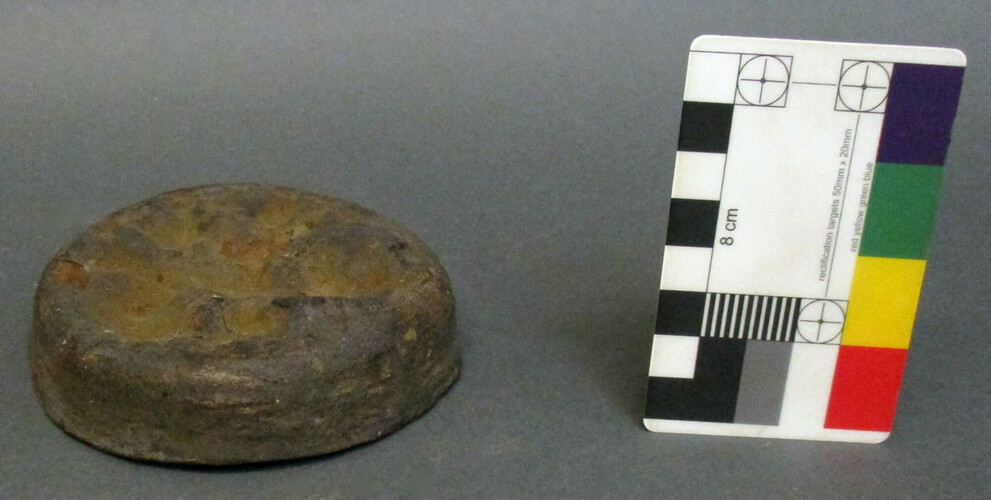 1999.20.15.2Hide lid for a wooden container. For the container see [1999.20.15 .1] [RM [OPS move] 20/9/2016]1999.20.15.2
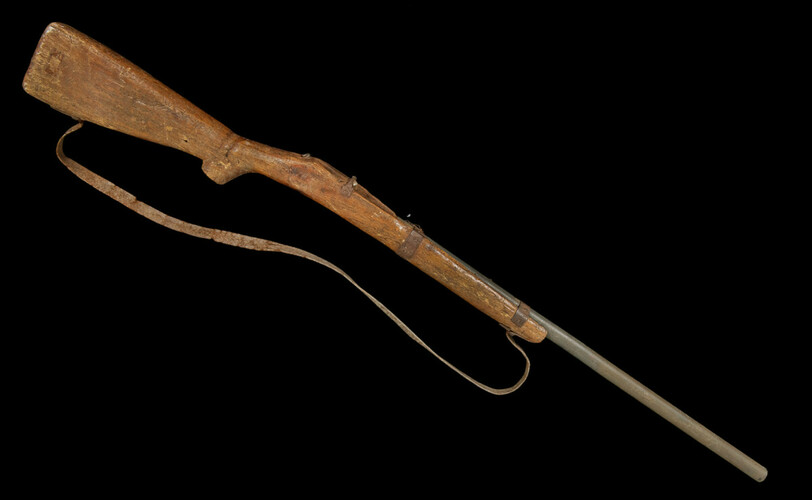 2010.4.2Home made Mau Mau rifle. [FC 13/04/2010]2010.4.2
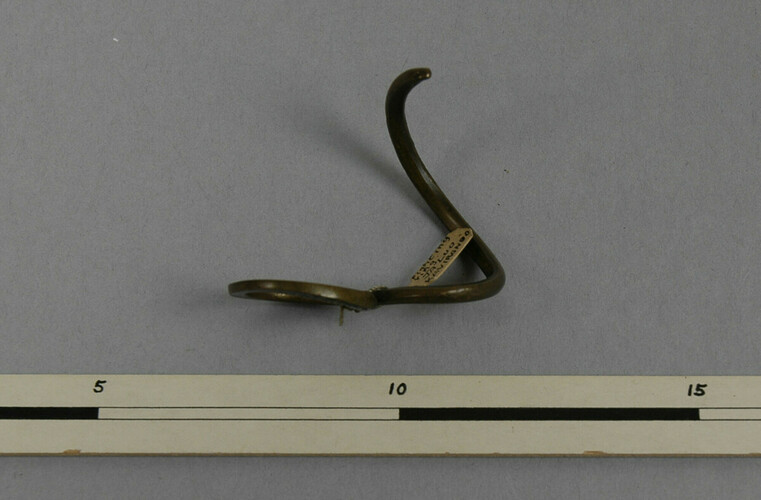 1937.34.38Brass wire fighting ring with spirally curved hook [SM 20/04/2007]1937.34.38