
- Collection type
- Object
- Description
- Fossil used in children’s game [L.Ph 'DCF 2004-2006 What's Upstairs?' 4/3/2005]
- Geographical reference
- England Somerset
- Cultural groups
- English
- Date / Period
- Date made: Before 1912
- Date collected
- By 1912
- Acquisition information
- Donated: 1912
- Materials and processes
- Material Fossil
- Dimensions
- Length: max 22 mm
- Object numbers
- Accession number: 1912.36.6
- Research and responses
The phylum of Brachiopoda has existed since the lower Cambrian period. But, it was only in Devonian that they had their most significant radiation. From the Carboniferous onwards, the number of species falls strongly, until a new maximum during the Jurassic. With the development of other marine organisms, such as gastropods or bivalves, brachiopods were continually regressing or moving to particular environments, as to the oceanic depths for example. Although resembling Lamellibranchia molluscs, brachiopods form a separate phylum, most closely related to the Bryozoa. Their shell is composed of two valves each with a different form and size: a smaller dorsal valve and a larger ventral valve. The ventral valve is provided with a hook more or less bent and perforated. The opening in the posterior end of the hook, through which protruded a fleshy stalk (pedicle), a kind of foot with which the animal generally lives fixed on the substrate, ventral valve downwards, is called foramen. These marine creatures aspire water and filter it using their lophophore, a filter-feeding apparatus shaped in a kind of arm or ribbon, to extract the nutritive oxygen and elements which allow them to live. Two classes of brachiopods are distinguished: the more primitive Inarticulata, of which well known examples the lingules, and the Articulata the most advanced brachiopods (Rhynchonellida, Terebratulida, Spiriferida...). Among the Inarticulata, the two valves are joined together only by muscles, the Articulata shells have a more sophisticared teeth and socket along the hinge.
http://en.wikipedia.org/wiki/Knucklebones: Knucklebones also known as hucklebones, dibs, jackstones, chuckstones or five-stones, is a game of very ancient origin, played with five small objects, originally the knucklebones of a sheep, which are thrown up and caught in various ways. Modern knucklebones consist of six points, or knobs, proceeding from a common base, and are usually made of metal or plastic. The winner is he who first completes successfully a prescribed series of throws, which, while of the same general character, differ widely in detail. The simplest consists in tossing up one stone, the jack, and picking up one or more from the table while it is in the air; and so on until all five stones have been picked up. ...
http://en.wikipedia.org/wiki/Jacks: Jacks (sometimes called jackstones, fivestones or onesies) is a playground game for children. The game originated hundreds of years ago, when the only playthings boys and girls had were materials they found near their homes. They collected small stones and animal bones and learned to use them in a game. They tossed them into the air and did similar to today's version of the game. A set of jacks consists of fifteen small metal six-pointed stars, called 'jacks', and a rubber ball. The playing surface is any flat area, such as the tarmac of a playground. Sometimes an area may be delineated in chalk, but more often it is just the space between the two players. The players decide who goes first, perhaps via ip dip, (American: 'One Two') or a variant, then the jacks are scattered loosely into the play area. The players take it in turn to bounce the ball off the surface, then pick up jacks, then catch the ball before it bounces twice. [AP 27/09/2006]
Search terms: Toy and Game, Children and Childcare, Geology, Animalia, Specimen, Game Accessory, Fossil, Gaming Piece
Further items to explore
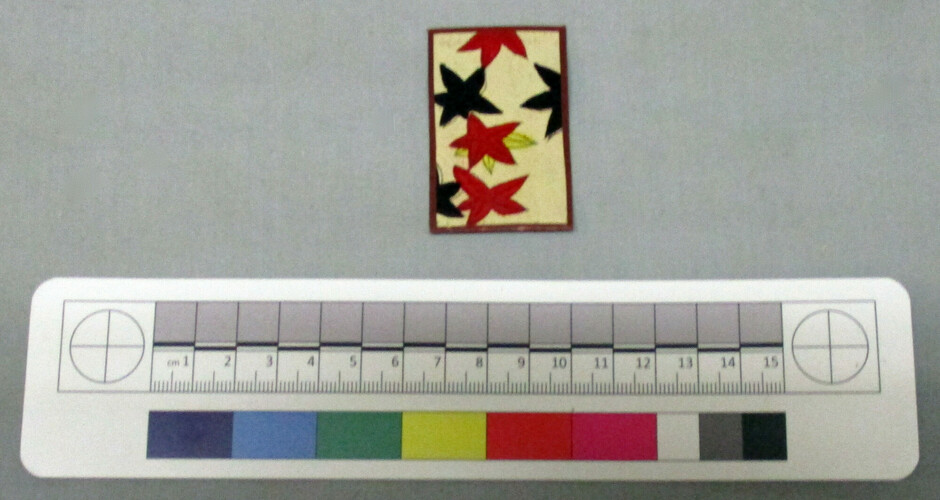 1901.47.1.51Gaming card. With an image which depicts black, yellow and red abstracted leaves. The card is rectangular and made from paper, the back of the card is dark red with an image glued to the front. The card is one of forty-nine red cards in a game set. [AB [OPS Move] 21/7/2016]1901.47.1.51
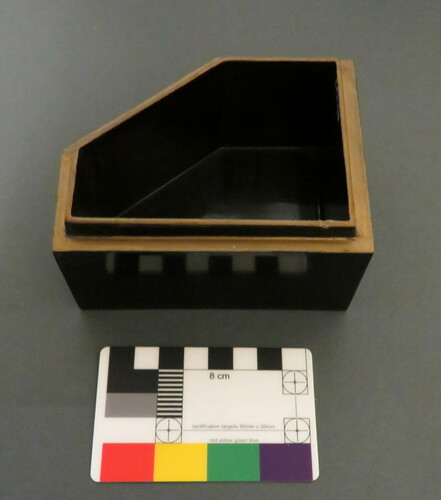 1992.8.3.7Five-sided box base, compartment of a lacquered gaming box set. The box base is plain black lacquer-ware, with a gold rim. For the lid for this box see [1992.8.3 .8]. The box contained 182 shells of assorted sizes and two pieces of resin, see [1992.8.3 .31]. [CW [OPS Move] 22/3/2017]1992.8.3.7
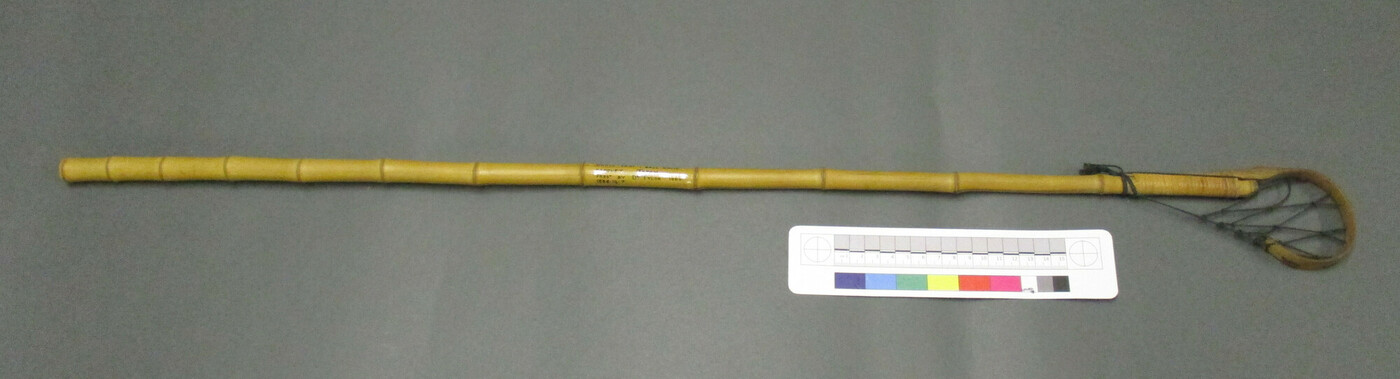 1886.14.7Polo or lacrosse racquet, consisting of bamboo shaft with rounded ?cane end bound by thin strips of cane. Rounded end is crossed with knotted stringwork net. [ASh [OPS move] 6/2/2017]1886.14.7
 1911.29.69.9One of twelve stones used in the game of 'merry-peg'. [El.B 'DCF 2004-2006 What's Upstairs?' 7/3/2005]1911.29.69.9
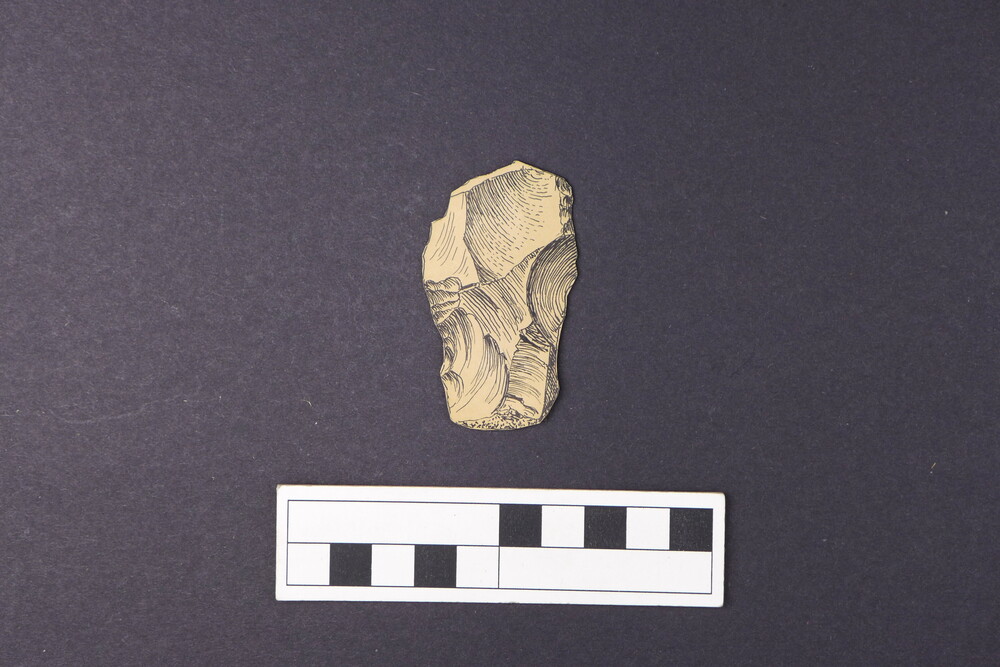 1941.5.1.12Drawing of tool1941.5.1.12
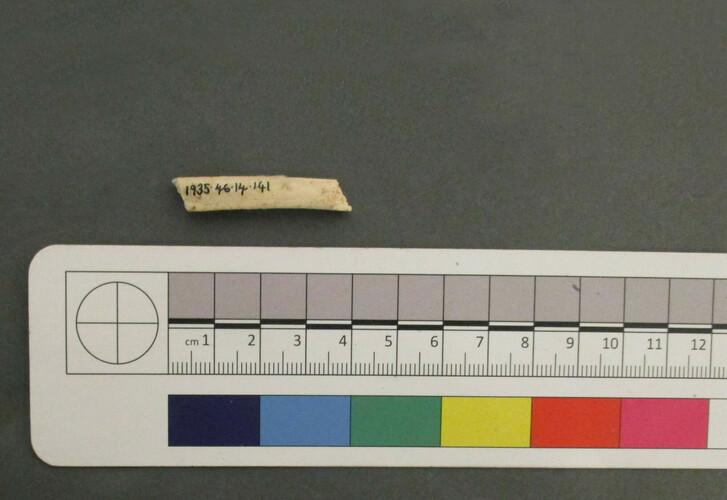 1935.46.14.141Animal rib fragment. [CW [OPS Move] 23/5/2017]1935.46.14.141
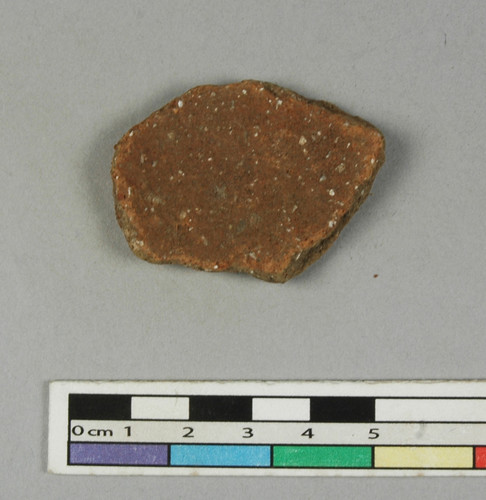 1884.138.4.105Ceramic sherd1884.138.4.105
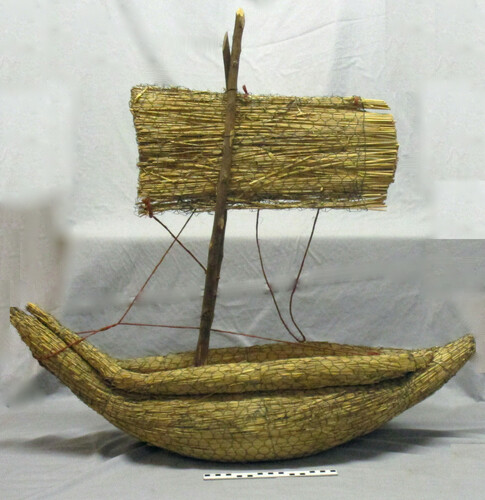 1970.12a.1Model of a boat made from straw covered with chicken wire.1970.12a.1