
- Collection type
- Object
- Description
- Sail for model canoe 1906.58.2 .1 [FC 17/08/2010]
- Long description
- Sail for model canoe. [for canoe see 1906.58.2 .1]. The sail has a yellow ochre colour and is made from joined single plant leaves, which are stretched between two wooden sticks. The leaves are sewn together and attached to the sticks with plant material. Some small strings are tied to the wooden stick, which most likely are part of the sail’s original attachment to the boat. (Katharina Kuntz, August 2010) [HR 13/08/2010]
- Date / Period
- Date made: Before 1896
- Date collected
- 1896
- Acquisition information
- Donated: 1906
- Materials and processes
- Material Wood Plant, Material Plant Fibre, Process Tied, Process Stitched
- Dimensions
- Width: max 573 mm, Length: max 670 mm
- Object numbers
- Accession number: 1906.58.2.2
- Research and responses
The sailcloth (ie, Polynesian name) is stretched between two wooden sticks, probably made of coconut wood, which stay together in a 55° angle. The vertical stick builds the upper yard-arm (ina ieta) and is about 575 mm high. The horizontal stick builds the lower yard-arm (ina inano) and is about 680 mm long. The upper yard-arm is sharpened on the lower end and is carved about 40mm from the bottom. In this chink runs a small string with which the lower yard-arm is lashed (ro n wi n ie) to the upper one. The upper ends of the upper and lower yard-arm and the bottom of the lower arm are cut straight.
The sailcloth is likely produced from Pandanus leaves, both horizontally and vertically sewn together in running stitches with approximately 1mm thick plant material. Perhaps the tied sticks were now placed on the prepared mat, which was then cut more accurately with some surplus. The mat is folded around the wooden sticks so the single horizontal leaves proceed in a 90° angle to the upper yard-arm and in an acute angle to the lower yard-arm. The cords, attaching the sail to the yard-arms (bakaoko), i.e. the mat’s attachment to the sticks, is a string which is tied to one end, runs over the turned down ends, pierces the plant material in regular intervals - mostly in the middle of the single leaves - is then wound round the stick and the mat, with an overlapping action to hold the leaves tight and continues its way to the other end. The upper end the sailcloth is also held by a string that runs from the upper end of the upper yard-arm to the upper end of the lower yard-arm and pierces the mat in running stitches.
There are three different sorts of strings, which all consist of S-twisted fibres, probably coconut. The first and thinnest simple yarn (binoka) is made out of two twisted fibres. It is a light brown colour and used to fix the mat to the lower yard-arm. The cords attaching the sail to the upper yard-arm also form a binoka, but a stronger one. Both arms are lashed together at the lower end with a brown kora, an S-twist twine, which is produced from two binokas. Reference: Koch.G. (1986) The Material Culture of Kiribati. pp 168-169, 220-221. (Katharina Kuntz, August 2010) [HR 13/08/2010]
Search terms: Model, Navigation, Canoe Outrigger, Sail
Further items to explore
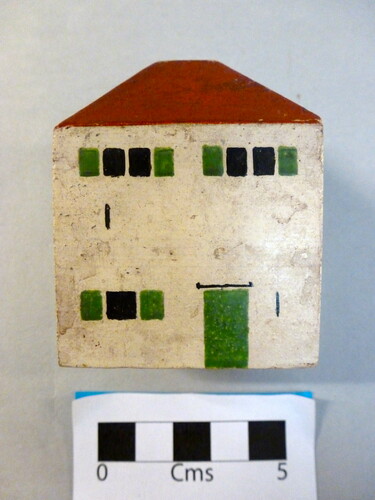 1985.36.172.3Model wooden house, painted white with a red roof. Part of a set of model buildings and trees [1985.36.172 .1 - .21] [ZM 22/02/2013]1985.36.172.3
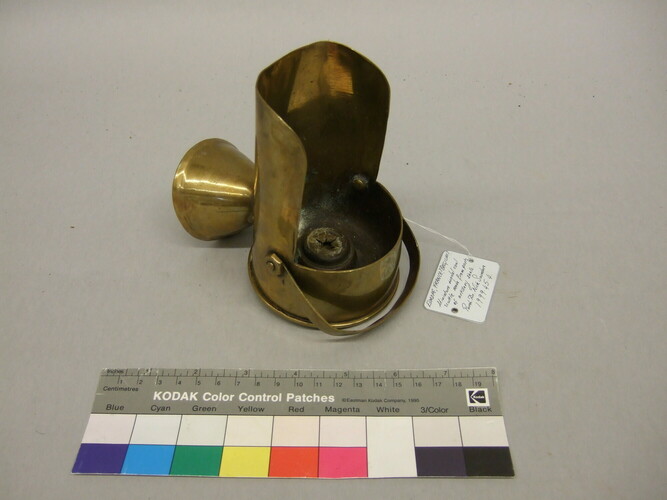 1999.45.4Model coal-scuttle made from a brass artillery shell [HH 05/05/2010]1999.45.4
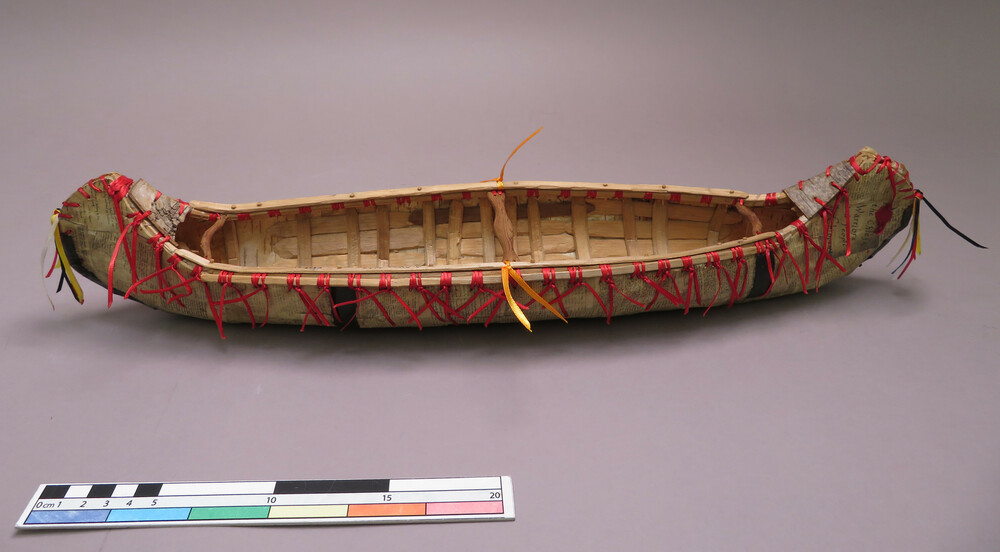 2024.9.1Treaty Canoe Replica. Artwork made by Alex McKay. Built much like a birch bark canoe, except a 'skin' of papier-mâché treaties replaces the bark hull. It is made from cedar; red, white, black, orange and yellow ribbon, glue, ink and linen paper. 2024.9.1
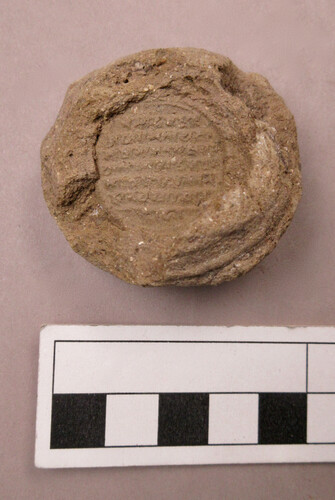 1886.1.7.9One of thirty-six clay models of 'chatyas'.1886.1.7.9
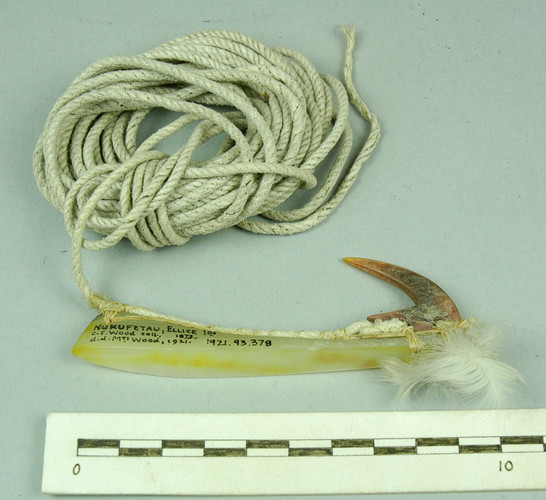 1921.93.378Fish hook of shell shank with turtle shell barbless hook. With a tuft of feathers and string line attached. [MJD 18/03/2009]1921.93.378
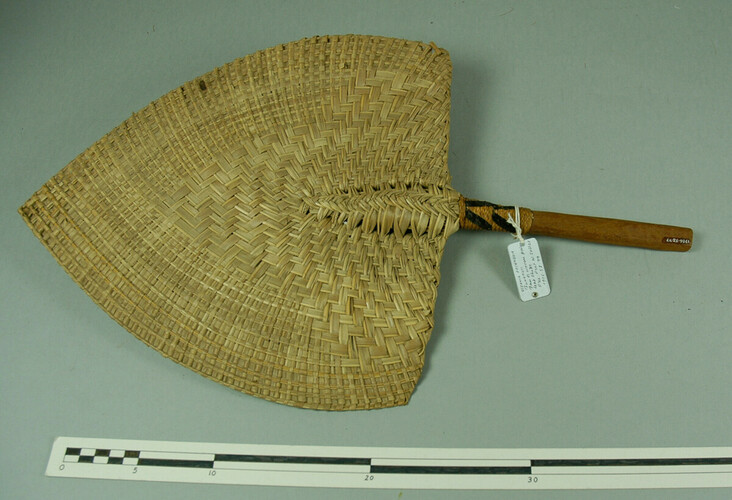 1906.58.77Fan of woven palm leaf strips with wooden handle bound with plaited plant fibre cord and strips of black palm leaf. [LKG 30/09/2009]1906.58.77
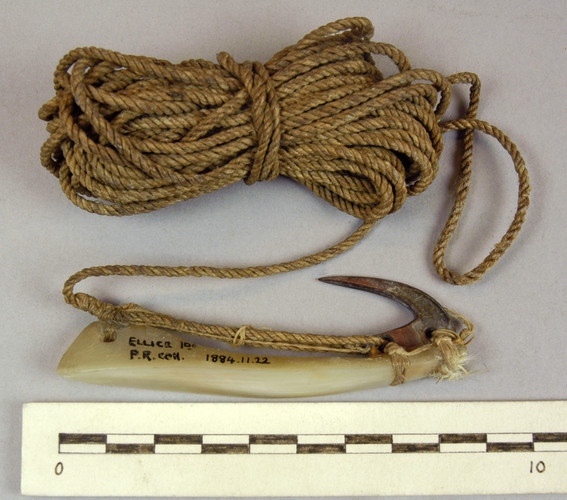 1884.11.22Pearl shell fish hook with attached string line.1884.11.22
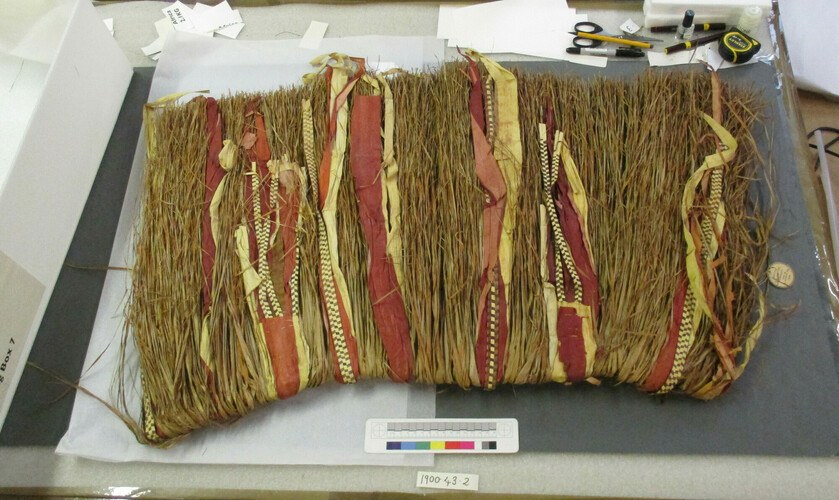 1900.43.2Skirt made from lengths of split plant fibre decorated with red dyed plant leaf and streamers of black and natural coloured fibre plaited together in geometric design. [FB 27/11/2014]1900.43.2