
- Collection type
- Object
- Description
- Black soapberry seed with short brown feathers tied to form a hane (shuttlecock), used to play hanetsuki. [MC, 06/10/2022]
- Geographical reference
- Cultural groups
- Japanese
- Date / Period
- Date made: Before 1891
- Date collected
- By 1891
- Acquisition information
- Donated: 1906
- Materials and processes
- Material Bird Feather, Material Plant Seed, Material String, Process Tied
- Dimensions
- Length: max 55 mm
- Object numbers
- Accession number: 1906.10.28
- Research and responses
Hanetsuki and Hagoita
Hanetsuki is a traditional Japanese game played at New Year, usually by women, during which players use a hagoita (bat) to hit a hane (shuttlecock) made of soapberry seed and feathers. Hanetsuki can be played by one or more players- the object of the game is to simply keep the hane up in the air for as long as possible. Each time a player drops the hane, they receive an ink marking (used for calligraphy) on their face to indicate a penalty.
Hagoita are elaborately decorated wooden bats, traditionally decorated with images of jewels, gods, flowers and sabres. During the Edo period, hagoita became more ornate, with delicate patterns, gold or silver linings, and detailed designs depicting actors and scenes from the kabuki theatre. Modern varieties of hagoita are decorated with a wider variety of characters, from politicians to cartoon characters.
Etymology
'Hane' means ‘feather’ in Japanese, and 'tsuki' is a conjugated form of a verb, 'tsuku' which means to strike or hit.
History
Is it possible that hanetsuki was developed from the Chinese game tijian-zi (later chien-tsu), which was introduced to Japan from China in the 14th century. The game involved keeping a shuttlecock (a leather ball ornamented with metal and feathers) in the air for as long as possible by kicking it. Chien-tsu was played for centuries, and was featured in French newspaper Le Journal de la jeunesse in 1875, which reported on the game’s difficulty and “ungraceful” nature.
One of the earliest mentions of hanetsuki was in the crown Prince Sadafusa’s newspaper which, during the Muromachi period in 1432, which reported on a shuttlecock event being played at the Imperial Court between a male and female team. It was during this period that hagoita developed their trapezoidal shape and hanetsuki matches were taking place as part of New Year festivities at the Royal Palace. Some historical accounts reported hagoita being thrown into the fire with other offerings during New Year’s celebrations.
Today, hagoita are more commonly sold as decorative charms given to women on oshogatsu (New Year’s Day). Since the Edo period, hagoita have been sold as New Year’s charms at the Hagoitaichi fair as part of the December festival stalls at Tokyo Asakusa Kannon temple grounds. Although hanetsuki is no longer commonly played as a household game at New Year, modern adaptations of hanetsuki (involving a court and net) have been taking place as competitions in Chuo Ward, Tokyo and Kawasaki City for over 60 years.
Symbolism
The 'hane' (shuttlecock) was thought to resemble a dragon-fly which ate mosquitos. Mosquitos were much feared in ancient Japan because they often brought serious illness, with children being especially vulnerable. It was believed that they would be protected throughout the year if they played hanetsuki at New Year. The weight of a shuttlecock is a black seed called "Mukuroji" meaning a child who never suffers from illness'. In 1544 in his book ‘Segen mondo’, Ichijo Furuya called hanetsuki “the game of the little barbaric demons” referring to the idea that hanetsuki chased away evil spirits.
Guillain , J. (2004), Badminton : An Illustrated History, Publibook, Paris.
Kodansha (2022). Hanetsuki, Encyclopedia of Japan, JapanKnowledge Lib: https://ezproxy-prd.bodleian.ox.ac.uk:2683/lib/display/?lid=10800LS000201
Kiritani, E (1995). Vanishing Japan: Traditions, Crafts & Culture, Charles, E. Tuttle Publishing Co. , Inc., Japan.
Nippon-kichi (2007). Hagoita and Hane (Paddle and Shuttle), Nippon-kichi: https://nippon-kichi.jp/article_list.do;jsessionid=CEAD51F82B87D708B97658ED25E52328?p=1261&ml_lang=en
Sensouji (2016). Visit, Asakusa Kannon Senso-Ji: https://www.senso-ji.jp/english/
Tokyo News (2022), Hanetsuki is a sport! Tournament in Chuo Ward Evolution of ancient Japanese play, Tokyo Web: https://www.tokyo-np.co.jp/article/154123?rct=t_news
In Japanese the game is called Hanetsuki; the bat is hagoita and the shuttle cock is hane, made from a soapberry (mukuroji) and feathers. The game is a traditional girl's game played at New Year and is associated with expelling bad luck. [Sources: http://homepage3.nifty.com/hinaya/shougatsueng.htm and http://www.jcccnc.org/community/culture.htm] [EC 'DCF 2004-2006 What's Upstairs?' 15/9/2005]
Related Documents File - Photocopy of an article by Robert George, 'Hagoita: From Game to Art' that was published in Anritsu News Winter 2006, Volume 25 Number 119. [ZM 19/10/2006]
Search terms: Sport, Toy and Game, Ball, Game Accessory
Further items to explore
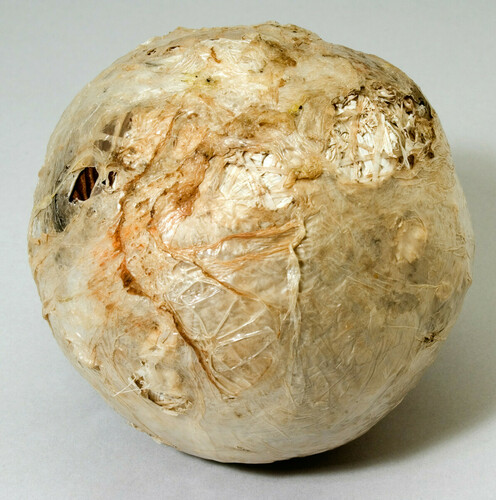 2002.1.1Football made from textile, plastic bags and plastic string. [ZM 2/11/2005]2002.1.1
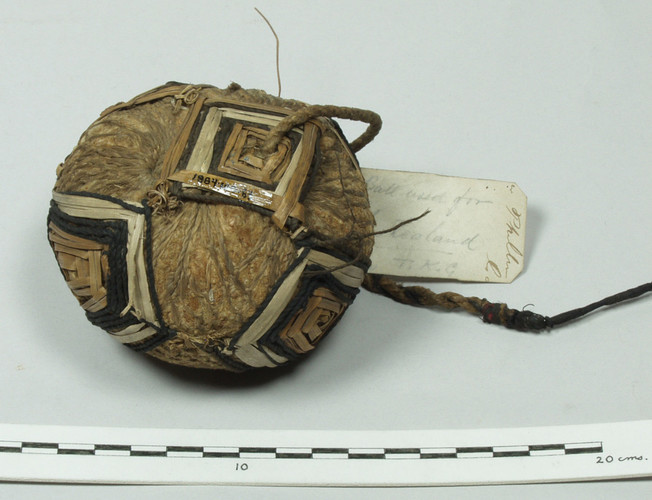 1884.100.63String work playing ball of flax, with length of twisted plant fibre cord attached [L.Ph 'DCF 2004-2006 What's Upstairs?' 15/3/2005]1884.100.63
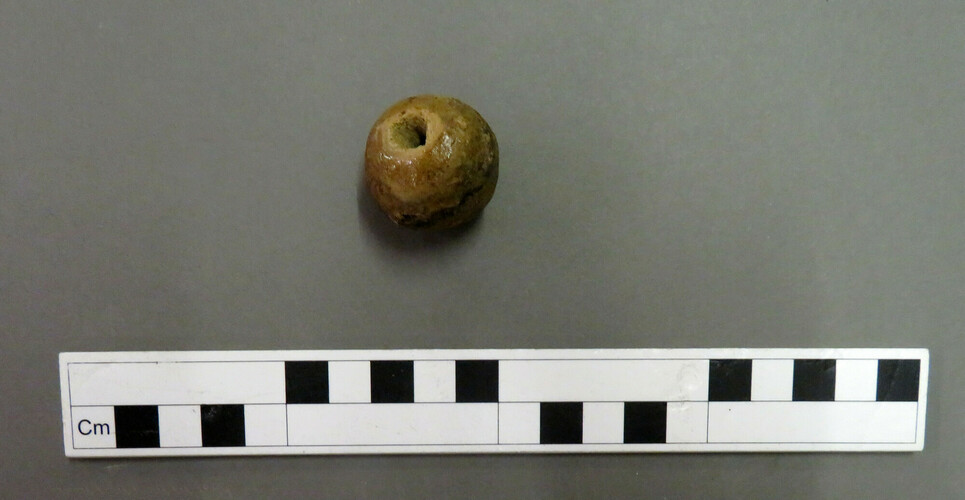 1978.20.389.6Clay ball. Spherical clay or pottery ball pierced to fit on the head of an arrow. [BA [OPS move] 18/12/2017]1978.20.389.6
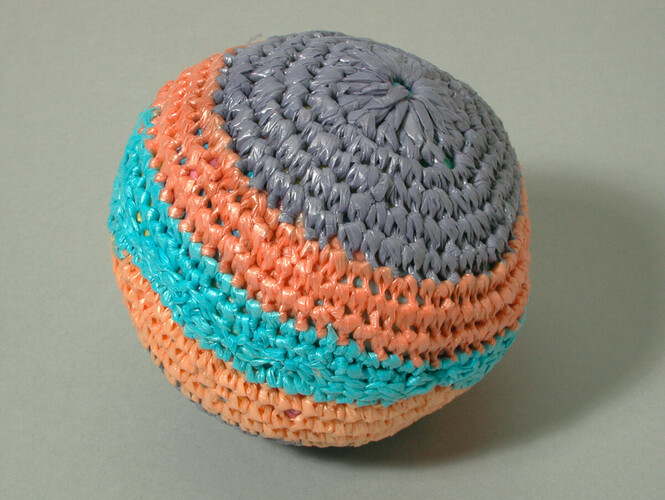 2000.23.5Children's igir kwas (football) ball made from recycled plastic bags. The plastic bags are light blue, mauve and peach. [MdeA 11/7/2000]2000.23.5
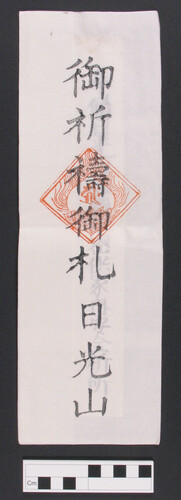 1985.53.396Amulet consisting of a paper folded into a narrow rectangular enevelope with a strip of paper glued inside. [El.B 18/10/2013]1985.53.396
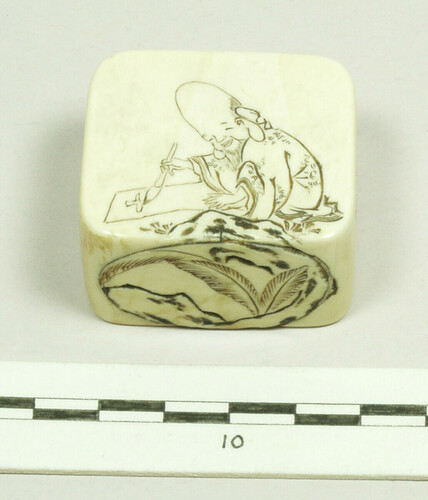 1980.34.1306Netsuke1980.34.1306
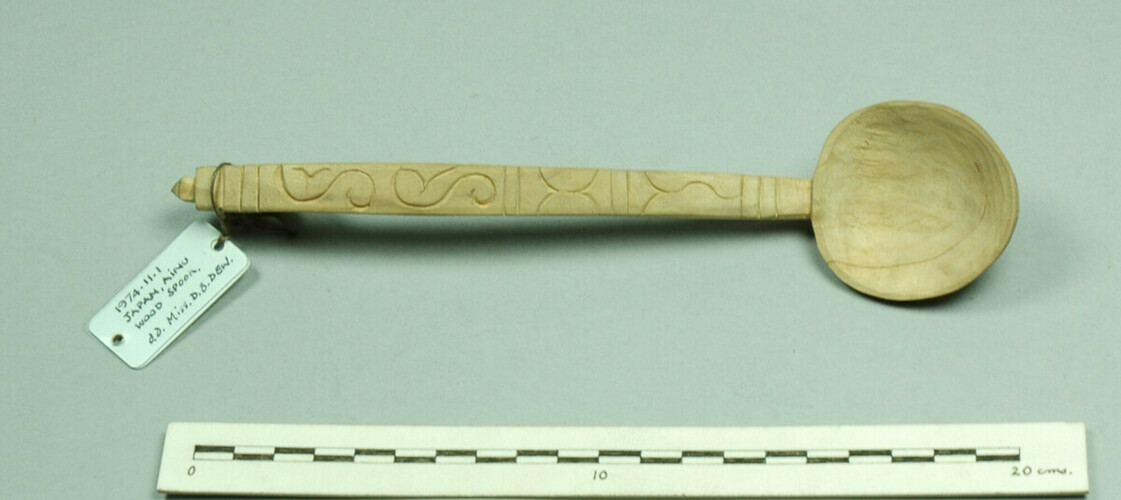 1974.11.1Carved wooden spoon with a flattish round bowl & an incised handle terminating in a hoop. [EC 'DCF 2004-2006 What's Upstairs?' 31/3/2006]1974.11.1
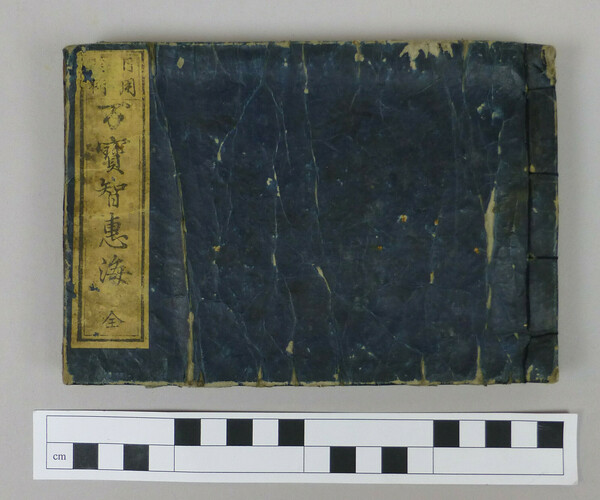 1985.53.502Book printed in Japanese, with dark blue paper covers. [El.B 28/10/2013]1985.53.502