- Collection type
- Object
- Description
- 'Stone grinder' of grey-brown rock with a flat oval base and a tall rounded top. [LKG 12/01/2010]
- Long description
- 'Stone grinder' of grey-brown rock with a flat oval base and a tall rounded top. The stone is characterised by roughly parallel dark grey veins which run diagonally across the flat base and up the front side of the stone as parallel arches. The top of the stone is roughened and slightly pitted. A large chip of stone is missing on that back side of the stone. [LKG 12/01/2010]
- Geographical reference
- Western Cape Province Cape Flats
- Date / Period
- Date made: Before 1878
- Date collected
- Between September 1876 and February 1878
- Acquisition information
- Donated: 1900
- Materials and processes
- Material Stone
- Dimensions
- Width 73 mm, Height 68 mm, Weight 417 g
- Object numbers
- Accession number: 1900.56.48
- Associated publications
- As well as exhibiting his collection at the Anthropological Institute on 26 February 1878, Sanderson also gave a paper about the collection; see 'Notes in Connection with Stone Implements rom Natal [a paper read by the author at a Meeting of the Anthropological Institute of Great Britain and Ireland on 26 February 1878]', by John Sanderson, Journal of the Anthropological Institute, Vol. VIII (1879), pp. 15-21. [JC 17 1 2002]
Referred to on page 24 of 'Stone Age Sub-Saharan Africa', by Peter Mitchell, in World Archaeology at the Pitt Rivers Museum: A Characterization, edited by Dan Hicks and Alice Stevenson (Oxford: Archaeopress, 2013), pp. 16-34. Mitchell writes: ‘Another early collection comprises the 40 stone artefacts (and 2 potsherds) collected or acquired by John Sanderson (principally in KwaZulu-Natal), exhibited by him to the Royal Anthropological Institute in 1878 (Sanderson 1878 [see above reference]) and donated by it in 1900 (1900.56.1-53). This is, in fact, the only 19th-century southern African Stone Age collection in the PRM that appears to have been exhibited to a British learned society, creating a sharp contrast with the origin of much of the British Museum's material of the same kind, much of which was acquired after first being displayed and discussed at meetings of the Royal Anthropological Institute or the Society of Antiquities (Mitchell 2002a [catalogue of the southern African Stone Age collections of the British Museum. London British Museum (British Museum Occasional Papers 108, with contributions from A. Roberts, A. Cohen and K. Perkins).]’. [MJD 14/11/2014]

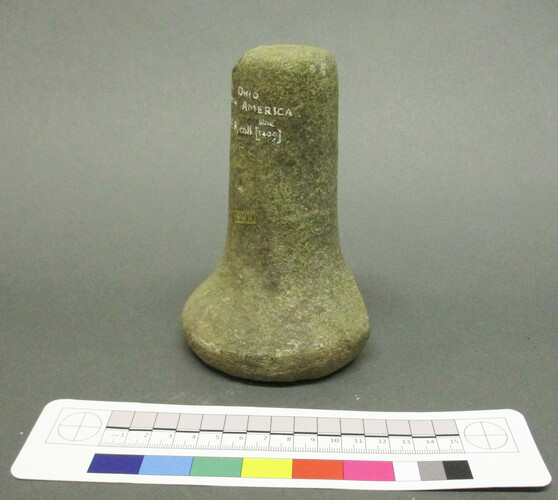 1884.128.25Stone pestle. Mottled yellow brown stone with a cylindrical shaft and a rounded flat base. Section missing from the side. [ASh [OPS move] 26/10/2016]1884.128.25
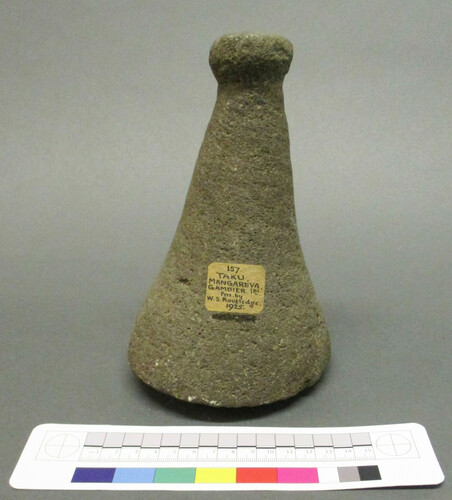 1925.29.97Stone pounder. Round handle at the top with a narrow neck that leads to wide flaring sides and a flat base. The base is convex in shape. The stone is grey in colour with a porous appearance. [ASh [OPS move] 26/10/2016]1925.29.97
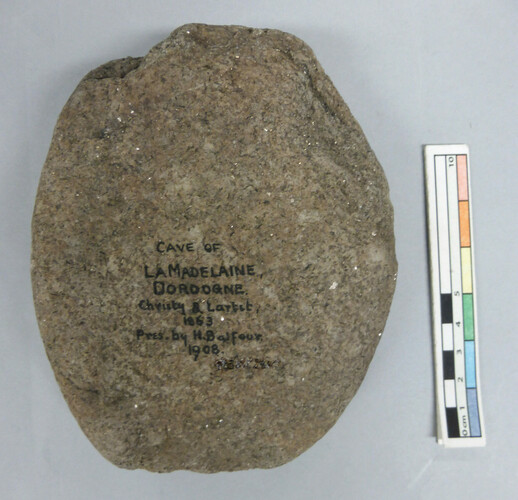 1908.5.81Pebble used for smoothing bone & horn implements1908.5.81
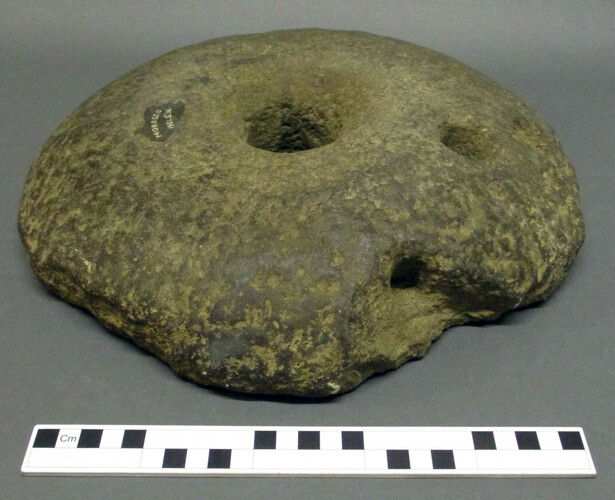 1961.5.18.1Grinding stone. Consists of two heavy perforated stones, [.1 & .2], with a central wooden peg [.3] inserted in the perforations and a separate wooden handle [.4]. [JC [OPS Move] 2/11/2016]1961.5.18.1
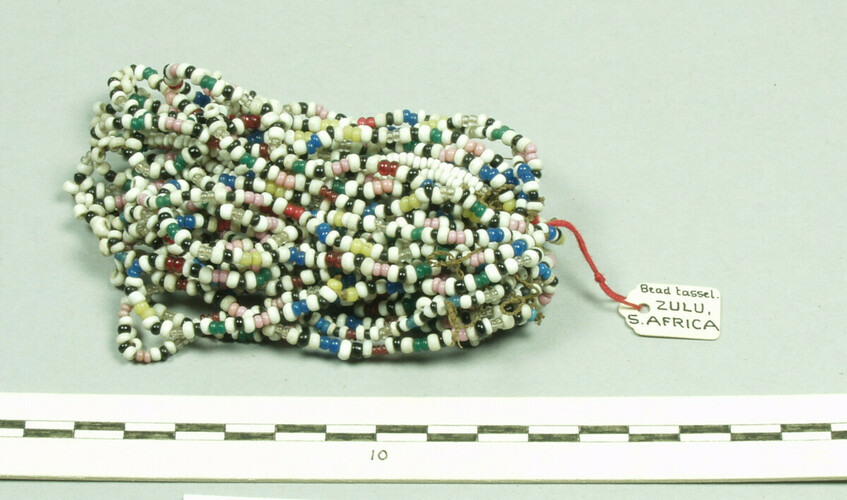 1944.2.47Tassel consisting of several looped strands of small multicoloured beads tied together. [N.B. 'DCF 2004-2006 What's Upstairs?' 14/7/2005]1944.2.47
 1935.13.106.639Triangular orange, tan and dark brown stone flake with area of cortex covering proximal edge. [LKG 18/06/2010]1935.13.106.639
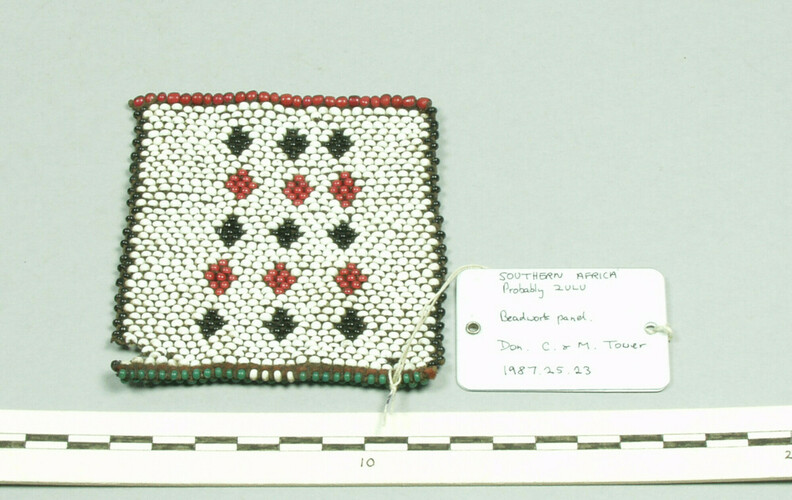 1987.25.23Ornament consisting of a rectangular beadwork panel with a decoration of small black and red lozenges on a white background; 2 borders black, 1 red, and 1 green-and-white. [N.B. 'DCF 2004-2006 What's Upstairs?' 8/7/2005]1987.25.23
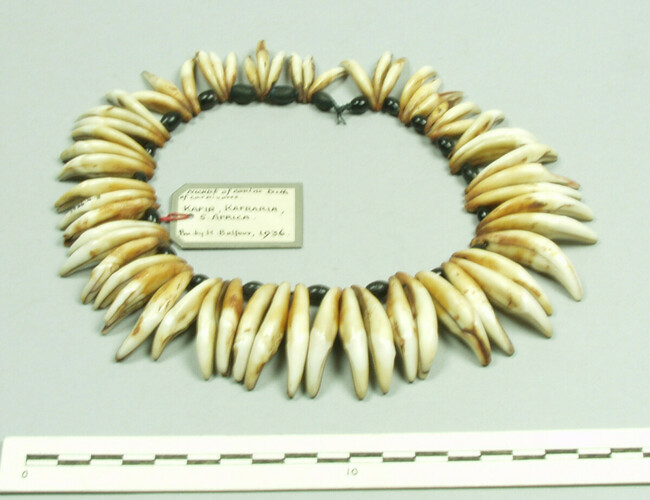 1936.4.3Neck ornament; groups of 3 carnivore canine teeth, graduated in size, alternating with black glass beads. [EC 'DCF 2004-2006 What's Upstairs?' 30/11/2005]1936.4.3