
- Collection type
- Object
- Description
- Kora Sanniya mask used in dances performed for curing, with an asymmetrical mouth and holes beneath the eyes to enable the wearer to see. [JN 15/07/2008]
- Long description
- Kora Sanniya mask used in dances performed for curing, with an asymmetrical mouth and holes beneath the eyes to enable the wearer to see. Kora Sanniya is said to be the demon which causes paralysis of the face. The mask is painted with red lines painted on the forehead. The mouth is upturned with one side higher than the other and the nose is carved projecting to one side. Both eyes are carved open. The mouth is perforated. [SM (Verve) 04/09/2013]
- Geographical reference
- Cultural groups
- Sinhalese
- Person
- Field collector Frederic(k) W. de Silva
- PRM source Frederic(k) W. de Silva
- PRM source Henry Luttrell Moysey
- Date / Period
- Date made: Before 1895
- Date collected
- By 1895
- Acquisition information
- Donated: 1895
- Materials and processes
- Material Wood Plant, Material Pigment, Process Carved, Process Painted, Process Perforated
- Dimensions
- Length: max 170 mm, Width: max 116 mm
- Object numbers
- Accession number: 1895.36.12 Other numbers: 16 [on list in RDF]
- Research and responses
The following notes were taken during a visit on the 9th July 2008 by Mohan Daniel, a mask specialist from Sri Lanka. He noted that the masks were not always correctly identified with the relevant demon on the list in the RDF or the writing on the objects that was presumably written by Frederick De Silva before the objects were donated to the museum. It is unclear whether this was done deliberately to prevent the masks being used, or whether it was accidental. Mohan Daniel believes that this mask is correctly identified as "Kora Sanniya" . He mentioned that masks like this were usually rubbed with an oil made from a now rare tree in Sri Lanka to act as an insect repellent. This oil leaves a shiny surface on the mask. Mohan Daniel believes that none of the masks in this collection [1895.36.1-18] were used, as they show no discolouration on the back of the mask and there are no holes to use to tie the mask onto the face. [JN 15/07/2008]
- Associated publications
- Illustrated in colour on page 332-333 of Les Maîtres du Désordres, edited by Josephine Chambonnière (Paris: Musée du quai Branly / Réunion des Musées Nationaux Grand Palais, 2012). Caption (same page): 'Dix-huit masques représentant les dix-huit maladies (Sri Lanka, avant 1895, 18 x 11,7 cm)'. (The eighteen masks in this collection are illustrated in accession number order, from left to right and from top to bottom of each page; the first nine on page 332 and the rest on page 333.) (Photocopy in RDF.) [FB 22/05/2013, JC 30 5 2013]
Search terms: Mask, Dance, Medicine, Religion, Medical Accessory
Further items to explore
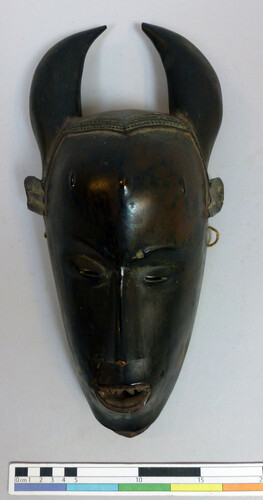 1983.25.4Wooden mask of a face. With carved slits for the eyes and an open mouth, geometric carving around the forehead and a pair of curved horns at the top of the head. Three raised bumps on the forehead probably representing facial scaring or decoration. [AB [OPS Move] 14/9/2016]1983.25.4
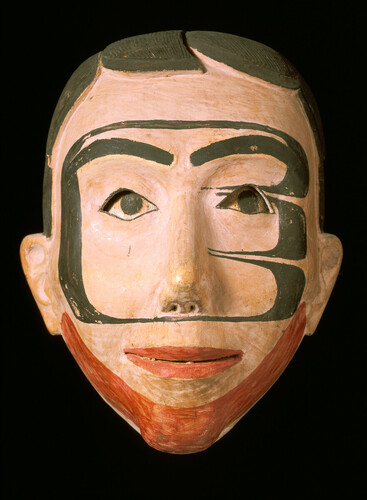 1891.49.6Wooden mask of a male face with moveable eyes and a black line running over the eyebrows, around each cheek and under the nose, and with a thick red line along the lower jaw. [CAK 24/08/2009]1891.49.6
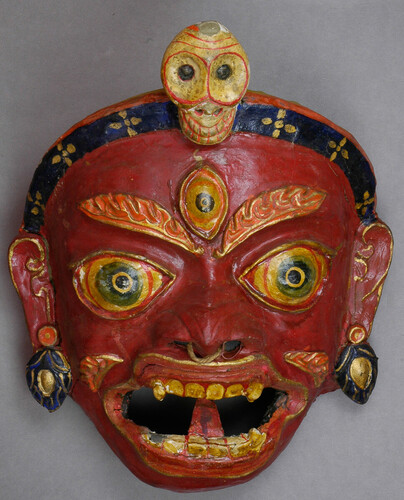 1967.25.12Face mask of papier mache, painted a dull red, orange and gold mouldings at eyebrows and cheeks, mouth open, upturned tongue (point broken off). Black headband with gold pattern painted on, death's head in centre, painted yellow and red. Mouth and nostrils pierced.1967.25.12
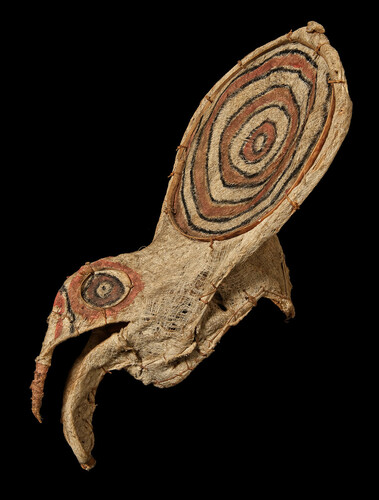 2008.69.1Mask.2008.69.1
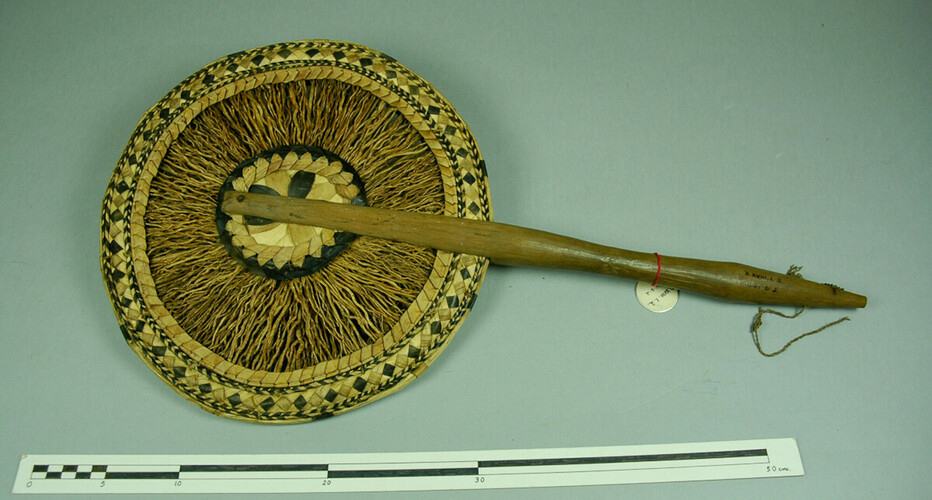 1961.6.2Fan of plant root edged with interwoven strips of bamboo. A long wooden handle is fixed to the centre of the fan by a nail. [LKG 04/09/2009]1961.6.2
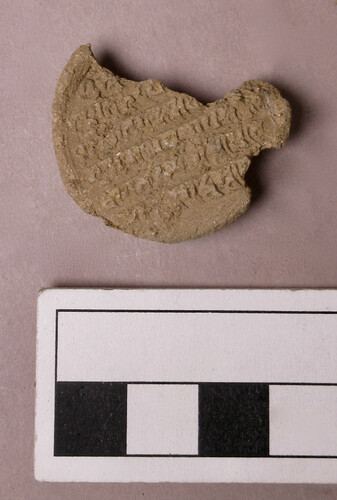 1886.1.7.16One of thirty-six clay models of 'chatyas'.1886.1.7.16
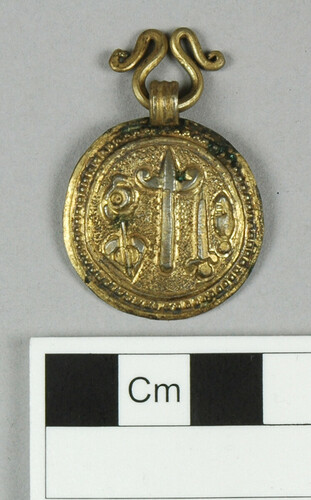 1985.51.736Gilded circular amulet with a suspension loop, depicting five weapons. [SM 04/05/2011]1985.51.736
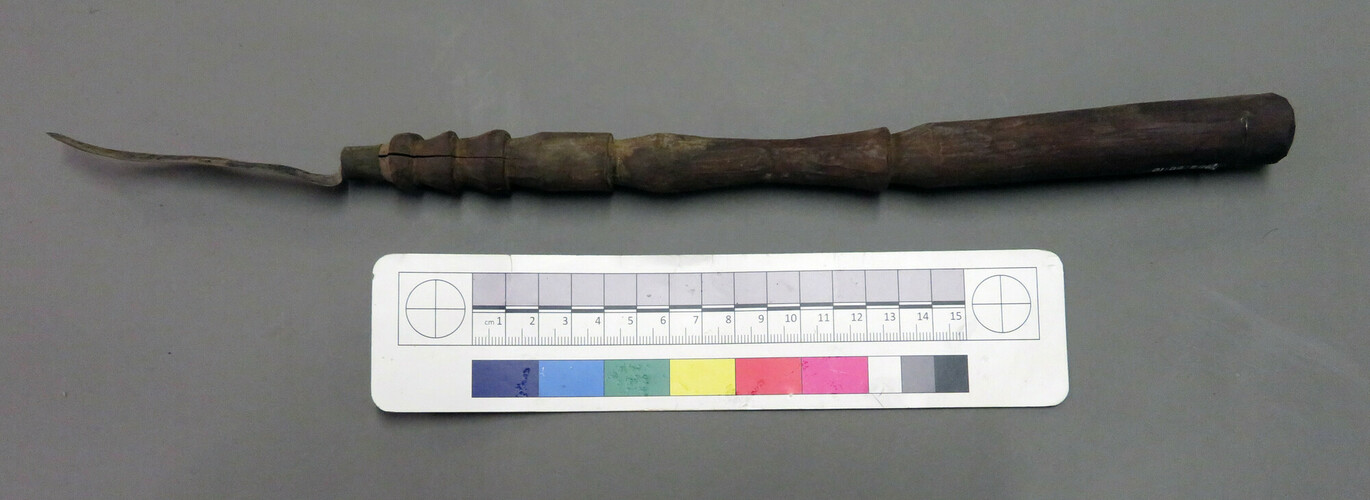 1905.60.10Weapon used in devil-dances. ?Stave with a serpentine metal blade, the tang is set into a wooden shaft. The shaft is carved with bands. [AB [OPS move] 22/1/2018]1905.60.10