
- Collection type
- Object
- Description
- Wooden face from a mummy casing. It is roughly carved and oval in shape but square at the top with a projecting, triangular nose. The eyes and mouth are defined by grooves and there are some traces of black paint on the eyes. [JC [OPS Move] 26/5/2017]
- Date / Period
- Date made: Circa 30-305 BC Archaeological period: Ancient Egyptian Archaeological period: Greco Roman
- Date collected
- 1889
- Acquisition information
- Donated: 1889
- Materials and processes
- Material Wood Plant, Material Pigment, Process Carved, Process Incised, Process Padded
- Dimensions
- Width: max 220 mm, Height: max 258 mm, Depth: max 68 mm
- Object numbers
- Accession number: 1889.27.87
- Research and responses
The labels attached to these objects state the masks are XXII Dynasty, but these are in fact Ptolemaic. [AS 26/04/2010]
- Associated publications
- Petrie, W.M.F. 1890. Kahun, Gurob and Hawara (London). [AS 06/07/2012] Referred to on page 136 of 'Greco-Roman Egypt', by Christina Riggs, in World Archaeology at the Pitt Rivers Museum: A Characterization, edited by Dan Hicks and Alice Stevenson (Oxford: Archaeopress, 2013), pp. 115-121. Riggs writes: ‘Accessioned in the same year and noted to also be from ‘Lahun, Gurob’ are a series of 11 crudely-carved wooden faces (1889.27.78–88), which would have been pegged/dowelled onto coffins or half-length covers for mummies. Very similar objects from the same excavation are now accessioned into the Petrie collection.5 Although often recorded to be of Ptolemaic date, an earlier Third Intermediate Period dating is also possible and there are similar flat examples from Thebes, taken from coffins dating to the Roman Period thus extending their possible date range.’. [MJD (Verve) 21/1/2016]
Further items to explore
 1886.2.58.12A ceramic figure from a necklace found around the neck of Mummy I. See [1886.2.58 .2 - .5] for 4 nuts, [1886.2.58 .6 - .11] for 6 other figures and [1886.2.58 .13 for a ceramic bead.1886.2.58.12
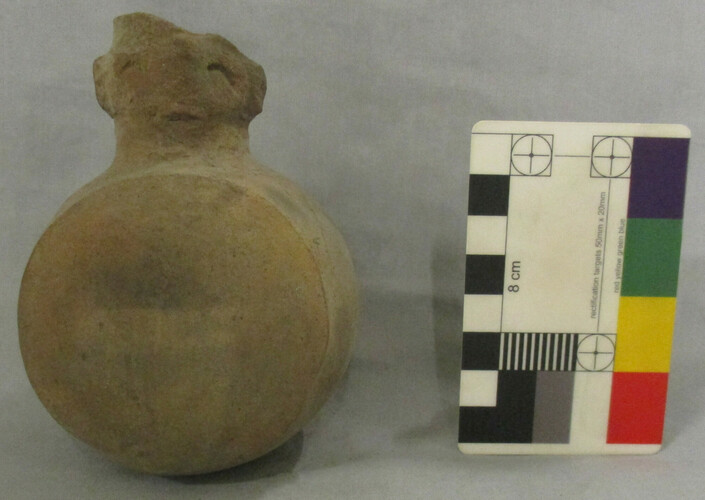 1886.2.112Redware pottery vessel with round body and flat sides. [MOBB [OPS move] 16/03/2016]1886.2.112
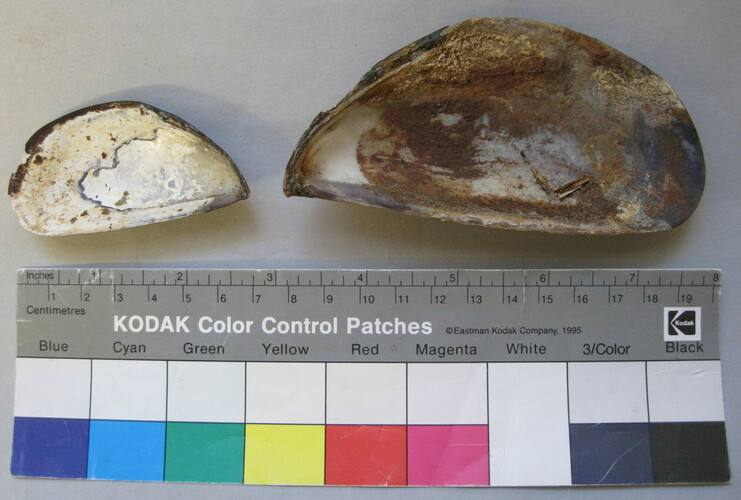 1886.2.93.1Mussel shell containing resinous substance. [FB 14/08/2013]1886.2.93.1
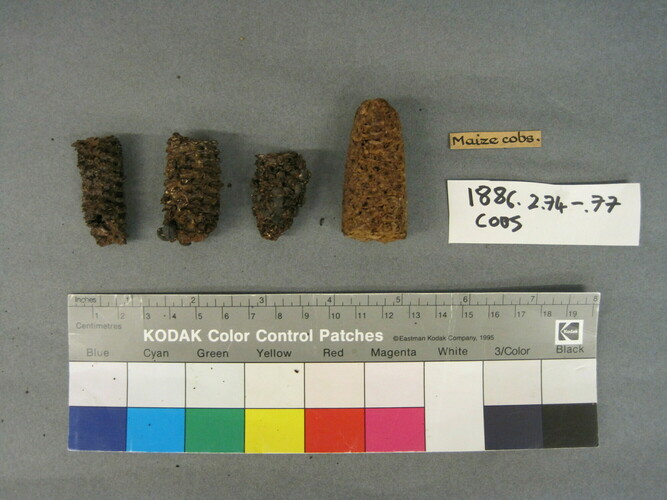 1886.2.74Pointed end of a corncob. [MOBB [OPS move] 26/9/2017]1886.2.74
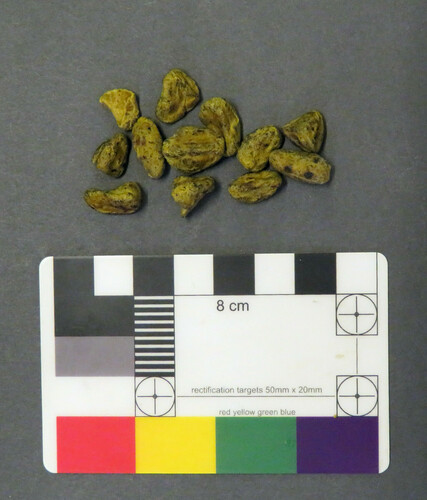 1985.54.3227Amulet. Pellets, numbering twelve, all broken - so it is impossible to know actual original number. Yellow in colour. [ASh [OPS move] 13/12/2017]1985.54.3227
 1985.54.501.3Amulet; one of four cowrie shells. For the other shells see 1985.54.501 .1, .2 & .4 [ASh [OPS move] 23/08/2017]1985.54.501.3
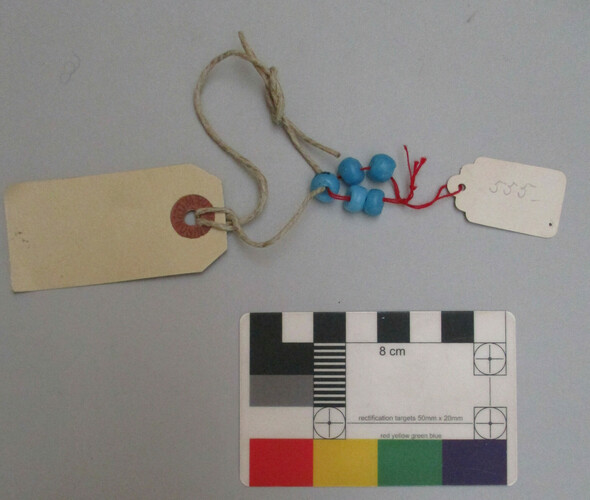 1985.54.152Amulet. Five circular blue glass beads, each one with a perforation in the centre. [BH [OPS Move] 28/2/2017]1985.54.152
 1985.54.1837.2Amulet; One of two pellets, green in colour, made from an unknown substance. Triangular in shape. For the other pellet see 1985.54.1837 .1 [ASh [OPS move] 13/09/2017]1985.54.1837.2