
- Collection type
- Object
- Description
- Potato carried by Henry Hopkins in his coat pocket as a cure for rheumatism.
- Geographical reference
- England Bedfordshire Leighton Buzzard
- Cultural groups
- English
- Date / Period
- Date made: Before 1894
- Date collected
- 1894
- Acquisition information
- Donated: 07/12/1894
- Materials and processes
- Material Potato Starch Plant
- Dimensions
- Length: max 40 mm
- Object numbers
- Accession number: 1894.46.1
- Research and responses
Research by Anne-Marie Condé found that carrying a potato in one’s pocket was a Victorian-era cure for rheumatism. Exactly how this was thought to work is unclear but it was commonly believed that the potato had to have been stolen for it to be effective. A person was to carry the potato in their left pocket if they were right-handed. Further information, including reference to another potato in the PRM collection (1897.83.3), can be found in the following essay: https://insidestory.org.au/john-curtins-potato/
The address of the Roebuck is 2 Hockliffe Street, Leighton Buzzard, Bedfordshire [AP 21/09/2006]
See publications below:
By atrupine Ettlinger presumably meant atropine OED online: a. A poisonous alkaloid found in the Deadly Nightshade and the seeds of the Thorn-apple. (as potatoes are related to deadly nightshade, I believe.) The poison in potatoes actually seems to be solanin or solanine:
http://en.wikipedia.org/wiki/Solanine: Solanine is a glycoalkaloid poison found in species of the nightshade family. It can occur naturally in any part of the plant, including the leaves, fruit, and tubers. It is very toxic even in small quantities. Solanine has both fungicidal and pesticidal properties, and it is one of the plant's natural defenses. ... Solanine and chaconine are present in potato shoots. In potato tubers 30–80% of the solanine develops in and under the skin and thus may be removed by peeling and removing the eyes. This is advisable if the tubers show green, but is not a guarantee of safety. Potato greening strongly suggests solanine build-up although each process can occur without the other. A bitter taste in a potato may be a more reliable indicator of toxicity. ... Solanine has fungicidal and pesticidal properties, and solanine hydrochloride (a modified version of solanine) has been used as a commercial pesticide, but never on a large scale.
Solanine has sedative and anticonvulsant properties, and has been used as a treatment for asthma, as well as for cough and cold medicines. However, its effectiveness for either use is questionable.
http://library.thinkquest.org/C007974/1_1pot.htm: This plant was the potato, which contains the poisonous glycoalkaloid solanine in all its parts but mostly in the blossoms and in the fruit. Its content is extremely high when tubers are unripe or green as a result of incorrect storrage but they cannot cause poisoning because solanin decomposes when boiled.
Only the fruit, blossoms, seeds, sprouts, and sun-greened tubers may be dangerous.
They can bring about stomachache, nausea and vomiting, dizziness, psychic depression, breathing disruptions, irregular pulse and even coma in the case of high dose intake and lack of therapy.
Bearing in mind the application of the potato in our everyday life, we should not expect it to have found application in medicine [AP 27/09/2006]
- Associated publications
- Mentioned in Ellen Ettlinger, Folklore vol 54, no. 1, (March 1943) pp 227-249, 'Just as crampnuts, "the woody out-growths, common on beech- or ash-trees were carried in the pocket as a cure for cramp," potatoes were frequently worn against rheumatism. Some examples, used by Oxford citizens about 1900, can be found in the Pitt Rivers Museum together with the name of their owners, which I do not like to reveal, because the potatoes had to be stolen, if they were to prove curative. I am indebted to Mr James Walton for the information that "atrupine, a reputed cure for rheumatism is found in potato "Eyes" which renders some justification for the belief."[ MS "Charms against Evil and Illness" p 4]' [p.238]
Further items to explore
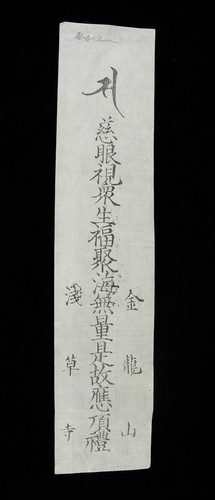 1908.82.446Amulet with prayers written in Kanji (Chinese characters) printed on it in black ink, with the Sanskrit letter "Sa" at the top. [SM 07/10/2008]1908.82.446
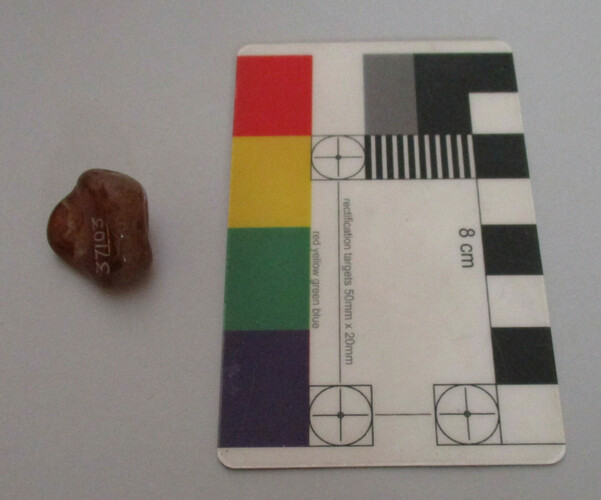 1985.54.868Amulet. Stone. Orange in colour, highly polished and semi-transparent. Some chips to the surface. [EH [OPS move] 7/3/2017]1985.54.868
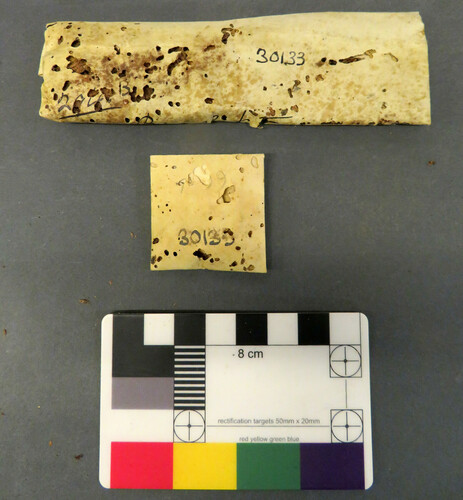 1985.54.2970Amulet, mixture of plant fibre and seeds in paper envelope. Has been eaten by pests. [AF [OPS Move] 30/11/2017]1985.54.2970
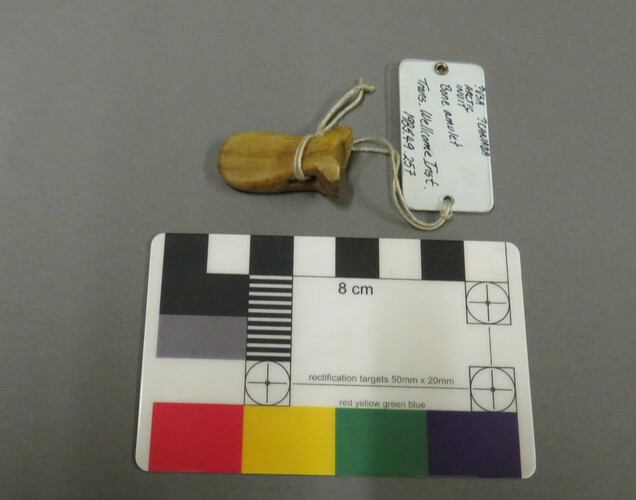 1985.49.257Carved bone amulet with roughly oblong base with two faces that taper to form a single rounded edge. Triangular perforation through the sides for suspension. [ILL [OPS move] 3/10/2017]1985.49.257
 2018.220.16Leeds shirt [COB 13/9/2018]2018.220.16
 1884.137.23.88Ceramic sherd1884.137.23.88
 1900.3.10Natural flint resembling monkey's head. [FB 08/11/2013]1900.3.10
 1951.13.717Key with ornamental scroll bow, fluted stem and complicated twin bit, with inscription on the stem. [El.B 08/04/2009]1951.13.717