
- Collection type
- Photograph
- Description
- Two elderly men at Bayt Abud workshop beat indigo-dyed cloth with heavy wooden mallets to make it stiff and shiny. They each wear a white, indigo-stained loincloth and kneel on a basketry mat, with the cloth laid over a log between them.
- Person
- Expedition or compiler Jenny Balfour-Paul
- Photographer Jenny Balfour-Paul
- PRM source Jenny Balfour-Paul
- Date / Period
- Date of photograph: 1989
- Acquisition information
- Donated: 14/05/2018
- Photographic process
- Black & White
- Dimensions
- Image dimension 35 mm
- Object numbers
- Accession number: 2018.137.2279
- Research and responses
The town of Zabid in the Tihama region of Yemen had been an important centre of the indigo dyeing industry from Medieval times, and even in the 1940s there were still over a hundred dyeing establishments in the town. By the Balfour-Pauls’ first trip there in 1983 only two of these remained – Bayt Muhammad Ali Abud and Bayt Ahmad Sa’d al-Hakami – and by 1989 Bayt Abud was the sole survivor. It was a desire to record the dyeing industry in this area that led Jenny Balfour-Paul to pursue her in-depth research into indigo. Balfour-Paul, J., 1997. Indigo in the Arab World. Richmond: Curzon, p.90. [JMC 18/08/2020]
This part of the process, undertaken after the dyeing with the indigo dye vat had been completed, is described by Balfour-Paul: "Finally, yet more neat indigo paste was rubbed into the cloth with a towelling brush...before the beaters, elderly men working in pairs, beat the cloth with heavy wooden mallets (made of tamarind and weighing at least 18 kilos) until it shone... The beaters had an array of mallets at their disposal, chosing [sic] the heaviest ones when feeling most energetic." Balfour-Paul, J., 1997. Indigo in the Arab World. Richmond: Curzon, pp.91-92. [JMC 18/08/2020]
For a wooden indigo beater with broken handle, collected by Jenny Balfour-Paul from Bayt Muhammad Ali Abud in 1983, see 2018.37.102. [JMC 18/08/2020]
- Associated publications
- This photograph is published as Plate 9(a) in Indigo in the Arab World by Jenny Balfour-Paul. The caption reads: "Beating the indigo-dyed cloth with heavy wooden mallets to make it stiff and shiny, Bayt 'Abud, Zabid, Yemen; December 1983..." Balfour-Paul, J., 1997. Indigo in the Arab World. Richmond: Curzon. [JMC 12/11/2020] This photograph is reproduced in black and white on p. 133 of Jenny Balfour-Paul's Indigo: Egyptian Mummies to Blue Jeans. The caption reads "Beating indigo-dyed cloth with heavy wooden mallets to make it stiff and shiny. Zabid, Yemen, 1989." Balfour-Paul, J., 2011. Indigo: Egyptian Mummies to Blue Jeans. London: British Museum. [JMC 12/11/2020]
Further items to explore
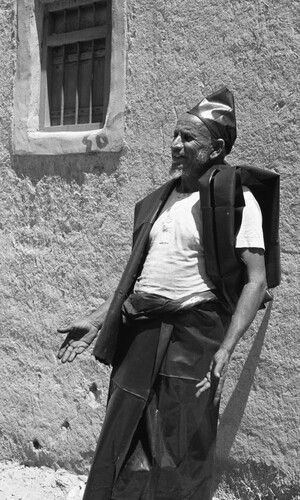 2018.137.2308Portrait of Abdullah Nasi Shu'ban, indigo dyer, demonstrating the wearing of indigo cloth. He wears shiny indigo-dyed cloth around his shoulders, wrapped around his waist, and as a pointed cap. He poses in front of a wall.2018.137.2308
 2018.137.1454Three boys play in small wooden boats on the Nile at Aswan. Two of the boats are filled with pink and purple flowers, while the other has strings of pink, red, orange and white flowers hanging from a short wooden mast.2018.137.1454
 2018.137.1627Two men lead a number of dogs along a path to a market. The men each wear a conical woven hat.2018.137.1627
 2018.137.303Sidi Moussa tannery. Many large stone vats are filled with different coloured dyes, while some are filled with a softening white liquid. Animal hides are hung along the walls to dry.2018.137.303
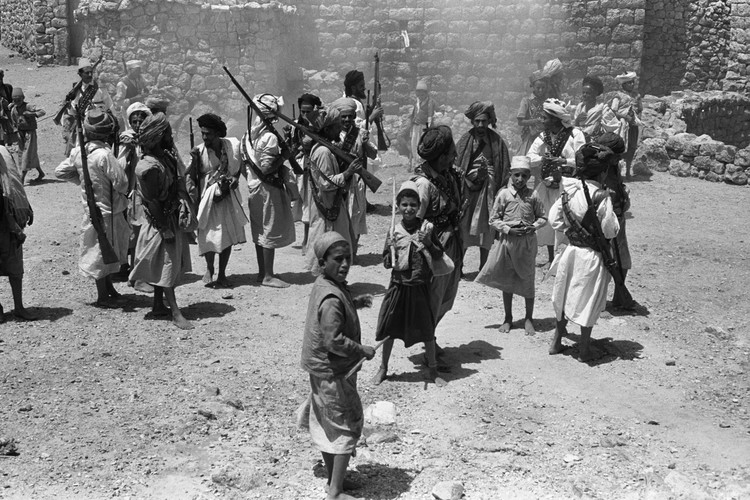 2004.130.5972.1View of a group of men and boys with riffles.2004.130.5972.1
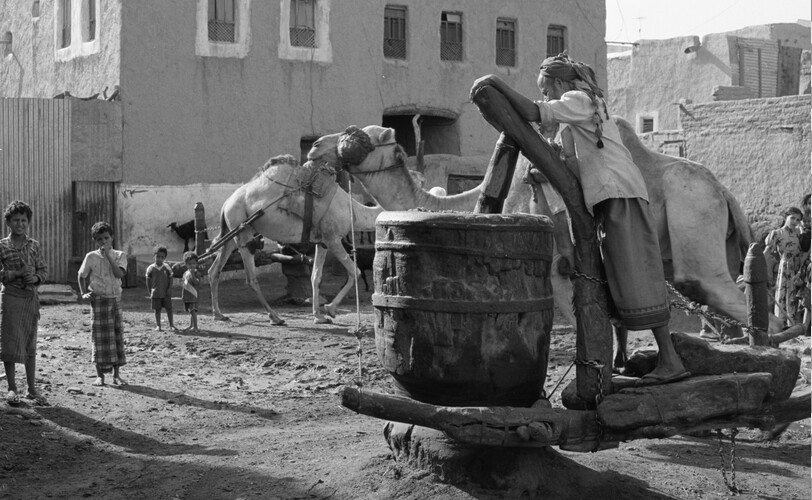 2018.137.2320A camel-powered sesame oil press in a courtyard in Beihan. A tethered and blindfolded camel is pictured walking in a circle around a large vat of sesame seeds, operating the wooden grinding mechanism. A man stands of on a part of the apparatus. Another camel with sesame oil press is pictured in the background. Several children look on.2018.137.2320
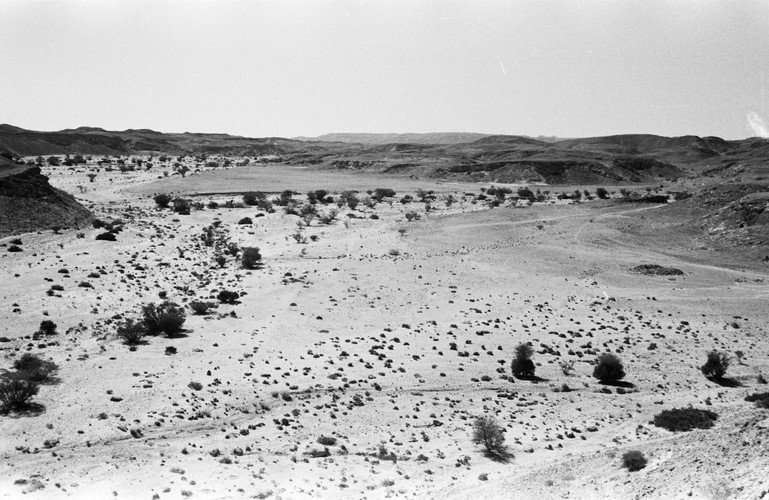 2004.130.3073.1Landscape of a gravelly dry riverbed in the Wadi Shalhamit. The riverbed is covered with sparse shrubbery and mountains can be seen in the distance.2004.130.3073.1
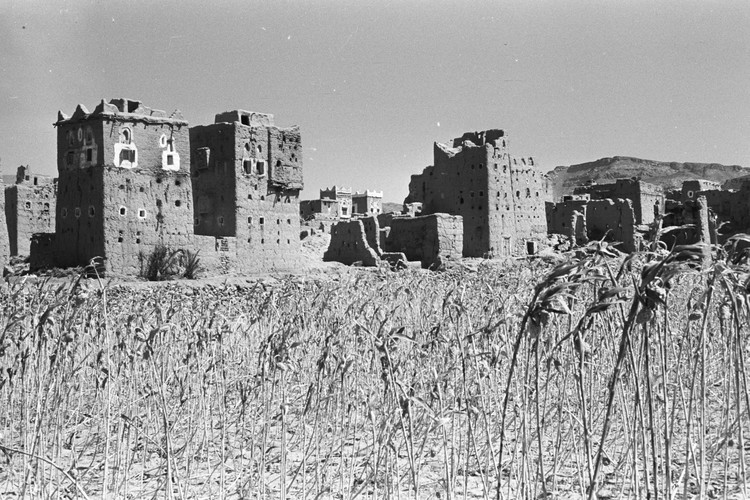 2004.130.8869.1View of a town of large multistoried buildings.2004.130.8869.1