
- Collection type
- Photograph
- Description
- A former indigo dyer demonstrates his old technique in an Aleppo dyeshop. He appears to dip an indigo-dyed cloth into a large stone vat.
- Person
- Expedition or compiler Jenny Balfour-Paul
- Photographer Jenny Balfour-Paul
- PRM source Jenny Balfour-Paul
- Date / Period
- Date of photograph: 1985
- Acquisition information
- Donated: 14/05/2018
- Photographic process
- Transparency Colour
- Dimensions
- Image dimension 35 mm
- Object numbers
- Accession number: 2018.137.1045
- Research and responses
Jenny Balfour-Paul writes in Indigo in the Arab World that indigo dyeing in the Levant had completely died out by the 1980s, although she adds it was easy to visualise the former prominence of the indigo-dyeing establishments of Aleppo and Damascus during this 1985 visit. She writes that "In the city of Aleppo, where as many as sixty dyeworks were recorded just before the First World War, there were numerous dyeing areas, the most important extending along the entire length of the Suq as-Sabbaghin. In one surviving dyeshop in 1985 could be seen an outsize stone vat, probably used for soaking the cloth..." Balfour-Paul, J., 1997. Indigo in the Arab World. Richmond: Curzon, p.99. [JMC 07/09/2020]
Further items to explore
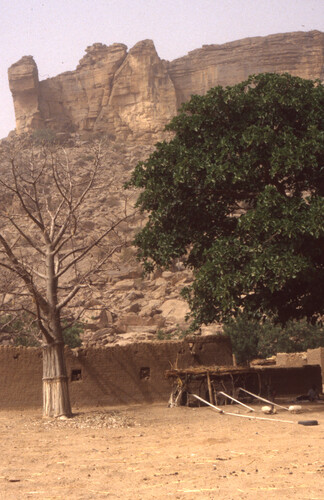 2018.137.1739A weaving hut in Enndé village, with the Bandiagara escarpment towering up in the background. Three weavers work on narrow strip looms with very long warp threads.2018.137.1739
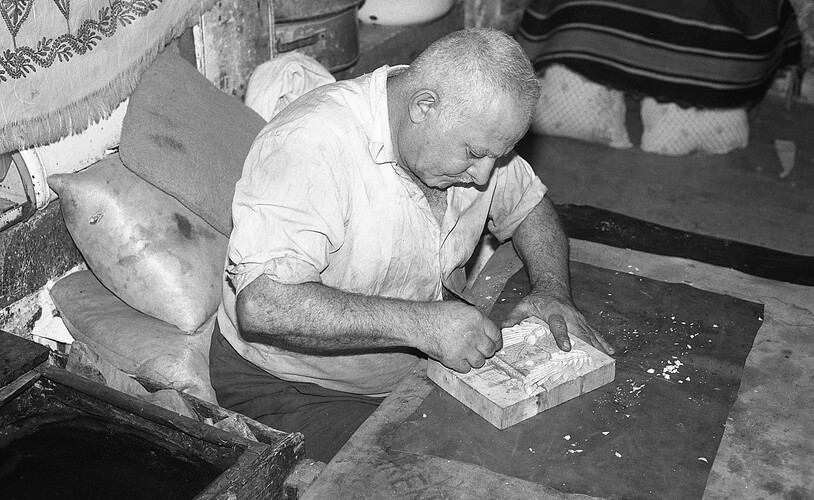 2018.137.2051Alkarim Watter carves a wooden fabric printing block with a large eagle design.2018.137.2051
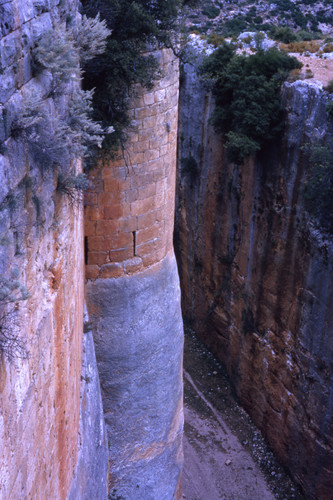 2018.137.44View of the moat at Sahyun Castle. A deep gorge carved in the rock, with the ramparts of the castle on the inside.2018.137.44
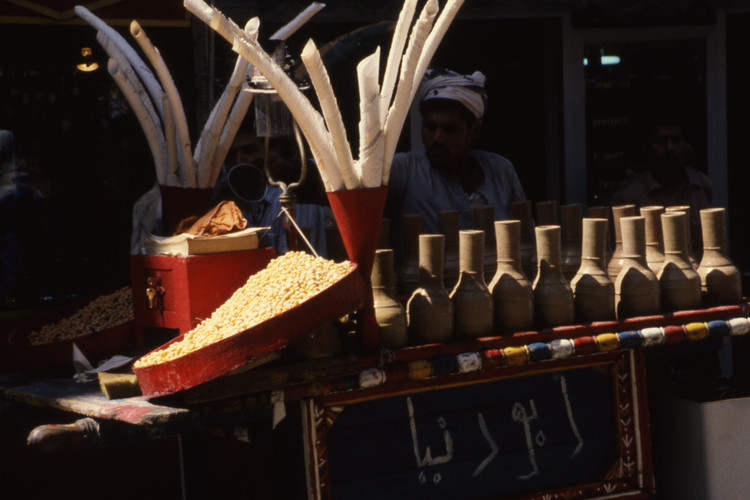 2018.137.1312View of a cart selling beans. Two piles of beans are pictured at the front of the cart, with two cones containing tall stacks of paper cones. Behind this are rows of jars with tall, narrow necks.2018.137.1312