
- Collection type
- Object
- Description
- Arrow consisting of a wooden shaft on to which two, presumably, chert microliths were formerly set in mastic. [JC 1 8 2003]
- Geographical reference
- Person
- Field collector Wilhelm Heinrich Immanuel Bleek
- PRM source Oxford University Museum of Natural History
- Date / Period
- Date made: 1870-1875, uncertain Date made: 1870-1880
- Date collected
- Early 1870s
- Acquisition information
- Transferred: 1886 Found unentered: 1989
- Materials and processes
- Material Chert Stone, Material Resin Plant, Process Flaked
- Dimensions
- Length: max 224 mm, Width: max 18 mm
- Object numbers
- Accession number: 1887.1.704
- Research and responses
Until 1999, there was only one computerized entry for the six arrows (1887.1.700-.705). This read as follows: 'By comparison with other specimens, Clark assumed that these pieces were made in Cape Town by a San Bushman for Dr. W. H. I. Bleek in the 1860s and donated by him to the University Museum (Clark: 135). They all originally consisted of microliths set in mastic and mounted on wooden foreshafts. Some of the microliths are now missing. .700-702 are marked "BUSHMAN, SOUTH AFRICA. July 1875. University Museum" and a label with these states "University Museum 1875. Trasnferred 1886." These 3 were found unentered and accessioned in June 1987. .703-705 were found unentered in Donald Tayler's office in October 1989, and accessioned in November 1989. .703-705 are marked "BOJESMAN, SOUTH AFRICA. A.D.", but also have remains of stick-on paper labels with "Bushman Arrow" written in the same hand as on 700-702. .700: 2 chert microliths set in mastic. .701: previously resembled .700, but both chert microliths were lost during X-raying at the Ashmolean Museum for Desmond Clark's paper. .702: previously had 2 green glass microliths, one of which was lost. .703: 2 chert microliths set in mastic. .704: Microliths missing. .705: 1 microlith present, 1 missing.' [JC 1 8 2003]
These three arrows (1887.1.703, 1887.1.704, 1887.1.705) are thought to have been collected by Bleek and given to the OUMNH in 1875 along with 1887.1.700, 1887.1.701, and 1887.1.702. The evidence for this is that when they were found unentered in 1989 they bore labels in the same hand as those on 1887.1.700, 1887.1.701, and 1887.1.702. [JC 29 7 2003]
According to Deacon and Deacon (see above, page 157), it was in 1870 that 'Dr Bleek asked one or more of the men he interviewed in the Breakwater Prison in 1870 to make some arrows for him'. Deacon and Deacon (pages 157ff ) go on to give a detailed description of the method of manufacture, poison used, etc. [JC 29 7 2003]
This object was looked at by Margaret Veall (D.Phil Candidate, School of Archaeology, University of Oxford) and Justin Pargeter (Stony Brook University). The visit took place July 17th 2015. [NC 23/07/2015]
- Associated publications
- Two (1887.1.700 and 1887.1.702) of these six arrows (1887.1.700-.705) are Illustrated in close-up detail in the right-hand image of Fig. 8.24 on page 159 of Human Beginnings in South Africa: Uncovering the Secrets of the Stone Age, by H. J. Deacon and Janette Deacon (Walnut Creek, CA: Altamira Press, 1999). The left-hand image illustrates 'arrows made by /Xam men for Dr Bleek in Cape Town in the early 1870s' in the collections of the South African Museum. The caption for the PRM arrows (same page) reads: 'Close-up of the tips of two of the arrows (Pitt-Rivers [sic] Museum collection). Note the mastic (gum) holding the stone inserts on the left [1887.1.700]. One of the inserts has fallen out of the mastic in the example on the right [1887.1.702]. The remaining insert has been blunted like the stone segments typical of the Wilton industry.' [JC 29 7 2003
Search terms: Tool, Archery Weapon, Arrow
Further items to explore
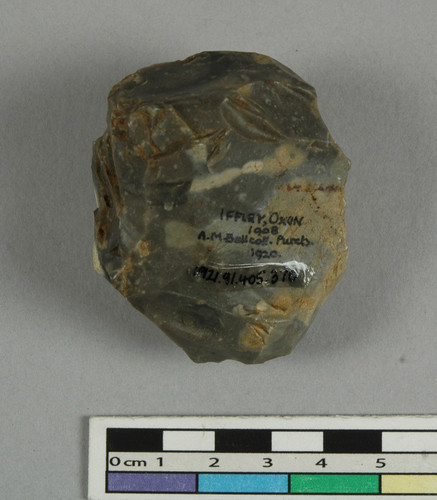 1921.91.405.370Flint core, mid grey in colour, irregular shaped. [MJD DDF Body Arts Project 2010/2011 16/02/2011]1921.91.405.370
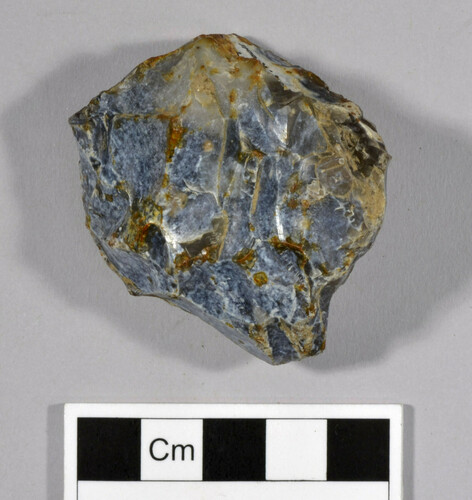 1884.140.1318Stone core1884.140.1318
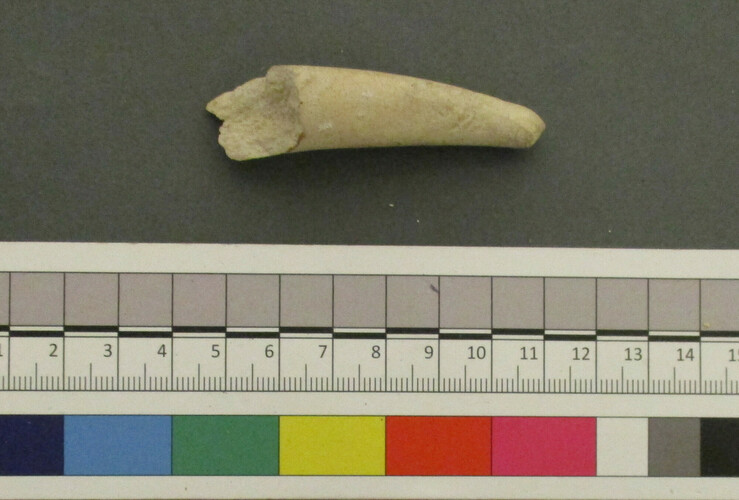 1935.46.13.21Deer antler tine fragment with worked tip. [CW [OPS Move] 15/5/2017]1935.46.13.21
 1935.13.106.92Yellow-grey stone flake. [LKG 19/05/2010]1935.13.106.92
 1952.12.23.16Ostrich eggshell bead, disc shaped with central hole. [MJD 04/08/2010]1952.12.23.16
 1935.13.106.252Red brown stone flake with an almost square outline save for curved edge. With lighter yellow-ochre veins of colour. [LKG 25/05/2010]1935.13.106.252
 1952.5.93.32Half a disc shaped ostrich eggshell bead. The bead is broken across the central hole. [MJD 05/08/2010]1952.5.93.32
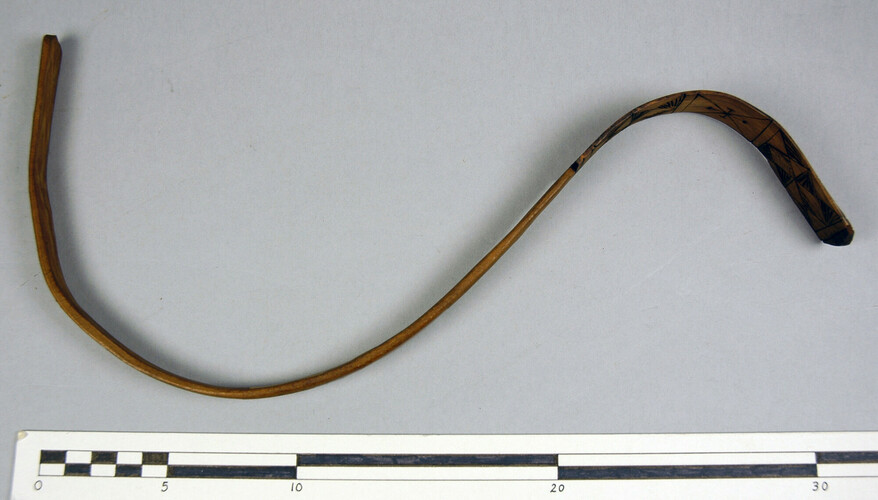 1891.50.14Strigil. An s-shaped piece of wood with rounded ends, narrower at one end than the other and burnt decoration at the wide end. Used for scraping sweat or dirt from the skin. [JP 26/10/2001]1891.50.14