
- Collection type
- Object
- Description
- Flint blade with parallel lateral edges and parallel ridges along the dorsal face resulting from flake removal. [MN 02/12/2008]
- Long description
- Flint blade with parallel lateral edges and parallel ridges along the dorsal face resulting from flake removal. The flint is a medium grey colour. There is little patina, the edges feel sharp and the blade does not appear 'rolled' or too weathered. [MN 02/12/2008]
- Geographical reference
- England Oxfordshire West Oxfordshire Standlake Brighthampton
- Person
- Maker Unknown Maker
- Field collector Mr Barter
- PRM source Oxford University Museum of Natural History
- Date / Period
- Archaeological period: Neolithic
- Date collected
- 1875?
- Acquisition information
- Transferred: 1886
- Materials and processes
- Material Flint Stone, Process Flaked
- Dimensions
- Thick: max 5 mm, Length: max 60 mm, Width: max 14 mm
- Object numbers
- Accession number: 1887.1.430.1
- Research and responses
http://www.gla.ac.uk/archaeology/resources/Anglo-Saxon/cemeteries/bright.html [please note this link was found to be dead on 02/12/2008, MN]: The cemetery at Brighthampton was discovered in 1857 by workmen demolishing a malthouse [Akerman 1857, 1860]. Akerman excavated 54 graves containing 59 individuals and also 10 cremations during 1857. In some cases, graves contained more than one burial, and in two instances (Akerman's graves 9 and 32) these appear to have been double inhumations. In the remaining cases, (Akerman's graves 13, 40, and 44), earlier burials were disturbed by later burials, but these are given the same grave number. Akerman, J.Y. 1857. Researches in a Cemetery of the Anglo-Saxon Period at Brighthampton, Oxon. Archaeologia 37: 391-398. Akerman, J.Y. 1860. A Cemetery of the Anglo-Saxon Period at Brighthampton, Oxon. Archaeologia 38: 84-97. [AP 05/12/2006].
The articles mentioned above [Akerman 1857 and 1860] make no mention of any flint blades. If flint blades 1887.1.430 .1 - .9 were found during Akerman's excavations then they were most likely recovered from the topsoil, subsoil or redeposited in a grave fill. The majority of the Akerman Brighthampton excavation archive is held by the Ashmolean Museum. For more detail on the Anglo-Saxon objects please see http://www.ashmolean.org/ash/amps/leeds/AS_Oxfordshire/brighthampton/brighthampton_index.html. [MN 02/12/2008]
Percy Manning in his survey of Oxfordshire in 1921 [page 256] mentions several archaeological finds and sites in Brighthampton including the Anglo-Saxon cemetery excavated by Akerman in the mid 19th Century. Flint blades 1887.1.430 .1 - .9 are not specifically mentioned however. A copy of the article is in RDF: Researchers File: Manning. Full article reference: Manning, P and Leeds, E. T. 1921. An archaeological survey of Oxfordshire. Archaeologia 71: 227-265. [MN 02/12/2008]
For general information on the Museum's collections of Oxfordshire archaeological material including lists of sites, grid references etc see Archaeological Material from Oxfordshire in the Collection of the Pitt Rivers Museum by Simon Thorpe, this is an unpublished spiral bound report dated June 1996 [copy in RDF: Researchers File: Thorpe]. [MN 02/12/2008]
- Associated publications
- This object was mentioned in Archaeological Material from Oxfordshire in the Collection of the Pitt Rivers Museum by Simon Thorpe. This is an unpublished spiral bound report dated June 1996 on the Museum's collections of Oxfordshire archaeological material including lists of sites, grid references etc [copy in RDF: Researchers File: Thorpe]. [MJD (Verve) 7/6/2017]
Search terms: Tool, Weapon, Blade Flake
Further items to explore
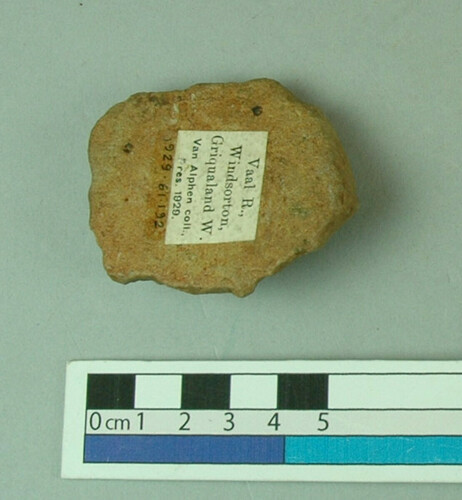 1929.61.192Stone tool, orange brown in colour with uneven edges. Two dark brown indented circles on ventral surface. [LKG 12/05/2010]1929.61.192
 1935.13.106.32orange brown stone flake. [LKG 19/05/2010]1935.13.106.32
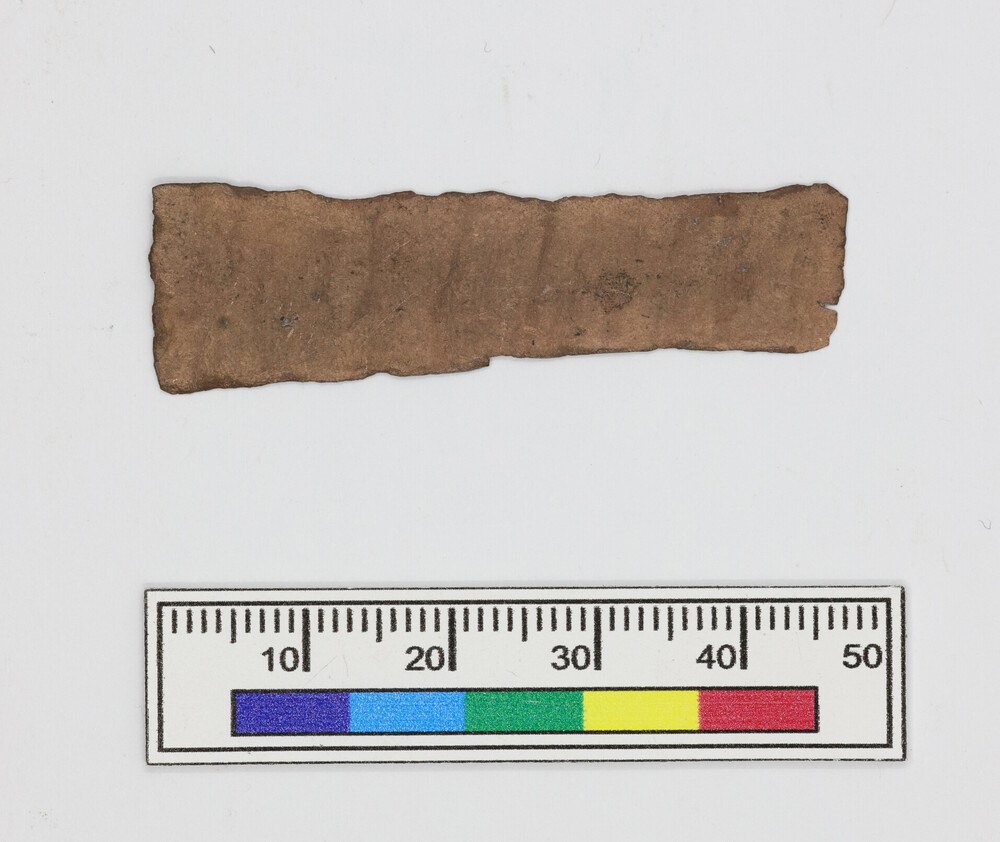 1901.42.115.3Copper adze.1901.42.115.3
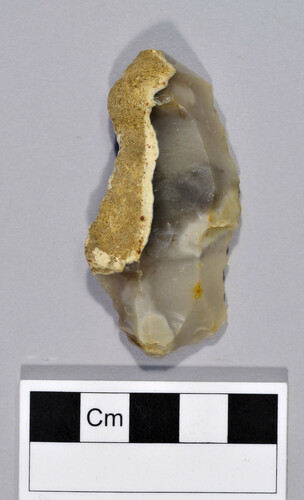 1884.123.467.9Stone blade flake1884.123.467.9
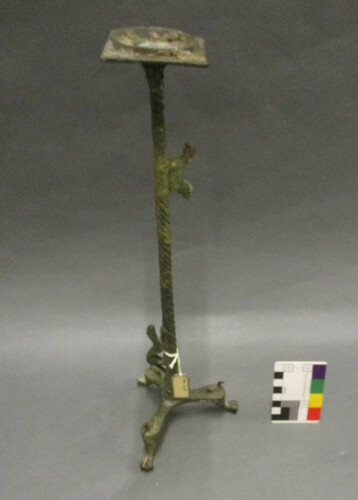 1884.116.95.1Lamp stand of bronze with three feet. The feet of the stand are lion's feet with ducks on the top of each. The stem is twisted and has a weasel and hen attached. Found with a [1884.116.95 .2] lamp and [1884.116.95 .3] metal disc. [BA [OPS move] 3/5/2017]1884.116.95.1
 1932.88.737.2Iron drip pan for use with lamp [1932.88.737 .1]. Open, shallow, pointed oval pan with flat bottom and expanding sides. Bent and curved arm at the back with notched projection just above the pan. Arm ends in a plate with circular sections either side of a double notched section. Hook with long, perpendicular spike attached via swivel hook behind the plate. [MOBB [OPS move] 24/5/2017]1932.88.737.2
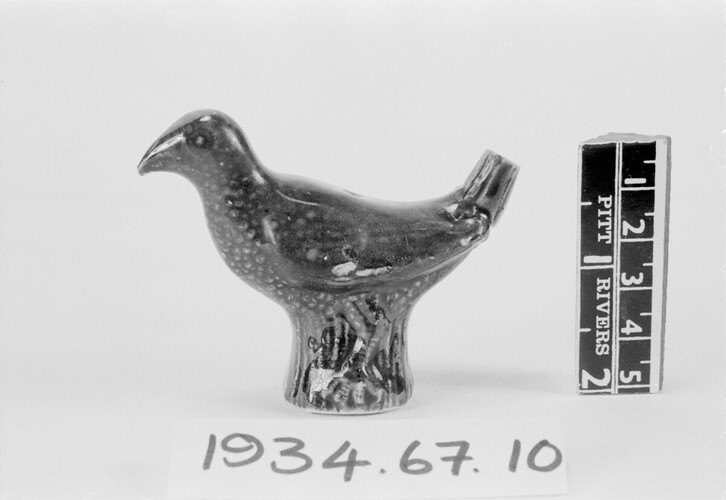 1934.67.10Porcelain 'cuckoo whistle', imitating the cuckoo's notes. One finger hole. Glazed brown.1934.67.10
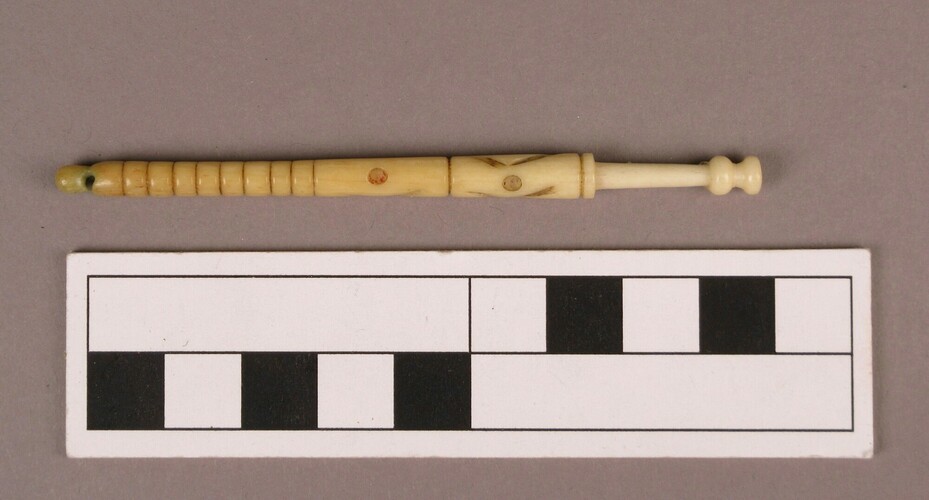 1955.6.11.57Bone bobbin with small traces of red pigment remaining in the decorative, drilled holes. The spangle is no longer present. [JFK 4/10/2018]1955.6.11.57