
- Collection type
- Object
- Description
- Curved and thick shell fish hook with barb bound to string line.
- Date / Period
- Date made: Before 1870
- Date collected
- By 1870
- Acquisition information
- Transferred: 1886
- Materials and processes
- Material Shell, Material String, Process Carved, Process Bound, Process Twisted
- Dimensions
- Width: max 44 mm hook, Length: max 44 mm hook
- Object numbers
- Accession number: 1887.1.39
- Research and responses
It is possible that this fish hook is one of the ones collected by Samuel J. Whitmee and given to University Museum via George Rolleston see 1887.1.469-471, 474-5 [AP 04/09/2012]
- Associated publications
- Illustrated with 1887.1.38 and 1887.1.40 in Figure 11 (line drawing) on page 26 in Fish Hooks (Pacific Island Records), by Harry G. Beasley (London: Seeley, Service & Co., Ltd, 1928). Beasley writes (page 26-27) under the heading 'Part I. Polynesia' and sub-headings 'Ellice Group' and 'Hooks of Pearl Shell in One Piece': 'The use of this class of hook would, judged by its scarcity, appear to have been very restricted, even in the early days, and excepting the metal hooks made after the old forms, to have long passed out of use. Mr Hedley [footnote 1 refers to Hedley, The Atoll of Funafuti, Bulletin, No. 3, Sydney Museum, 1897, Part IV), when he visited Funafuti in 1896, failed to secure a single specimen, although one was seen in native hands, of which fig. 11a [sic; actually Fig. 11b] is a copy. He gives the name as "matau'tifa." Excepting this solitary example, I have only found three others, fortunately of undoubted authenticity, and I am indebted to Mr Balfour, of the Pitt Rivers Museum, Oxford, for permission to include them here. The close resemblance of these to that figured by Mr Headley [sic] is obvious, the sole difference being the position of [26/27] the outer barb, which may be a draughtman's error, or more probably due to the taste of the maker. Figure 11 shows a very good illustration of these hooks. Their excessive thickness is remarkable, the broken specimen in the centre [1887.1.39] showing this to advantage. The snoods are of unnecessary thickness, being composed of twisted hibiscus fibre (fo-tangata); these do not end in the customary loop, but by a knot, whilst the attachment of the snoods to the shanks is clumsy, being further whipped with brown fibre. That on the left [1887.1.38] still retains portions of the original feather hackle, an occurrence I have failed to find connected with this class of hook from other [island] Groups. The measurements are 1 7/16 in. (3.7 cm.) in length, while that on the right is 1 3/4 in. (4.5 cm.) long.' [JC 24 6 2016]
Search terms: Fishing, Hook, Fishing Accessory
Further items to explore
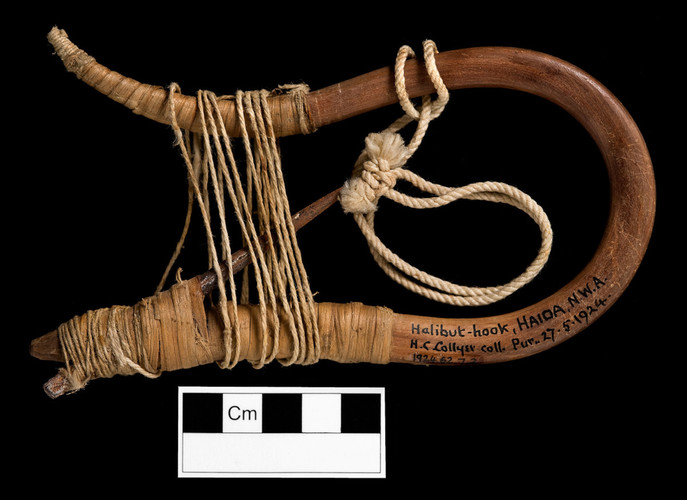 1924.62.7.2Wooden halibut hook with iron barb bound with cedar bark and string. [CAK 29/06/2009]1924.62.7.2
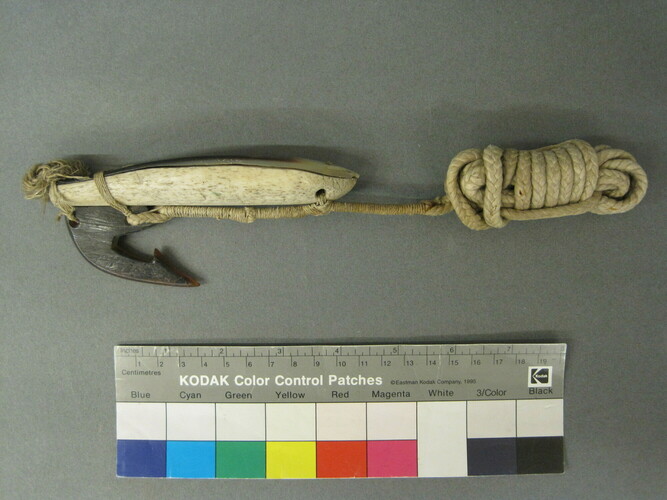 1886.1.1305Lure hook. The hook is made of turtle shell. The whale bone shank is faced with mother of pearl and the line is made of olona bark fibre. [JFK 18/2/2009]1886.1.1305
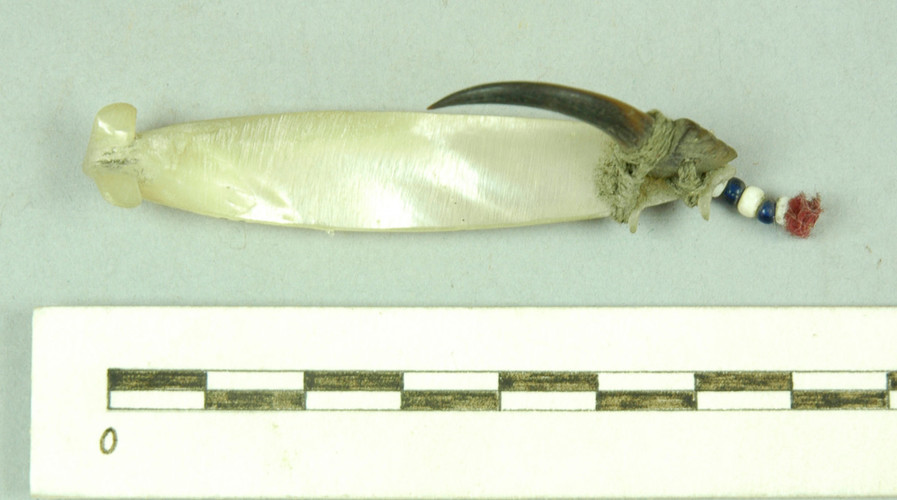 1926.23.35Fish hook of pearl shell shank and turtleshell hook with string of beads. [MJD 21/04/2009]1926.23.35
 1897.44.19.2Hanging hook for iron lamp [1897.44.19 .1]. [MOBB [OPS move] 23/2/2017]1897.44.19.2
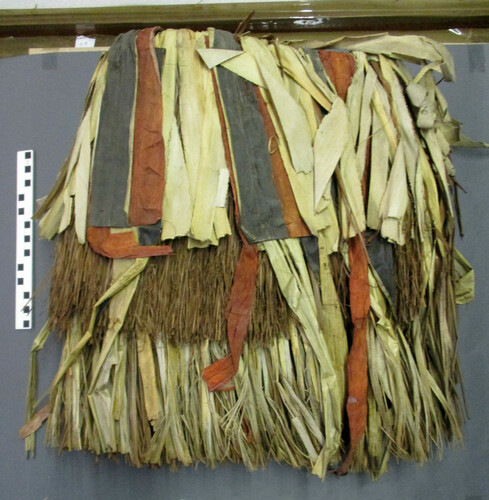 1893.40.7Plant fibre skirt in three layers of fringes finest in centre and broad streamers of red and natural and black on plaited fibre cord. [FB 19/02/2015]1893.40.7
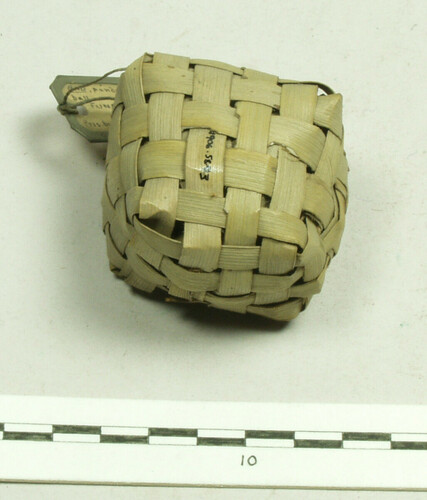 1906.58.93Plaited pandanus leaf ball for a catching game. [E.S-R 'DCF 2004-2006 What's Upstairs?' 11/1/2005]1906.58.93
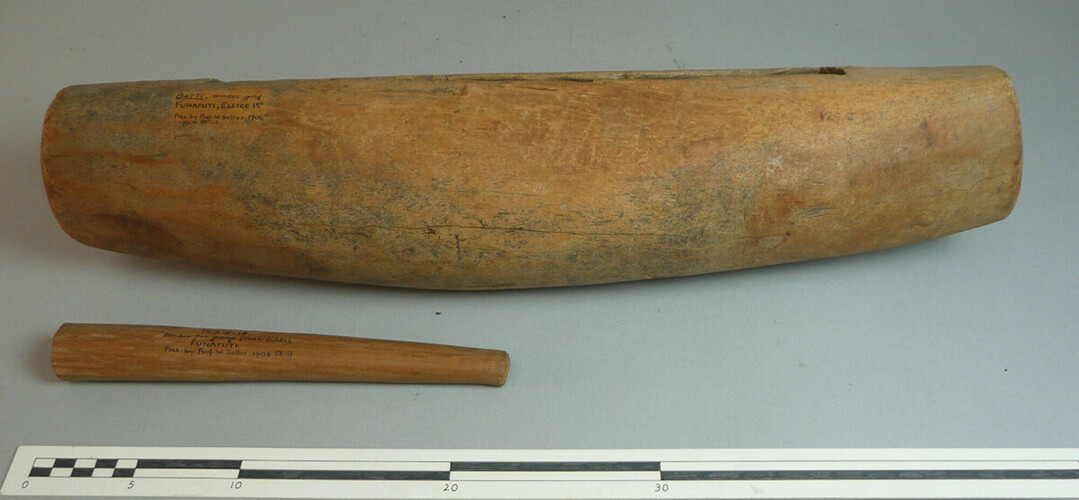 1906.58.112Wooden gong, hollowed with slit opening, and striker [1906.58.113]. [MJD 18/9/2008]1906.58.112
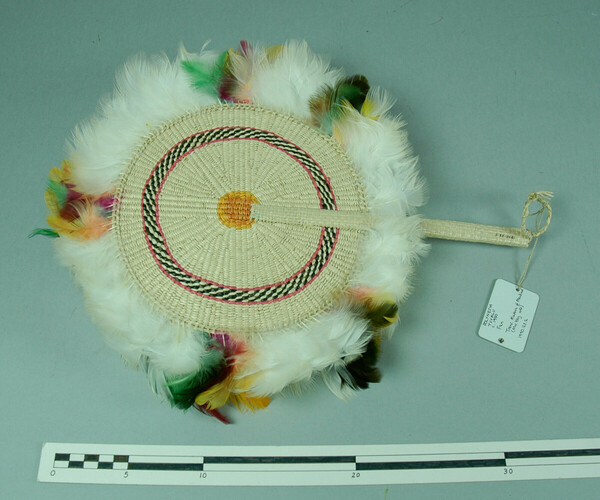 1990.23.2Circular fan woven of palm-leaf with a yellow circle at the centre and a border of feathers around the outer edge. [LKG 30/09/2009]1990.23.2