
- Collection type
- Object
- Description
- Gourd for mbira resonator.
- Geographical reference
- Person
- Field collector Unknown Collector
- PRM source Stephen Goldsmith
- PRM source Pitt Rivers Museum Shop
- Date / Period
- Date made: Before 1999
- Date collected
- By 1999
- Acquisition information
- Purchased: 1999
- Materials and processes
- Material Gourd Plant, Material Metal Wire, Material Metal, Material Rubber Plant, Process Recycled
- Dimensions
- Diameter: max 327 mm, Height: max 335 mm
- Object numbers
- Accession number: 1999.24.1
- Research and responses
It is likely that a form of mbira existed when the Shona people first settled on the Zimbabwean plateau in the 10th century. Archaeological evidence demonstrates that by the sixteenth century, when early European missionaries began to arrive, the mbira was already well established in the region.
Mbiras or sansas (the name varies by region) are traditional instruments from Zimbabwe and many archaeological examples have been found at the archaeological site Great Zimbabwe. To this day, mbiras are prolific instruments in Shona culture, coming in many different shapes, sizes, materials, soundboards, and methods of resonation. Mbiras are popular as personal instruments and are also played by specialist musicians during celebrations such as harvest, ceremonies such as weddings and funerals, and any other occasions that involve music in Shona culture. Many mbiras come with gourd resonators, with large gourds such as pumpkins and calabashes being a popular choice due to their round shape.
The Zimbabwean karimba, known as nyunga-nyunga in Shona, is a type of mbira with a small, flat soundboard and one to two rows of keys. Small karimbas are typically played to accompany a vocalist, whereas larger versions tend to be played at religious ceremonies. Some types of mbiras are primarily played for religious/spiritual purposes. One prominent example of this is the universally recognised (due to their introduction to the United States in the 1960s and 70s) mbira dzaVadzimu (meaning ‘of the ancestors’), which are traditionally used for Shona religious ceremonies and spiritual ceremonies, particularly by Zezuru people in central Mashonaland. They can be identified by their broader, heavier keys and a hole for the little finger in the right-hand corner of the soundboard. By contrast, njari mbiras are characterised by their slender keys. Another type of mbira with a differentiating key type is the mbira dzavaNdau (played by the Ndau people in the Chipenge region and Mozambique), which has bass keys on the left, with notes ascending to the right. In addition to varying numbers and widths of keys, mbiras can also come in a variety of unique shapes. For example, matepe or hera mbira (associated with the Korekore and Budya people) have soundboards that are carved to form a distinctive bell shape, with the keys curving around the body of the instrument. Similarly to mbira dzaVadzimu, the matepe/hera mbira are typically played at spiritual ceremonies.
During the colonial period, Europeans learned to play mbira from the locals in Zimbabwe along with taking many mbira back to Western Europe. This likely had an impact on the emergence of a European-style music notation system in Zimbabwe. In Zimbabwe and South Africa, mbira skills and songs are traditionally passed from person to person rather than in a formal learning environment. However, teaching methods began to change over time. For example, in the 1960s, expert player Jege Tapera began teaching karimba at the Kwanongoma College of African Music. Today, mbira are widely available to buy in music shops in Zimbabwe and can be studied in several university music departments across the globe.
Sources:
Professor Robert Nyamushosho (interview)
Jones, C. (1992). Making Music, Musical Instruments in Zimbabwe Past and Present, Academic Books Zimbabwe, pp. 110-113
Search terms: Music, Specimen, Technique, Musical Instrument, Lamellophone
Further items to explore
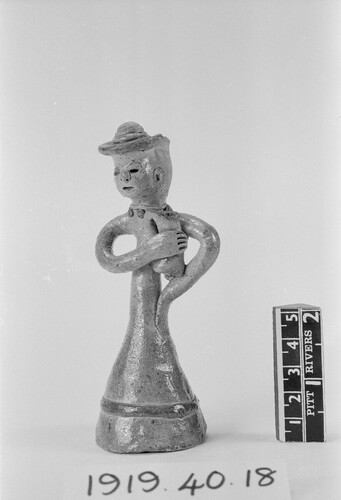 1919.40.18Pottery whistle in the figure of a woman holding a jug.1919.40.18
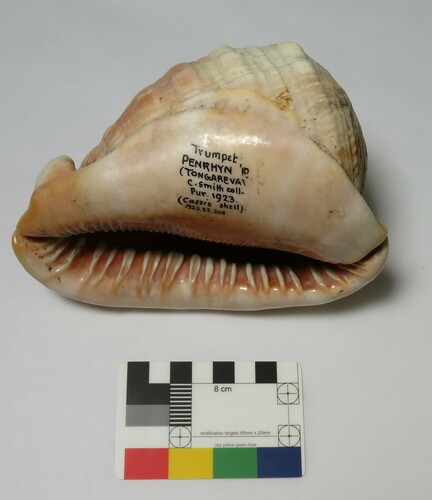 1923.87.308Cassis shell trumpet [JID 3/1/2020]1923.87.308
 1938.36.785.2Bullroarer, bound together with 1938.36.785 .1-.3. [DCF Court Team 17/2/2003]1938.36.785.2
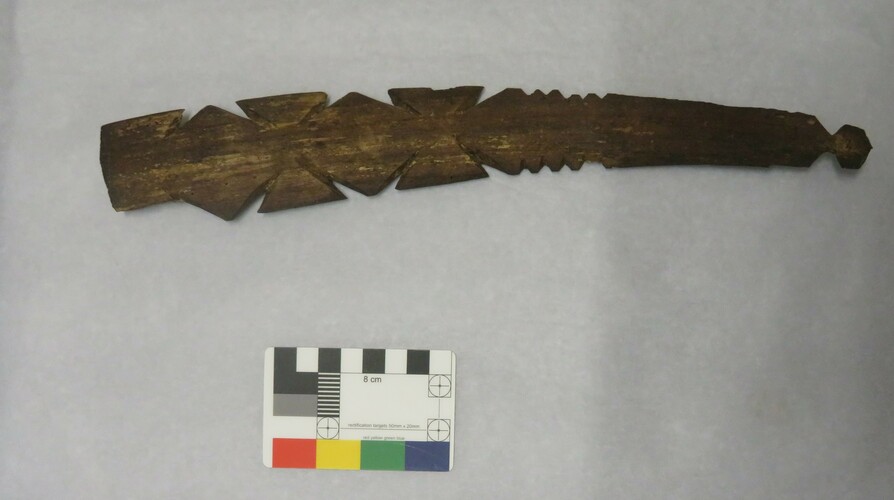 1953.10.108Bullroarer pendant1953.10.108
 1906.78.43Metal arm ornament; circlet of coiled brass wires worn smooth on upper and lower edges. [EC 'DCF 2004-2006 What's Upstairs?' 12/10/2005]1906.78.43
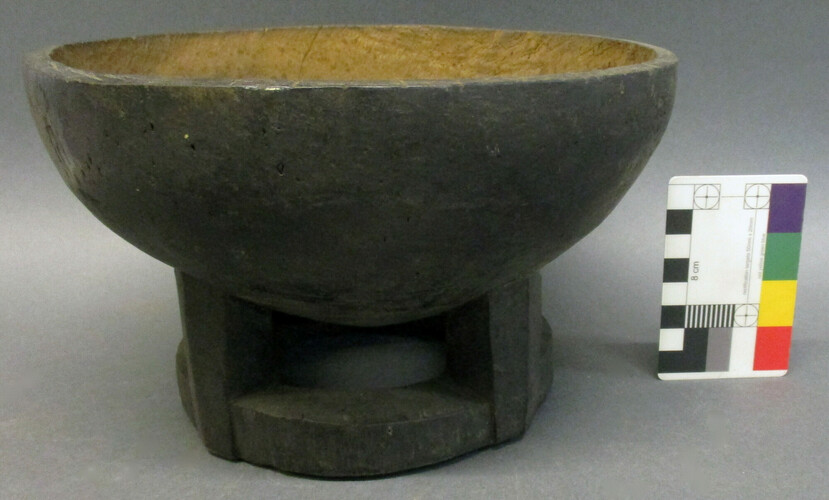 1927.19.31Circular wooden food bowl with a flat, four-legged pedestal base cut from one block. [RM [OPS move] 15/9/2016]1927.19.31
 2003.60.22Knobkerry/ club. Long wooden handle ending in a small ball-shaped club head. [JP 5/3/2004]2003.60.22
 1907.38.124Part of a blue and white glazed bowl. [DCF Court Team 22/2/2003]1907.38.124