
- Collection type
- Object
- Description
- Spear-thrower made of plant fibre.
- Long description
- Braided plant-fibre cord with a solid, knotted sphere at one end and a loop at the other. The loop has four tassels made from loops of plant fibre at its base. [JU 18/12/2013]
- Person
- Field collector Johann Reinhold Forster
- Field collector Georg Forster
- PRM source Ashmolean Museum, University of Oxford
- Date / Period
- Date made: Before 22/07/1774, uncertain Date made: Before 23/07/1774, uncertain
- Date collected
- 22 or 23 July 1774 ?
- Acquisition information
- Transferred: 19/04/1886, uncertain
- Materials and processes
- Material Plant Fibre, Process Plaited, Process Woven
- Dimensions
- Length 220 mm
- Object numbers
- Accession number: 1886.1.1677 Other numbers: Forster 147
- Research and responses
A loose note in Peter Gathercole's hand dated 27 September 1970 concerning this and 1886.1.1678 (from New Caledonia) reads: 'These beckets are not catalogued at all. For this reason I think they are [the] ones in the Forster catalogue (Nos 147 and 160). I don't know yet which is which. (Note now in RDF.) [NMM 24 1 1997; JC 21 12 1999]
This and the other possible Forster spearthrower, 1886.1.1678, were re-examined in March 1997 by Peter Gathercole and Nicolette Meister and an attempt was made to identify which was which. To do so they drew on the account of Anders Sparrman, who was also on Cook's second voyage, who stated that the spear-slings of New Caledonia were 'of better quality, and more elegantly knitted, with hairs of bats worked in' (see page 17 of A. Sparrman's Ethnographical Collection from James Cook's 2nd Expedition (1772-1775), by J. Söderström (The Ethnographical Museum of Sweden, Stockholm (Statens Etnografiska Museum), new series, Publication, No. 6), (Stockholm: Bokförlags Aktiebolaget Thule, 1939)). The two objects were then examined by C. A. Norris of the Oxford University Museum of Natural History. He confirmed that 1886.1.1678 had hair woven into the fibres and that 'the hair appears to be rufous in colouration, which would tend to support the theory that it comes from a fruit bat (genus Pteropus is a possibility) rather than a pig' (see his note in RDF: 1886.1.1638). It was thus decided that 1886.1.1677 is Forster 147 from Malakula and that 1886.1.1678 is Forster 160 from New Caledonia. [NMM 24 1 1997; JC 21 12 1999]
For an account of spear-throwers in Vanuatu, see pages 188-189 in Ethnology of Vanuatu: An Early Twentieth Century Study, by Felix Speiser (translated by D.Q. Stephenson) (Bathurst: Crawford House Press, 1990). A copy is available in RDF. [JC 24 4 2019]
- Associated publications
- Listed according to the 'Forster list' numbering system in 'From the Islands of the South Seas 1773–4: An Exhibition of a Collection Made on Capn. Cook's Second Voyage of Discovery by J. R. Forster—A Short Guide (Oxford: Pitt Rivers Museum, no date [1970]). The text from the 'Forster' manuscript is followed by the following notes: 'Missing'. [NMM 24 1 1997; JC 21 12 1999] Listed as number 2 under ‘New Hebrides...Other Weapons’ on page 249 of 'Artificial Curiosities': Being an Exposition of Native Manufactures Collected on the Three Pacific Voyages of Captain James Cook, R.N. at the Bernice Pauahi Bishop Museum, January 18, 1978 – August 31, 1978 on the Occasion of the Bicentennial of the European Discovery of the Hawaiian Islands by Captain Cook - January 18, 1778 (Bernice P. Bishop Museum Special Publication 65), by Adrienne L. Kaeppler (Honolulu: Bishop Museum Press, 1978): 'Spear thrower, Oxford (147). Missing. Evidence: Forster collection. Literature: Gathercole, n.d. (1970), p. 21.' [JC 21 12 1999] Published as part of the Forster Collection on a dedicated website at www.prm.ox.ac.uk/forster (from February 2001). [JC 7 7 2005] For an account of the history of the collection of which this is part, see 'The Cook-Voyage Collections at Oxford, 1772–1775', by Jeremy Coote, in Jeremy Coote (ed.), Cook-Voyage Collections of 'Artificial Curiosities' in Britain and Ireland, 1771–2015 (MEG Occasional Paper No. 5), Oxford: Museum Ethnographers Group (2015), pp. 74–122. (Copy in RDF: Researchers: Jeremy Coote (Cook-Voyage Collections).) [JC 9 6 2016]
Search terms: Weapon, Spear-thrower
Further items to explore
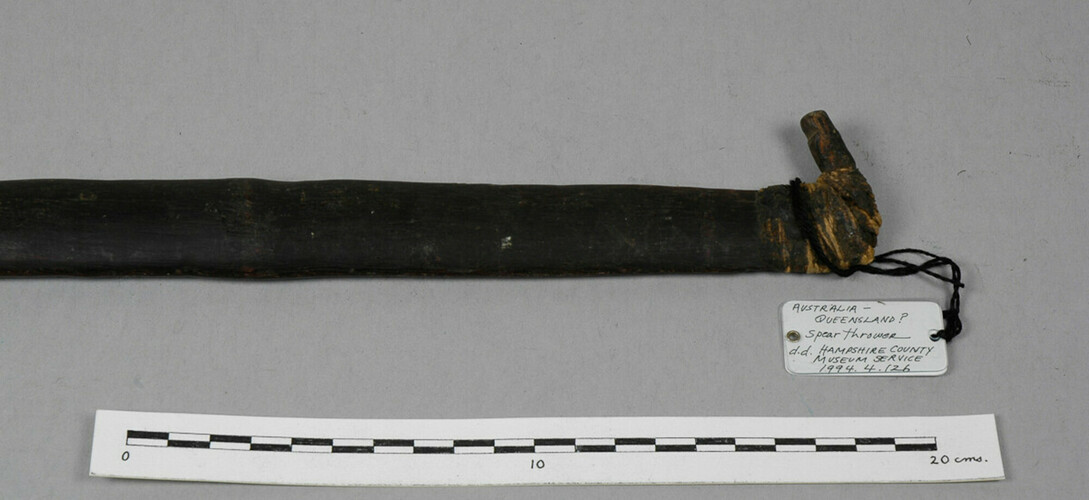 1994.4.126Straight narrow spear-thrower of dark wood with peg bound in resin and string at one end. The opposite end shows signs of having been bound at one time. [LM 21/08/2007]1994.4.126
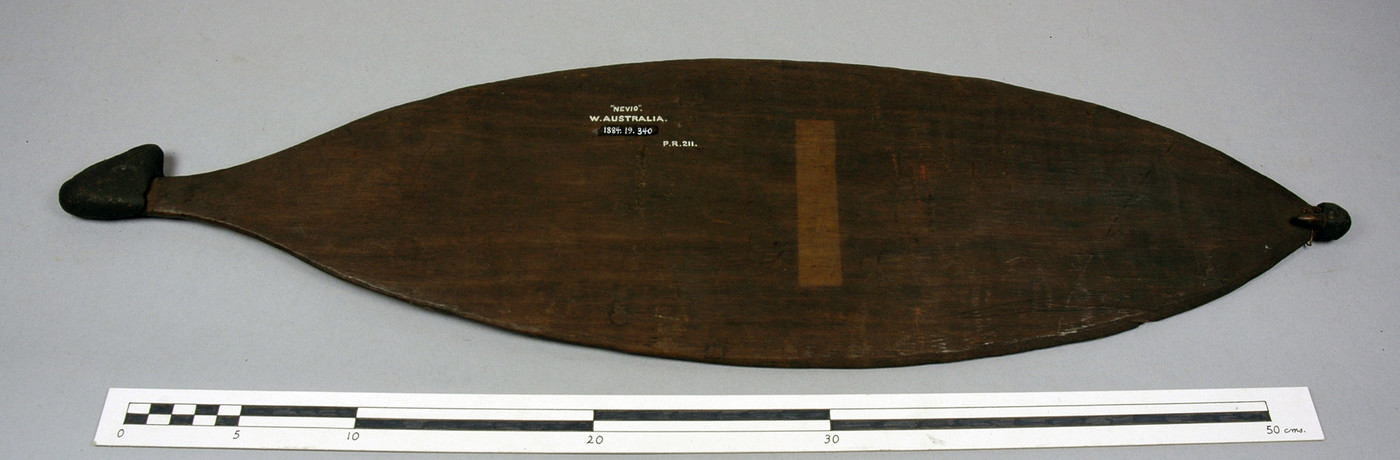 1884.19.340Spear thrower, paddle shaped with hook bound in resin and fibre resin at handle [NM]1884.19.340
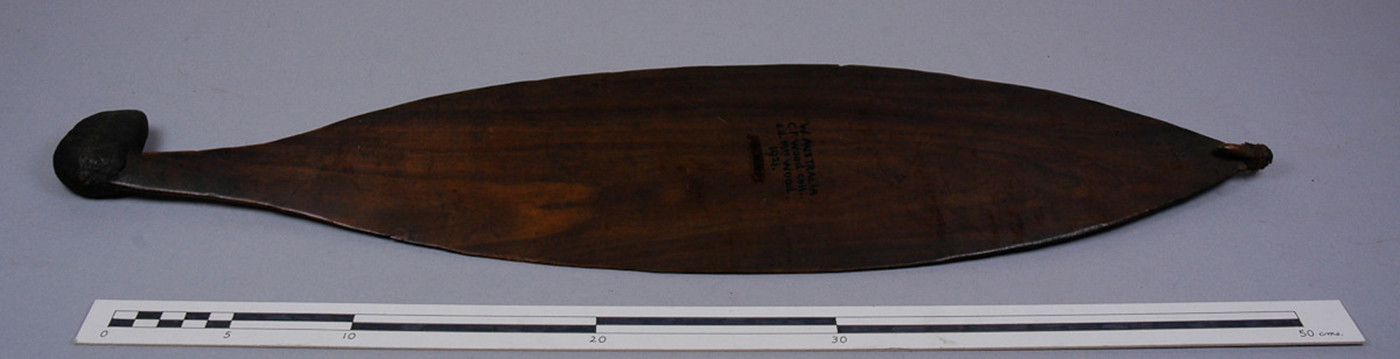 1921.93.387Paddle-shaped spear-thrower with knob of resin at handle, and opposite end with hook bound by resin and fibre. [SM 04/02/2008]1921.93.387
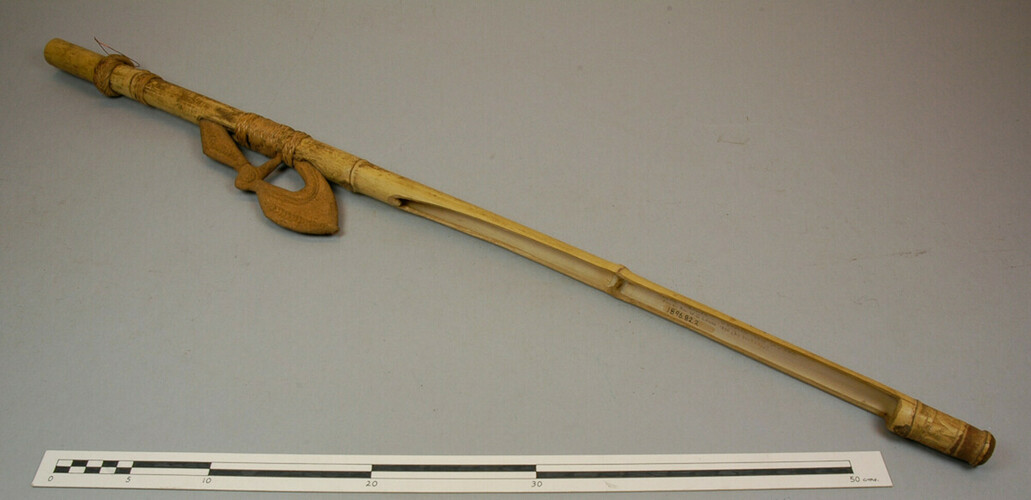 1896.82.2Spearthrower made of a length of bamboo, partly cut away to leave a decoratively carved node to engage the spear butt. A carved wooden bird figure, acting as a spear support, fits into a slot in the bamboo shaft. Carving and shaft are bound with rings of twill-plaited rattan, the thickest ring being at the handle end. [LM 15/10/2007]1896.82.2
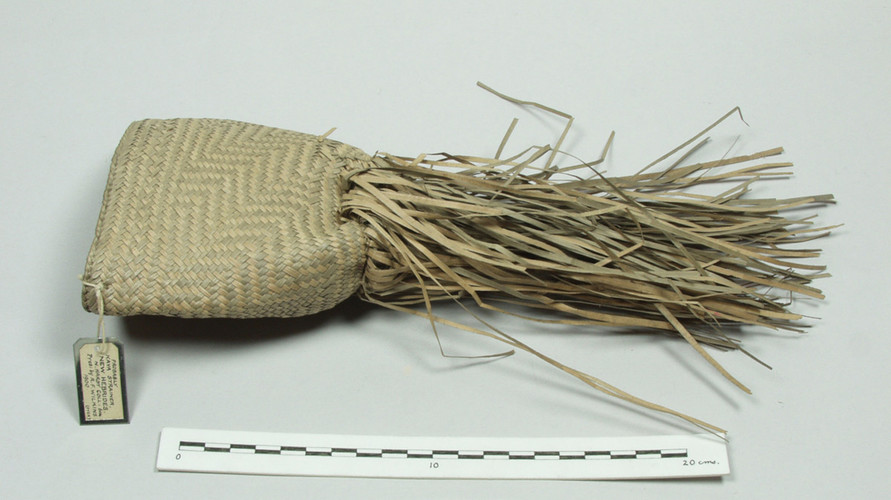 1900.55.614Kava strainer made from woven strips of plant fibre with bushy tasseled end.1900.55.614
 1895.22.237Wooden club with squared off, circular sectioned head which tapers to an expanded, domed butt. [BS [OPS Move] 09/09/2016]1895.22.237
 1907.10.48Wooden bow which is curved in shape. [SB [OPS move] 15/8/2017]1907.10.48
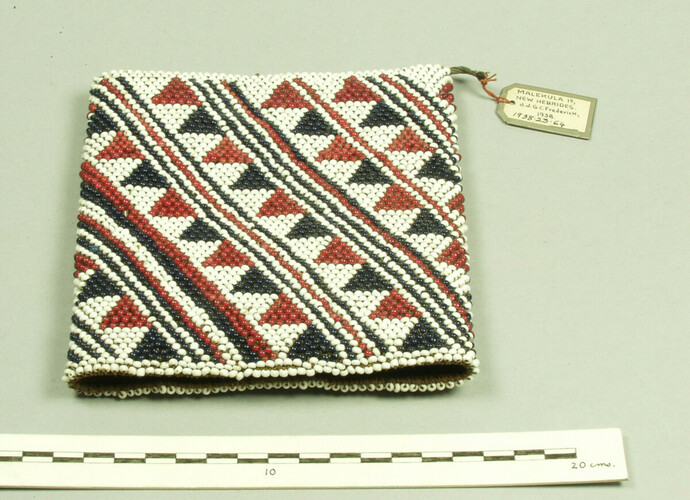 1938.23.64Armlet of red, white and navy blue trade beads on a fibre stringwork backing; diagonal diamond patterns. [EC 'DCF 2004-2006 What's Upstairs?' 22/7/2005]1938.23.64