
- Collection type
- Object
- Description
- Thick felted barkcloth - white with traces of red dye. [JU 04/01/2013]
- Long description
- Thick felted barkcloth; white with traces of red dye. [JU 04/01/2013]
- Geographical reference
- Society Islands Tahiti
- Person
- Field collector Johann Reinhold Forster
- Field collector Georg Forster
- PRM source Ashmolean Museum, University of Oxford
- Date / Period
- Date made: Before 04/06/1774, uncertain
- Date collected
- Between 17 August and 18 September 1773, or between 22 April and 4 June 1774?
- Acquisition information
- Transferred: 19/04/1886
- Materials and processes
- Material Bark Cloth Textile Plant, Material Pigment, Process Beaten
- Dimensions
- Length x Width 1750 x 1600 mm
- Object numbers
- Accession number: 1886.1.1637.7 Other numbers: Forster 16
- Research and responses
The entry in the 1970 Short Guide states that this barkcloth is missing, but upon examining the figure of the Mourner in the Cook display case this barkcloth was found to be on the figure and clearly marked with the original Forster number '16'. (1886.1.1246 was previously thought to be Forster number 16.) [NM 15/3/97]
It seems that this item has been confused with Forster 10 which the Catalogue of Curiosities describes as 'Cloth ... 10. Red ....'. No record exists for Forster 10 other than that listed in the Catalogue of Curiosities. However in 'From the Islands of the South Seas 1773-4: An Exhibition of a Collection Made on Capn. Cook's Second Voyage of Discovery by J. R. Forster- -A Short Guide (Oxford: Pitt Rivers Museum, no date [1970]) it is listed with the measurements 175 cm x 160 cm. These measurements match those for Forster 16. Therefore we can assume that Forster 16 / 1886.1.1637.7 was in fact exhibited in this exhibition but was incorrectly listed as no. 10 rather than no. 16. [JP 3/9/2002]
A sample of the barkcloth was given to Caroline Cartwright of the Department of Conservation and Scientific research at the British Museum for identification.[JU 13/12/2012]
The sample was identified as paper mulberry (Brousonnetia papyrifera). See RDF for the report [JU 16/12/2013]
- Associated publications
- Listed according to the 'Forster list' numbering system in 'From the Islands of the South Seas 1773-4: An Exhibition of a Collection Made on Capn. Cook's Second Voyage of Discovery by J.R. Forster- -A Short Guide (Oxford: Pitt Rivers Museum, no date[1970]). The text from the 'Forster' manuscript is followed by the following notes: '16. a red piece. Missing.' Listed as one of number 3 under ‘Tahiti...Bark Cloth’ on page 130 of 'Artificial Curiosities': Being an Exposition of Native Manufactures Collected on the Three Pacific Voyages of Captain James Cook, R.N. at the Bernice Pauahi Bishop Museum, January 18, 1978 - August 31, 1978 on the Occasion of the Bicentennial of the European Discovery of the Hawaiian Islands by Captain Cook - January 18, 1778 (Bernice P. Bishop Museum Special Publication 65), by Adrienne L. Kaeppler (Honolulu: Bishop Museum Press, 1978): '3. Oxford (8-22) [This last number is incorrect and should read 20], 13 pieces from the Forster collection including three pieces belonging to the mourning dress and a turban used to fasten the large helmet.' [JP 23/7/2002] Listed as one of figure h under the number 3 ‘Tahiti...Complete mourning dresses’ on page 124 of 'Artificial Curiosities': Being an Exposition of Native Manufactures Collected on the Three Pacific Voyages of Captain James Cook, R.N. at the Bernice Pauahi Bishop Museum, January 18, 1978 - August 31, 1978 on the Occasion of the Bicentennial of the European Discovery of the Hawaiian Islands by Captain Cook - January 18, 1778 (Bernice P. Bishop Museum Special Publication 65), by Adrienne L. Kaeppler (Honolulu: Bishop Museum Press, 1978): '3. Mourning dress, Oxford (1-4 and 9-11): (a) shell face mask with surmounted headpiece edged with tropical bird feathers; (b) turban of bark cloth with tying cords; (c) crescentic wood chest piece with mounted pearl shells; (d) chest apron of tiny slips of mother-of-pearl shells; (e) feather tassels; (f) bark cloth apron with coconut shell discs; (g) feathered cloak; (h) three pieces of bark cloth, white, red, and brown; (i) bark cloth sash. Evidence: Forster collection. Second voyage. Literature: Gathercole, n.d. (1970) [see above]'. [JP 23/7/2002] Published as part of the Forster Collection on a dedicated website at www.prm.ox.ac.uk/forster (from February 2001). [JC 7 7 2005] For an account of the history of the collection of which this is part, see 'The Cook-Voyage Collections at Oxford, 1772–1775', by Jeremy Coote, in Jeremy Coote (ed.), Cook-Voyage Collections of 'Artificial Curiosities' in Britain and Ireland, 1771–2015 (MEG Occasional Paper No. 5), Oxford: Museum Ethnographers Group (2015), pp. 74–122. (Copy in RDF: Researchers: Jeremy Coote (Cook-Voyage Collections).) [JC 9 6 2016]
Search terms: Barkcloth, Ritual and Ceremonial, Death
Further items to explore
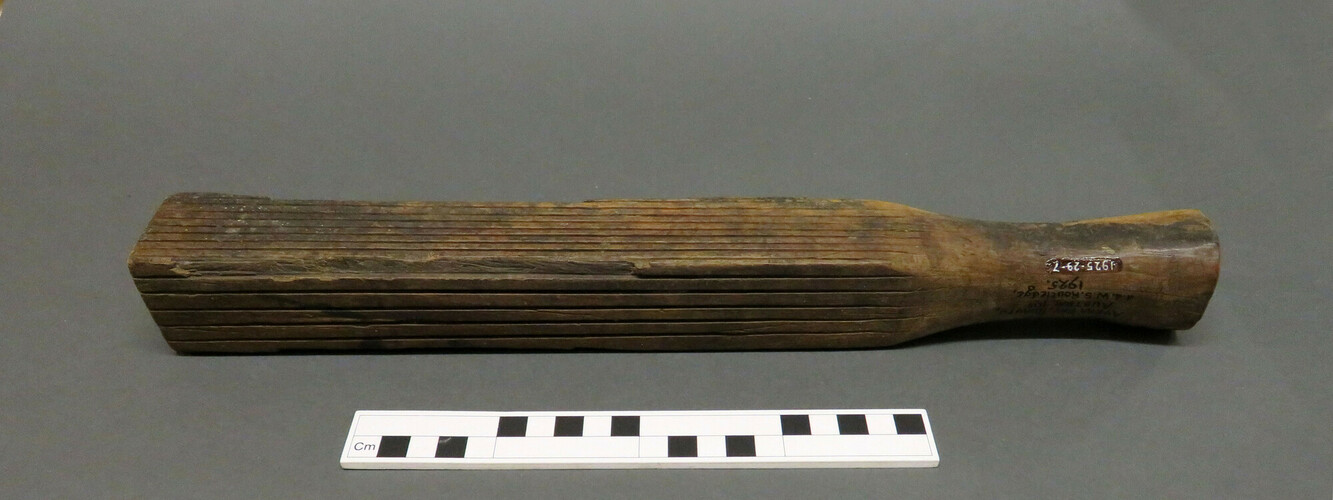 1925.29.7Wooden barkcloth beater. It comprises a cylindrical handle which flares out towards the end and and a long square-sectioned head. The faces of the head have longitudinal grooves of varying degrees of fineness. Both ends have been squared-off. [EH [OPS Move] 29/3/2017]1925.29.7
 1922.47.4Very large ornamented piece of barkcloth1922.47.4
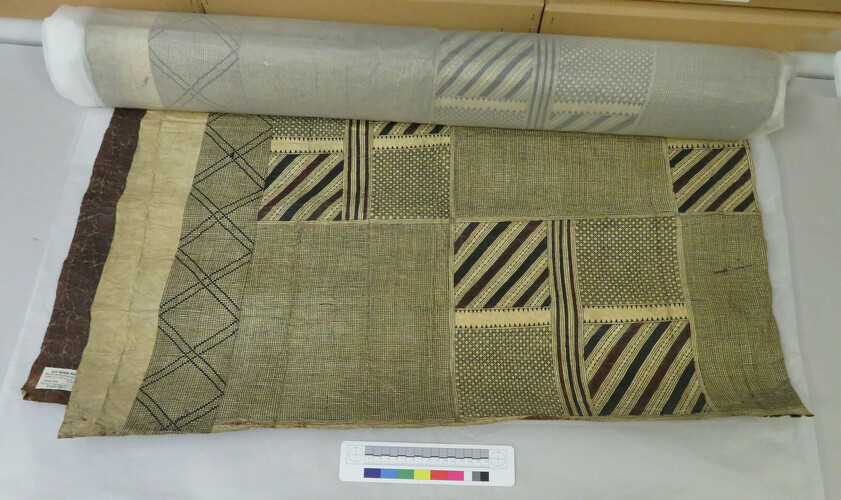 2005.98.1Barkcloth with painted decoration. [AF [OPS move] 9/8/2017]2005.98.1
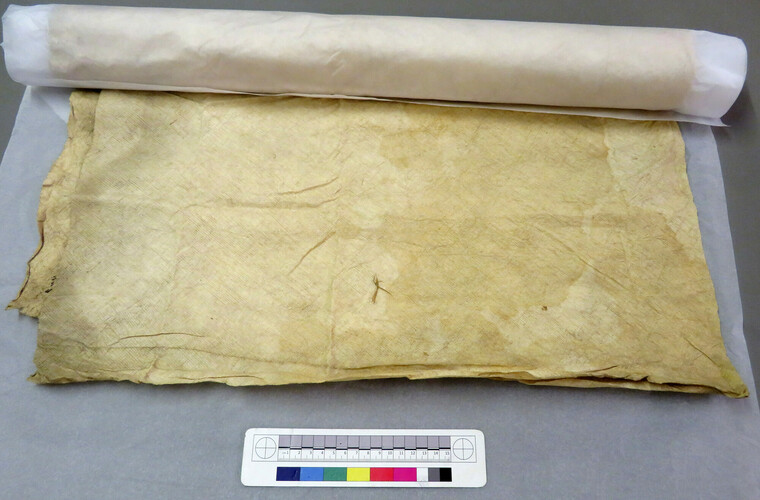 1884.87.92Sheet of barkcloth. It is cream in colour with a fine texture. The surface has crosshatch grooves from the beater. It is folded in half. [AF [OPS move] 15/8/2017]1884.87.92
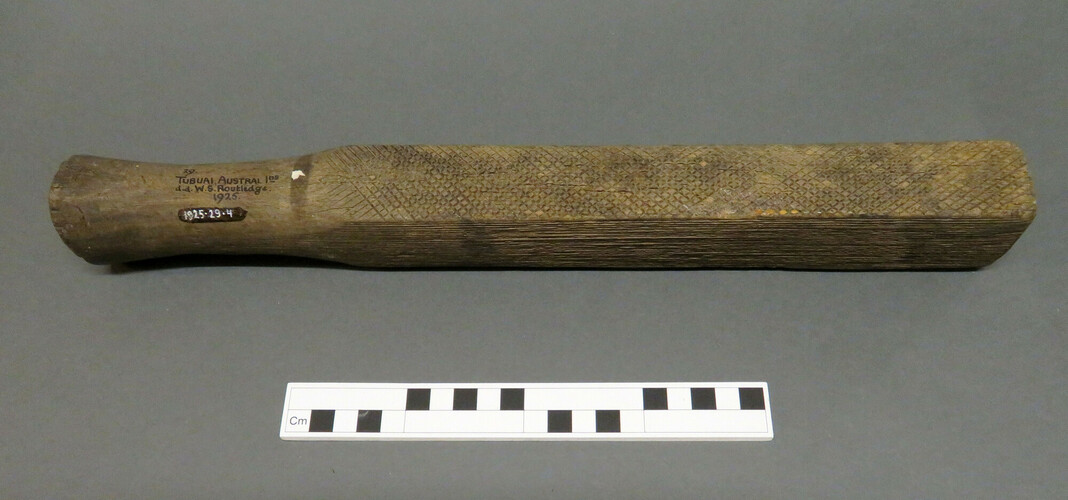 1925.29.4Wooden barkcloth beater. It has a short, plain cylindrical handle and a long rectangular head, square in section. The head has fine longitudinal grooves on three faces and an incised grid of lozenges on the other. Both ends are squared-off. [JC [OPS Move] 29/3/2017]1925.29.4
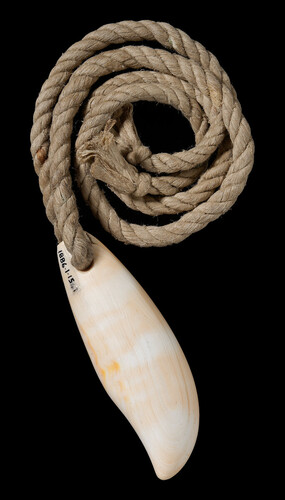 1886.1.1540Imitation whale tooth ornament, made from shell one end of which is perforated and threaded with twisted cord of barkcloth knotted at the ends. [FB 24/09/2012]1886.1.1540
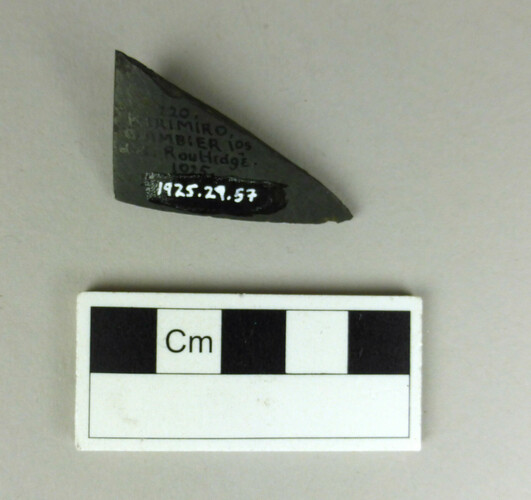 1925.29.57Small fragment of finely ground adze blade.1925.29.57
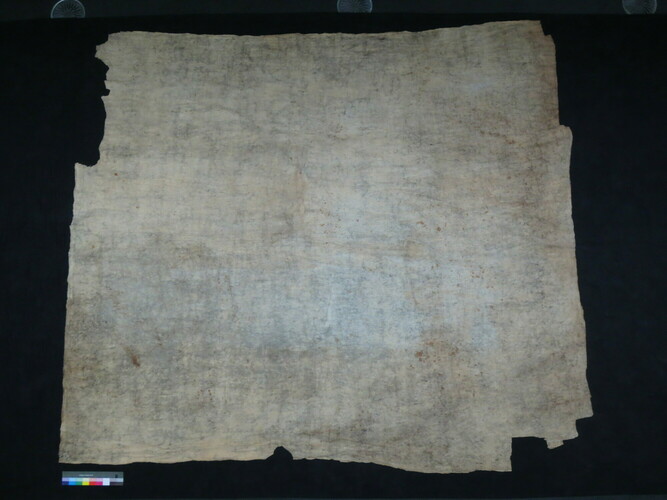 1886.21.17Barkcloth with red surface decoration1886.21.17