
- Collection type
- Object
- Description
- Part of a Mourner's Dress. Feathered cloak.
- Long description
- Lengths of coconut fibre cord are connected by feather bundles, creating a ladder-like structure. A folded quill or piece of plant stem is bent in half and bound with plant material. This creates the ‘rung’ of the ladder-like structure. To this are bound feathers, making up a feather bundle. The feathers have been split down the middle of the rachis, making each section twist. The cloak was made by making a long length of this ‘ladder’ structure, and looping it over a thick vegetable fibre cord at the neck end. Usually 6 lengths make 1 section. The individual ladders are tied together with lengths of barkcloth ‘string’ and coconut fibre. More rigid horizontal ties made from pandanus(?) leaf are woven through the structure on the reverse, sometimes strengthened with Freyncetia (Climbing screwpalm, Pandanaceae) aerial rootlets. Sometimes these rootlets are bound with cord and not associated with the leaf fibre. The cloak is constructed so that there is a single section of 6 ‘ladders’ left free on each side. Some contemporary images of the costume show the wearer with feather covered arms, and one image. The ‘ladders’ are bound together at the base of the feather bundles, thus meaning that in the cloak, the individual ‘ladders’ are effectively on edge, with all the feather bundles pointing out of the surface of the cloak. [JU 03/01/12]
- Geographical reference
- Society Islands Tahiti
- Person
- Field collector Johann Reinhold Forster
- Field collector Georg Forster
- PRM source Ashmolean Museum, University of Oxford
- Date / Period
- Date made: Before 04/06/1774?, uncertain
- Date collected
- Between 17 August and 18 September 1773, or between 22 April and 4 June 1774?
- Acquisition information
- Transferred: 19/04/1886
- Materials and processes
- Material Plant Fibre, Material Bird Feather, Material Net Textile, Process Woven, Process Netted
- Object numbers
- Accession number: 1886.1.1637.4 Other numbers: Forster 4
- Research and responses
A sample of the aerial root or stem from the back of the cloak was taken to be analysed by Dr Debra Carr and Dr David Lane from Cranfield University. Dr Carr has found intercellular crystals, or phytoliths, made from calcium oxalate, in samples of Freycinetia from New Zealand. The presence of the crystals could be an identification feature. The sample was analysed by X-ray fluorescence, X-ray diffraction and under the electron microscope. No evidence of crystals was found, although the elemental map obtained by the XRF suggested that calcium levels were highest just under the epidermis, where crystals would be expected. A copy of the XRF mapping report is in the RDF. [JU 23/02/2012]
Some feather fragments from the cloak were given to Andrew Charlton from DEFRA, who will test them for pesticide residues [JU 24/07/2012] Further feather fragments were swabbed with distilled water to remove surface residues and the swabs sent to Andrew Charlton for further pesticide analysis [JU 07/12/2012]
A sample of the aerial root/stem was given to Caroline Cartwright of the Department of Conservation and Scientific Research at the British Museum for identification.[JU 13/12/2012] It was confirmed as being from Freycinetia arborea. See RDF for report [JU 16/12/2013]
The surface of the mat was analysed by Kelly Domoney, Research Fellow at Cranfield Forensic Institute, using an Oxford Instruments XMET-500 handheld XRF. [JU 08/08/2013]
- Associated publications
- Listed according to the 'Forster list' numbering system in 'From the Islands of the South Seas 1773-4: An Exhibition of a Collection Made on Capn. Cook's Second Voyage of Discovery by J. R. Forster- -A Short Guide (Oxford: Pitt Rivers Museum, no date[1970]). The text from the 'Forster' manuscript is followed by the following notes: 'The Mourning Dress No. 4. The feathered Coat, or Ahow-roope, consisting of strings in form of a Net, covered with bunches of feathers and worn on the back...These magnificent dresses were worn by the chief mourner when he led a group of youth in a warlike procession, apparently designed to symbolically revenge any injury received by the deceased. Banks took part in this ceremony during the first voyage, and may have brought back a dress. Most of those which arrived in Europe, however, probably did so in 1775. It was Tahitian greed for the red feathers obtained at Tonga in October 1773 which brought them on to the market. The feathers were "...used as Symbols of the Eatua's or Divinities in all their religious ceremonies" (Cook), and were in short supply on Tahiti.' Listed as figure g under the number 3 ‘Tahiti...Complete mourning dresses’ on page 124 of 'Artificial Curiosities': Being an Exposition of Native Manufactures Collected on the Three Pacific Voyages of Captain James Cook, R.N. at the Bernice Pauahi Bishop Museum, January 18, 1978-August 31, 1978 on the Occasion of the Bicentennial of the European Discovery of the Hawaiian Islands by Captain Cook-January 18, 1778 (Bernice P. Bishop Museum Special Publication 65), by Adrienne L. Kaeppler (Honolulu: Bishop Museum Press, 1978): '3. Mourning dress, Oxford (1-4 and 9-11): (a) shell face mask with surmounted headpiece edged with tropical bird feathers; (b) turban of bark cloth with tying cords; (c) crescentic wood chest piece with mounted pearl shells; (d) chest apron of tiny slips of mother-of-pearl shells; (e) feather tassels; (f) bark cloth apron with coconut shell discs; (g) feathered cloak; (h) three pieces of bark cloth, white, red, and brown; (i) bark cloth sash. Evidence: Forster collection. Second voyage. Literature: Gathercole, n.d. (1970) [see above]'. [JP 23/7/2002] Listed as part of the complete mourning dress (Forster 1-4, 9-11) on page 562 of 'Appendix A: Catalogue of Society Island Objects with Secure Eighteenth-Century Provenance' in 'Shaping the Body Politic: Gender, Status, and Power in the Art of Eighteenth-Century Tahiti and the Society Islands', by Anne Elizabeth D'Alleva (New York: Columbia University, Ph.D. thesis, 1997). She describes it as follows: 'Shell and turtle shell face mask edged with tropic bird feathers; turban of bark cloth with tying cords (these are unique: wrapped with finely braided human hair, tamau); crescentic wood chest piece with pearl shells, feather tassels at each end; barkcloth tunic covered with small coconut shell ornaments; tunics of white, red, brown barkcloth; black feather cape; barkcloth sash.' [JP 31/7/2002] Such feather cloaks are discussed in 'The Feather Cloak of Tahiti', by Te Rangi Hiroa (Peter H. Buck), in Journal of the Polynesian Society, LII, no. 1 (March 1943), pp. 12-15. [JC 18 12 2003] Published as part of the Forster Collection on a dedicated website at www.prm.ox.ac.uk/forster (from February 2001). [JC 7 7 2005] For an account of the history of the collection of which this is part, see 'The Cook-Voyage Collections at Oxford, 1772–1775', by Jeremy Coote, in Jeremy Coote (ed.), Cook-Voyage Collections of 'Artificial Curiosities' in Britain and Ireland, 1771–2015 (MEG Occasional Paper No. 5), Oxford: Museum Ethnographers Group (2015), pp. 74–122. (Copy in RDF: Researchers: Jeremy Coote (Cook-Voyage Collections).) [JC 9 6 2016]
Search terms: Clothing, Ritual and Ceremonial, Death, Cloak
Further items to explore
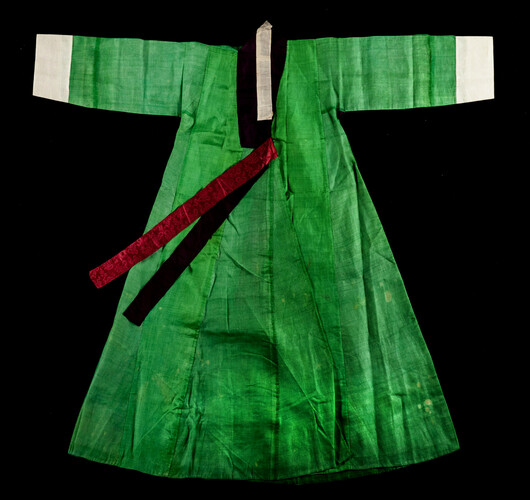 1896.62.206.3Green and purple coat worn by women out of doors as a disguise, also a man's military coat.1896.62.206.3
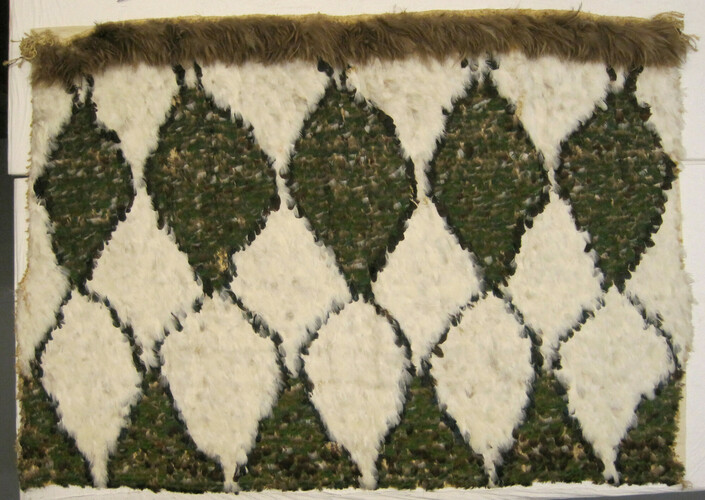 1941.8.292Cloak. Made of flax. Decorated with kiwi, pigeon, and peacock feathers.1941.8.292
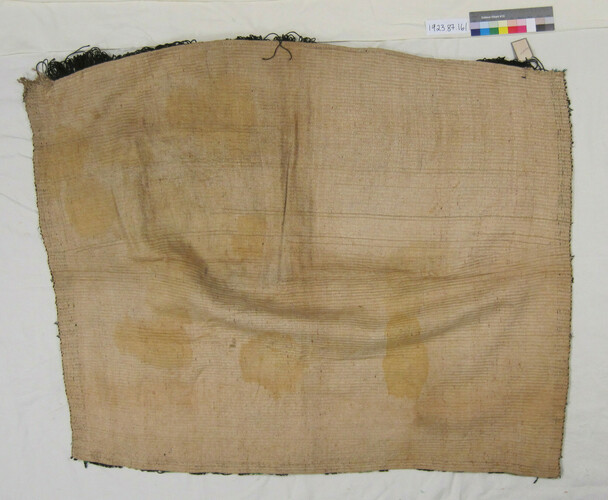 1923.87.161Cloak. Made of flax. With black pendant strings and borders of black 'flax' tufts mingled with green, red & yellow wool (imitating feather bordering).1923.87.161
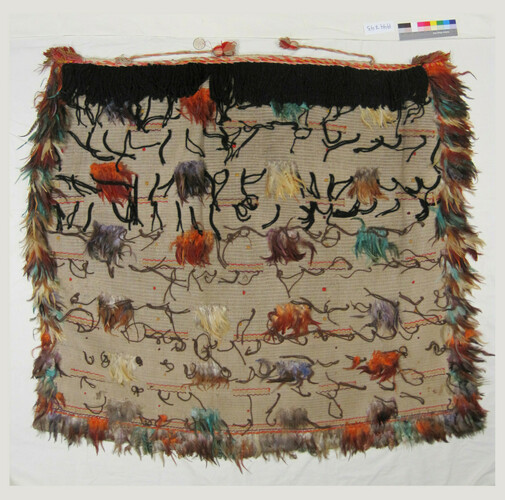 1944.7.43Cloak. Made of wool with patches of feathers tied in.1944.7.43
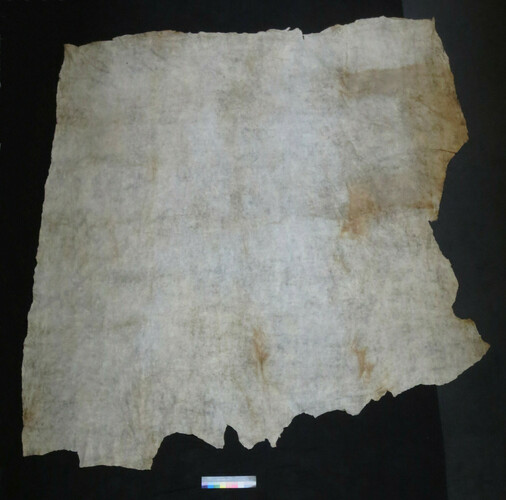 1886.21.29Barkcloth: white, finely ribbed.1886.21.29
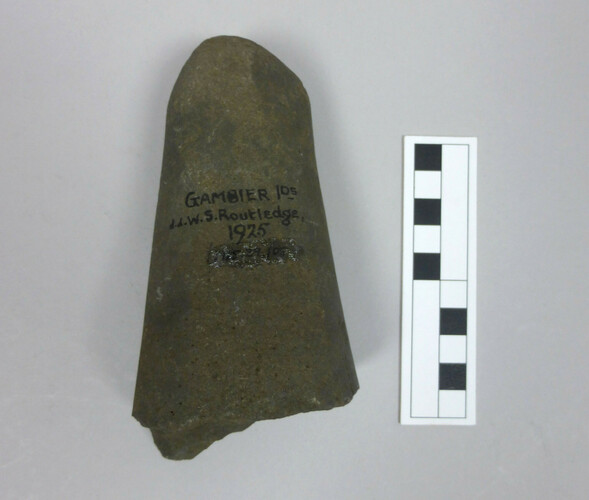 1925.29.105Fragment of stone pounder1925.29.105
 1886.1.1275Wooden footrest for a stilt. [CW [OPS Move] 31/5/2017]1886.1.1275
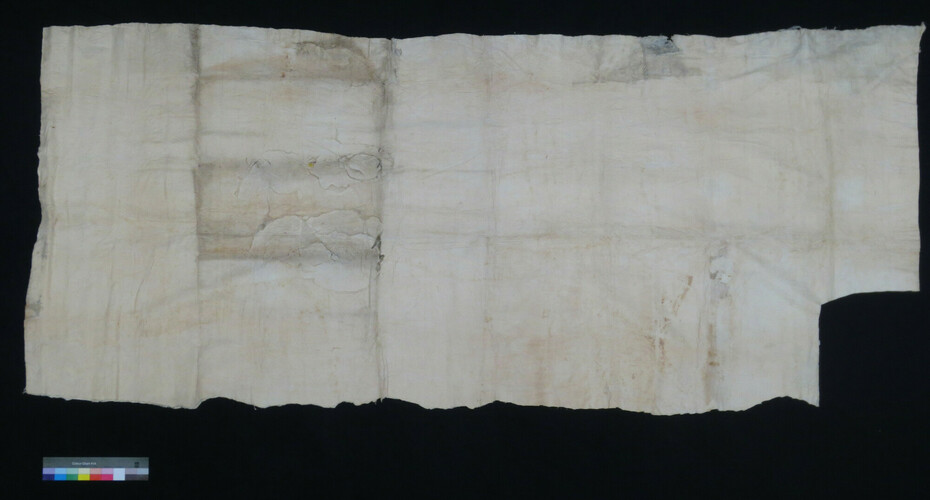 1886.1.1251Barkcloth, yellowish in colour1886.1.1251