
- Collection type
- Object
- Description
- Necklace of white (dentalium)? shell beads with a section of 18 brown coconut beads of the same shape. [JFK 19/2/2009]
- Long description
- Necklace of white (dentalium)? shell beads with a section of 18 brown coconut-shell beads of the same shape. [JFK 19/2/2009]
- Geographical reference
- Cultural groups
- Māori
- Person
- Field collector Johann Reinhold Forster
- Field collector Georg Forster
- PRM source Ashmolean Museum, University of Oxford
- Date / Period
- Date made: Before 10/11/1774
- Date collected
- 1773 or 1774 (between 26 March and 11 May 1773, or between 18 May and 7 June 1773, or between 3 November and 25 December 1773; or between 16 October and 10 November 1774)
- Acquisition information
- Transferred: 19/04/1886
- Materials and processes
- Material Plant Fibre, Material Coconut Plant, Material Dentalium Shell, Process Perforated, Process Strung, Process Twisted, Process Knotted, Process Carved
- Dimensions
- Length 1100 mm
- Object numbers
- Accession number: 1886.1.1569 Other numbers: Forster 98 Duncan 194
- Research and responses
Of the nine necklaces grouped together as 'Forster 98', five have been positively identified by Adrienne Kaeppler as being from Tonga (1886.1.1570, 1886.1.1571, 1886.1.1572, 1886.1.1573, 1886.1.1576), three have been identified as being from New Zealand (1886.1.1568, 1886.1.1569, 1886.1.1574), and one (1886.1.1575) remains to be identified. (Samples of the fibre from 1886.1.1575 were taken and examined under the microscope. The fibre appears to be a nettle fibre, rather than New Zealand flax, suggesting that this necklace is from Tonga.) [JC 7 6 2001; JU 12/09/2012]
Kathie Way, Senior Curator of Mollusca at the Natural History Museum confirmed the identification of the white beads of this necklace as Dentalium. The grooves visible on some of the shells are characteristic of some of the larger types of Dentalium [JU 19/09/2012]
- Associated publications
- Listed according to the 'Forster list' numbering system in 'From the Islands of the South Seas 1773–4: An Exhibition of a Collection Made on Capn. Cook's Second Voyage of Discovery by J. R. Forster—A Short Guide (Oxford: Pitt Rivers Museum, no date [1970]): 'The Friendly Isles (Tonga)...98. Nine different kinds of necklaces; together with three mother of pearl shells which hang on the breast. The latter have not been traced. Materials of the eight surviving necklaces and overall lengths (from top to bottom of the exhibit): [A; 1886.1.1573:] human hair, white and pink shell, 64 cm.; [B; 1886.1.1571:] white shell and coconut shell, with six ivory pendants, 50 cm.; [C; 1886.1.1572:] white shell and coconut shell, with two canine teeth, 25 cm.; [D; 1886.1.1570:] white shell and coconut shell, 220 cm.; [E; 1886.1.1574:] dentalium shell, bone and brown shell, 76 cm.; [F; 1886.1.1576:] bird bone and brown shell, 115 cm.; [G; 1886.1.1569:] dentalium shell, 110 cm.; [G; 1886.1.1568:] dentalium shell and brown shell, 165 cm.' N.B. The missing ninth has now been identified as 1886.1.1575. [NMM 22 1 1997; JC 30 12 1999, 14 8 2015] Listed under numbers 8 to 10 under ‘New Zealand...Necklaces’ on page 178 of 'Artificial Curiosities': Being an Exposition of Native Manufactures Collected on the Three Pacific Voyages of Captain James Cook, R.N. at the Bernice Pauahi Bishop Museum, January 18, 1978 - August 31, 1978 on the Occasion of the Bicentennial of the European Discovery of the Hawaiian Islands by Captain Cook - January 18, 1778 (Bernice P. Bishop Museum Special Publication 65), by Adrienne L. Kaeppler (Honolulu: Bishop Museum Press, 1978): 'Three necklaces of dentalium shells, bone, and other shells, Oxford (98). Lengths 76 cm, 110 cm, and 165 cm. Evidence: Forster collection, second voyage. Literature: Gathercole, n.d. (1970) [see above], attributed to Tonga by Forster.' [JC 24 5 2000] Published as part of the Forster Collection on a dedicated website at www.prm.ox.ac.uk/forster (from February 2001). [JC 7 7 2005] For an account of the history of the collection of which this is part, see 'The Cook-Voyage Collections at Oxford, 1772–1775', by Jeremy Coote, in Jeremy Coote (ed.), Cook-Voyage Collections of 'Artificial Curiosities' in Britain and Ireland, 1771–2015 (MEG Occasional Paper No. 5), Oxford: Museum Ethnographers Group (2015), pp. 74–122. (Copy in RDF: Researchers: Jeremy Coote (Cook-Voyage Collections).) [JC 9 6 2016]
Search terms: Ornament, Neck Ornament
Further items to explore
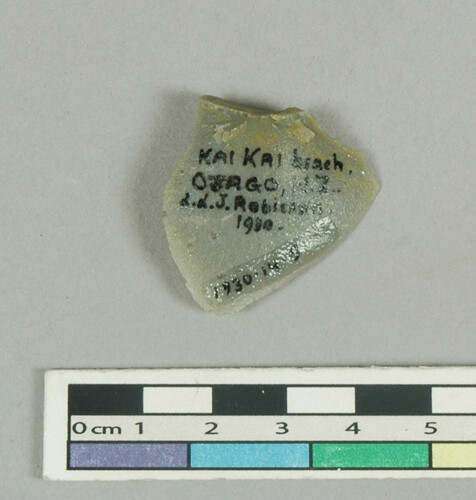 1930.14.5Flake of silicious stone. [El.B 18/05/2011]1930.14.5
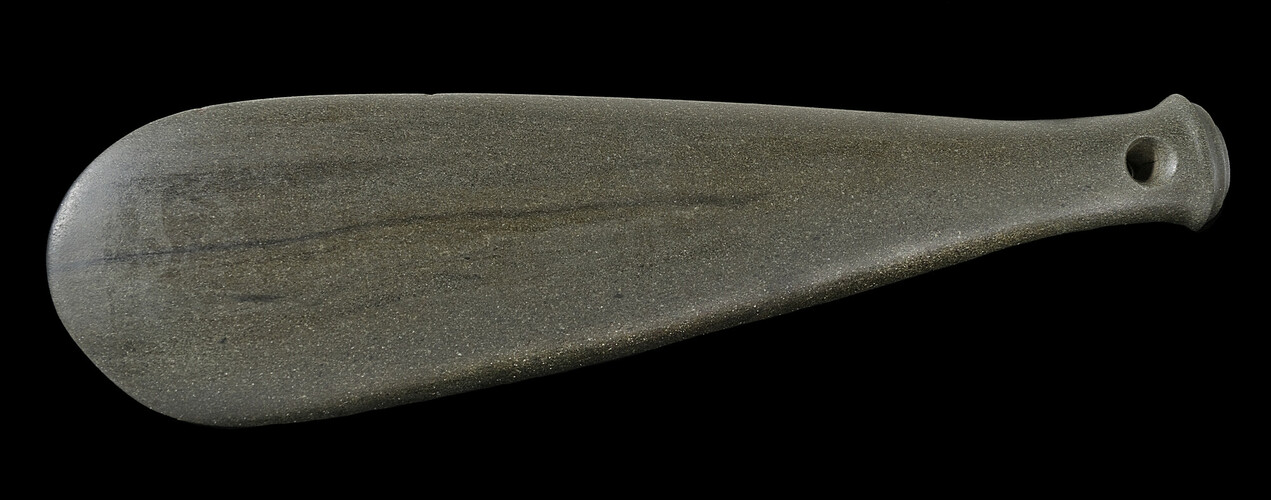 1886.1.1149Hand-weapon carved from basalt with a very smooth finish and a hole at the handle.1886.1.1149
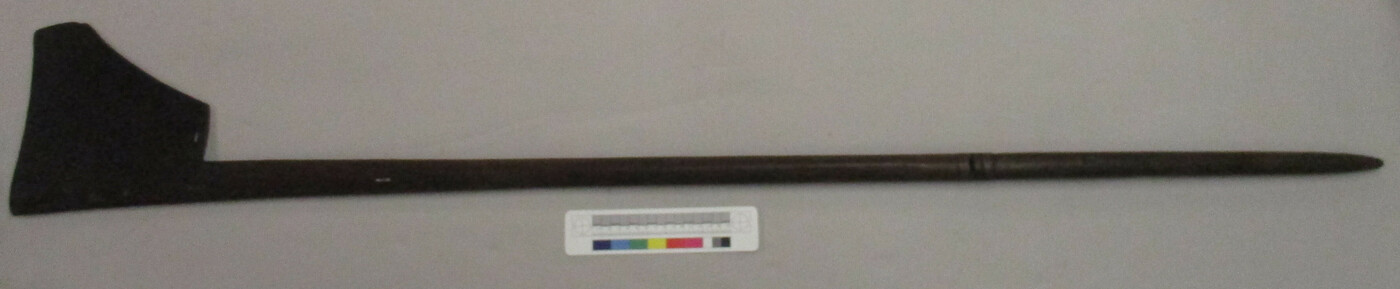 1884.12.286Flag-shaped club with long cylindrical shaft and trapezoid head with one sharp, concave edge. Towards the proximal end is a conventionalised grotesque face, carved around the shaft. It tapers to a point at the butt. [JC [OPS Move] 12/08/2016]1884.12.286
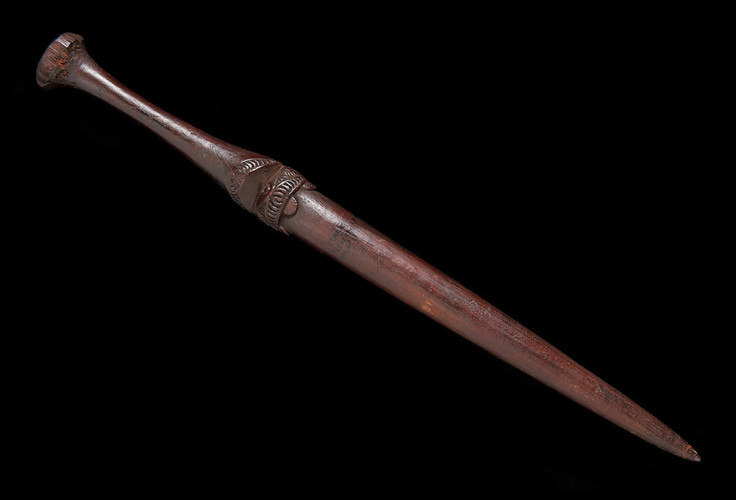 1887.1.715Weaving peg.1887.1.715