
- Collection type
- Object
- Description
- A dance paddle, of wood. Broken and repaired locally by binding the two pieces together with coconut fibre. [JC 5 8 2015]
- Long description
- The object is a paddle of carved wood with a single raised ridge across the top of the blade, 418 mm from the top of the handle. The blade itself is curved at the bottom and appears straight along the sides, though there is a slight bowing outward of the edges toward the bottom. This may indicate that the bottom of the paddle may have worn or broken thus forming its current shape. Other examples of similar paddles appear to have more of an S shaped curve. The paddle was broken in the past and repaired using a plaited cord of plant fibre that has been tightly wrapped around the handle of the paddle. The repair starts 173 mm from the top of the handle and is 63 mm in length. A large piece appears to be missing from the back of the handle and appears to have worn smooth. Regular markings, tool marks (?) are seen just below the repair on the front of the paddle. [Emma Schmitt (Conservation Intern) 06/09/2013; JU 17/09/2013]
- Person
- Field collector Johann Reinhold Forster
- Field collector Georg Forster
- PRM source Ashmolean Museum, University of Oxford
- Date / Period
- Date made: Before 29/06/1774
- Date collected
- Between 2 and 7 October 1773 or between 26 and 29 June 1774
- Acquisition information
- Transferred: 19/04/1886
- Materials and processes
- Material Wood Plant, Material Sennit Coconut Seed Fibre Plant, Process Carved, Process Bound, Process Plaited, Process Repaired (local), Process Recycled
- Dimensions
- Length: max 730 mm, Height 3 mm handle, Width: max 180 mm
- Object numbers
- Accession number: 1886.1.1367 Other numbers: Forster 81 Other numbers: Duncan 199
- Associated publications
- Listed according to the 'Forster list' numbering system in 'From the Islands of the South Seas 1773–4: An Exhibition of a Collection Made on Capn. Cook's Second Voyage of Discovery by J. R. Forster—A Short Guide (Oxford: Pitt Rivers Museum, no date [1970]): 'The Friendly Isles (Tonga)...81. a spatule of wood to mix up their paste of breadfruit with. Actually a dance paddle, which Cook saw in use during his third voyage in May and June 1777. As this type of dance was not seen during the second voyage, it is hardly surprising that Forster made an error in identification. The handle has been repaired with a coconut fibre binding. Length: 73 cm.' [NMM 18 12 1996; JC 30 12 1999, 19 5 2011, 14 8 2015] Discussed on page 218 of 'Eighteenth-Century Tonga: New Interpretations of Tongan Society and Material Culture at the Time of Captain Cook', by Adrienne L. Kaeppler, in Man, n.s., Vol. VI, no. 2 (June 1971), pp. 204-220: 'A dance paddle was collected by Forster, but there are no descriptions of Tongan dance in the second voyage accounts. The paddle is listed in the Tongan section of the Catalogue as No. 81, 'a Spatule of wood to mix up their paste of breadfruit with', but this need not be as incorrect as it sounds. Tongans did make breadfruit paste and several breadfruit pounders were collected. If a utensil was was necessary at a moment's notice it is not unlikely that a discarded dance paddle would be used. The Pitt Rivers Museum example has been broken and mended with coconut fibre and its shape would be a good one for mixing breadfruit paste.' [JC 30 12 1999] Listed as number 1 under ‘The Friendly Isles (Tonga)...Dance Paddles’ on page 231 of 'Artificial Curiosities': Being an Exposition of Native Manufactures Collected on the Three Pacific Voyages of Captain James Cook, R.N. at the Bernice Pauahi Bishop Museum, January 18, 1978 - August 31, 1978 on the Occasion of the Bicentennial of the European Discovery of the Hawaiian Islands by Captain Cook - January 18, 1778 (Bernice P. Bishop Museum Special Publication 65), by Adrienne L. Kaeppler (Honolulu: Bishop Museum Press, 1978): 'Paddles used in the sancxe me'etu'upaki were collected on the second and third voyages. The dance was seen only on the third voyage and Forster describes his second voyage paddle as "a Spatule of wood to mix up their paste of breadfruit with" - perhaps a secondary use for a broken paddle. 1. Dance paddle (mended with sennit), Oxford (81). Length 73 cm. Evidence: Forster collection, second voyage. Literature: Gathercole, n.d. (1970) [see above]; Kaeppler, 1971, p. 218 [see above]'. [JC 30 12 1999] Discussed (with 1886.1.1513) on pages 47–8 of 'Tongan Kava Bowls as Centerpieces for Performance', by Adrienne L. Kaeppler, Baessler–Archiv, new series, Vol. 45 (1997), pp. 47–61: 'Three large bowls traceable to the Pacific voyages of Captain James Cook are in Göttingen, Oxford, and London. The Göttingen and Oxford bowls were acquired during the second Cook-voyage by the expedition naturalists Reinhold and Georg Forster.... The Oxford bowl [1886.1.1513] was described by Georg Forster in his "Catalogue of Curiosities sent to Oxford" as number 65 "a wooden dish or platter from which they eat" from Tonga, while number 81 [1886.1.1367] was described as "a Spatule of wood to mix up their paste of breadfruit with" (and object that is actually a broken dance paddle).... / The Forsters probably collected their two bowls while on plant-collecting excursions in the villages, and perhaps did not question their original owners about their use.' [JC 6 10 2015] Discussed on page 16 of Transformations: The Art of Recycling, by Jeremy Coote, Chris Morton, and Julia Nicholson (Oxford: Pitt Rivers Museum, 2000): 'Among other examples of such "local" recycling on permanent display in the Museum is a "dance paddle" from Tonga collected in October 1773 by Reinhold Forster and his son George while on Captain Cook’s second great voyage of discovery. When they collected it, it was being used as "a Spatule of wood to mix up their paste of breadfruit with"; only in 1969 was it realised that it was a broken dance paddle that had been mended with sennit so that it could have a new life as a food-stirrer.' [JC 3 6 2000] Published as part of the Forster Collection on a dedicated website at www.prm.ox.ac.uk/forster (from February 2001). [JC 7 7 2005] This object was featured in the Museum's audio guide produced during the DCF-funded 'What's Upstairs?' project, 2004–2006. [BR 'DCF 2004-2006 What's Upstairs?' 8/11/2005] For an account of the history of the collection of which this is part, see 'The Cook-Voyage Collections at Oxford, 1772–1775', by Jeremy Coote, in Jeremy Coote (ed.), Cook-Voyage Collections of 'Artificial Curiosities' in Britain and Ireland, 1771–2015 (MEG Occasional Paper No. 5), Oxford: Museum Ethnographers Group (2015), pp. 74–122. (Copy in RDF: Researchers: Jeremy Coote (Cook-Voyage Collections).) [JC 9 6 2016]
Search terms: Dance, Food and Drink, Tool, Spatula, Dance Accessory, Food Accessory
Further items to explore
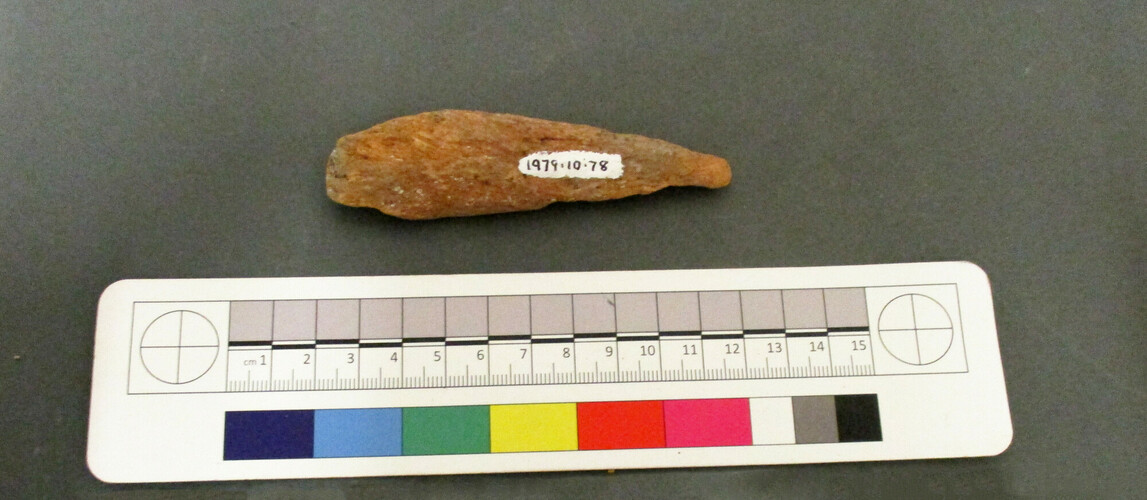 1979.10.78Bone tool fragment, possibly a spatula. The bone is tapered at one end. [RH [OPS Move] 9/5/2017]1979.10.78
 1936.4.9.5Bamboo sliver1936.4.9.5
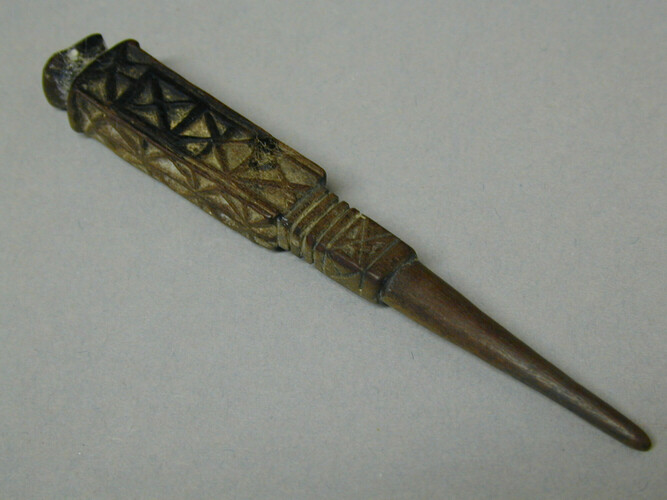 1914.76.16Kohl stick1914.76.16
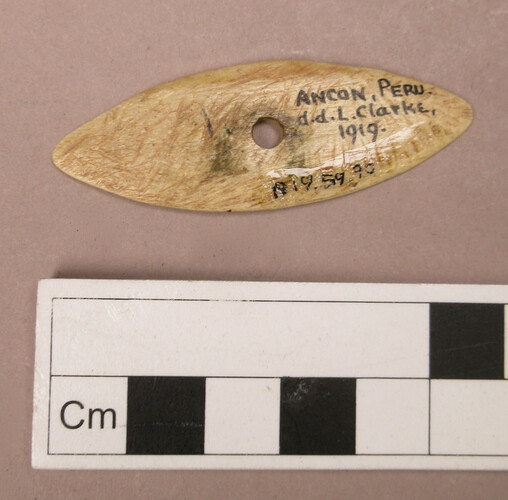 1919.59.90Bone spatula, perforated for suspension1919.59.90
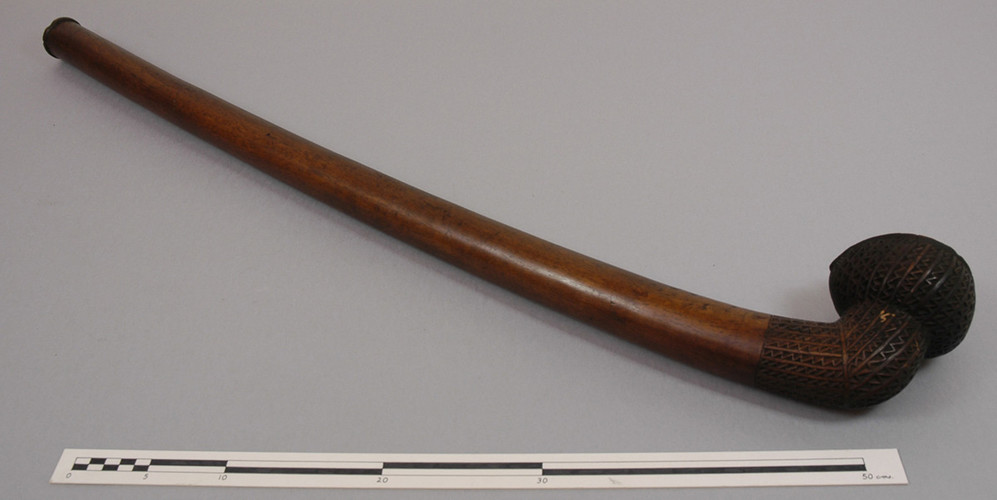 1884.12.154Wooden club with zigzag-carved hemispherical head in the form of a face with the eyes inlaid with shell. [LM 19/3/2007]1884.12.154
 1884.63.11Club carved all over.1884.63.11
 1948.12.2BPandanus mat with fringe and small red feather trim. [HR 16/9/2015]1948.12.2B
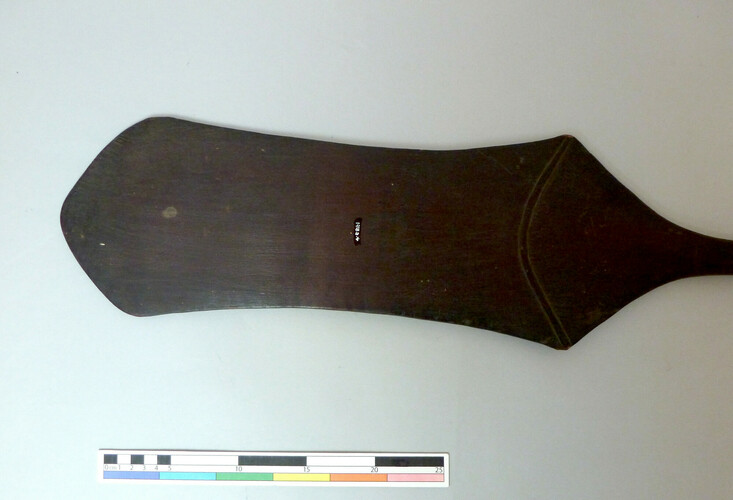 1918.2.4Paddle club, Kinikini. Club made from dark wood with broad paddle shaped blade. [FB 05/03/2012]1918.2.4