- Collection type
- Object
- Description
- Incising tool. Shark's tooth set in wood, secured with sennit.
- Long description
- Incising tool. Shark's tooth set in wood, secured with a binding of plaited coconut fibre. [JU 17/12/2013]
- Date / Period
- Date made: Before 29/06/1774
- Date collected
- Between 2 and 7 October 1773 or between 26 and 29 June 1774
- Acquisition information
- Transferred: 19/04/1886
- Dimensions
- Width: max 32 mm, Length: max 190 mm
- Object numbers
- Accession number: 1886.1.1321
Other numbers: Forster 174 Duncan 209
- Associated publications
- Object: Crafting Aotearoa, A Cultural History of Making in New Zealand and the Wider Moana Oceania, Main author: Karl Chitham; Main author: Kolokesa U Mahina-Tuai; Main author: Damian Skinner, 2019, Page illustrated: 59
- Listed in the Catalogue de la Section Ethnographique de l’Exposition Internationale Coloniale et d’Exportation Générale tenue à Amsterdam du 1 Mai au 31 Octobre 1883, by L. Serrurier (Leiden: E. J. Brill, 1883) [Also published in Dutch], the accompanying catalogue to the above exhibition, as no. 11: ‘Collection of objects from Captain Cook’s second voyage, exhibited by the Ashmolean Museum, Oxford. … 11. Scissors or knife, fitted with a shark’s tooth; woven coconut tree fibres around the handle. Tonga (Cook, 2nd Voyage, p. 217. Wood Uncivilised People, p. 164).' [Translated from French by Adrienne Hopkins, 2002]. [JP 22/9/2004]
Listed according to the 'Forster list' numbering system in 'From the Islands of the South Seas 1773–4: An Exhibition of a Collection Made on Capn. Cook's Second Voyage of Discovery by J. R. Forster—A Short Guide (Oxford: Pitt Rivers Museum, no date [1970]): 'Appendix; were omitted before...174. Shark's tooth set in wood, from the Friendly Isles. A burin. The tooth (from a species of Mako shark) is secured with sinnet cord. The random holes in the haft might have been made by the iron nail from Tonga (No. 101a) [1886.1.1320], the point of which fits them nicely (Forsters' doodling?). Length: 19 cm.' [NMM 9 12 1996; JC 30 12 1999, 14 8 2015]
Illustrated as plate 4b(i) accompanying 'Eighteenth-Century Tonga: New Interpretations of the Tongan Society and Material Culture at the Time of Captain Cook', by Adrienne L. Kaeppler, in Man, n.s., Vol. VI, no. 2 (June 1971), pp. 204-220. The history of the provenancing of the awl is discussed in detail by Kaeppler on pages 215-216. [JC 30 12 1999]
Listed as number 11 under ‘The Friendly Isles (Tonga)...Tools’ on page 233 of 'Artificial Curiosities': Being an Exposition of Native Manufactures Collected on the Three Pacific Voyages of Captain James Cook, R.N. at the Bernice Pauahi Bishop Museum, January 18, 1978 - August 31, 1978 on the Occasion of the Bicentennial of the European Discovery of the Hawaiian Islands by Captain Cook - January 18, 1778 (Bernice P. Bishop Museum Special Publication 65), by Adrienne L. Kaeppler (Honolulu: Bishop Museum Press, 1978): '11. Shark tooth incising tool, Oxford (174). Length 19 cm. Evidence: Forster collection, second voyage. Literature: Literature: Gathercole, n.d. (1970) [see above]; Kaeppler, 1971 [see above], pp. 215-216'. [JC 15 8 2014]
Published as part of the Forster Collection on a dedicated website at www.prm.ox.ac.uk/forster (from February 2001). [JC 7 7 2005]
Listed as catalogue number 347 (with 348) and illustrated in colour on page 208 of James Cook and the Exploration of the Pacific, by Adrienne l. Kaeppler et al. (London: Thames & Hudson, 2009) with the caption: '347, 348 Two incising tools | Tonga, by June 1774 | Wood, shark tooth, coconut fibre, 19 x 3.2 cm | bone, iron nail, coconut fibre, 10 x 2 cm | Pitt Rivers Museum, University of Oxford, 1886.1.1321 (Forster 174); 1886.1.1320 (Forster 101a) | Tools such as these were used by Tongan artists to incise designs into clubs and other wooden objects, Cook and his companions were intrigued by the sight of the tool with the iron nail acquired on the second voyage. Cook recorded having seen it on Thursday 7 October 1773: 'the only piece of Iron we saw among them was a small tool like a bradawl and which had been made of a small nail' (Beaglehole 1961, p.266). The tool must have been acquired then and in due course passed to Reinhold Forster who noted in his Observations, 'when we landed at Tonga-tabu one of the natives sold a very small nail carefully fastened in a handle of hard wood [in fact bone], and tied to it by strings of coconut-core' (Forster 1778, p.368). Georg Forster listed it as an old nail brought to the Friendly Isles by Tasman in 1642 and preserved by the Natives & used as a Googe or borer' and Reinhold Forster was of the opinion that 'this nail was undoubtedly left by Tasman, who was there in 1643 and consequently had been preserved 130 years' (Forster 1778, p.368). Cook was sufficiently intrigued to ask the Tu'i Tonga Fatafehi Paulaho about it during his visit to Tonga in 1777 on the third voyage: 'he told me it came from Onnuahtabutabu [Niuatoputapu], and on asking him how the people of that island came by it, he said one of them sold a Club for five Nails after wards came to Tongatapu and were the first they had seen, so that the Iron they got from Captain Tasman must have been worn out and forgot long ago' (Beaglehole 1967, p.162). Forster goes on to say that it 'is now lodged amongst other curiosities in the British Museum' (Forster 1778, p.368), but no such object has been found there and it is assumed that the present object is the piece described by Cook and Forster. Gathercole suggests that the holes in the wooden handle might have been made with the tool with the iron nail, which fits the holes perfectly (Gathercole no date [1970]; Kaeppler, 1971, p.215f.). J[eremy].C[oote].' [FB 09/04/2013]
For an account of the history of the collection of which this is part, see 'The Cook-Voyage Collections at Oxford, 1772–1775', by Jeremy Coote, in Jeremy Coote (ed.), Cook-Voyage Collections of 'Artificial Curiosities' in Britain and Ireland, 1771–2015 (MEG Occasional Paper No. 5), Oxford: Museum Ethnographers Group (2015), pp. 74–122. (Copy in RDF: Researchers: Jeremy Coote (Cook-Voyage Collections).) [JC 9 6 2016]

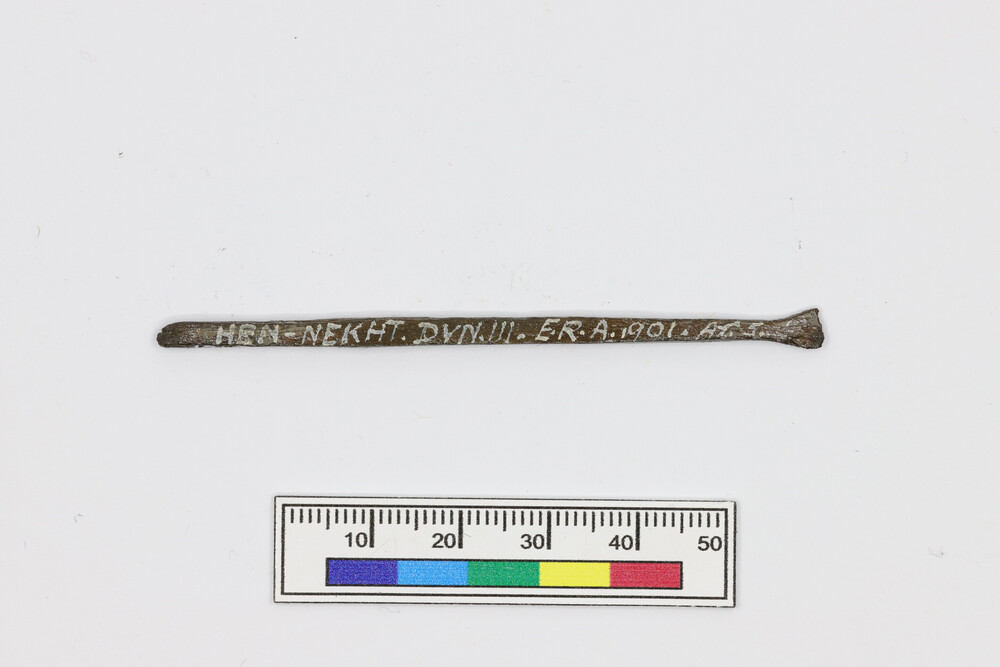 1901.42.122Copper chisel.1901.42.122
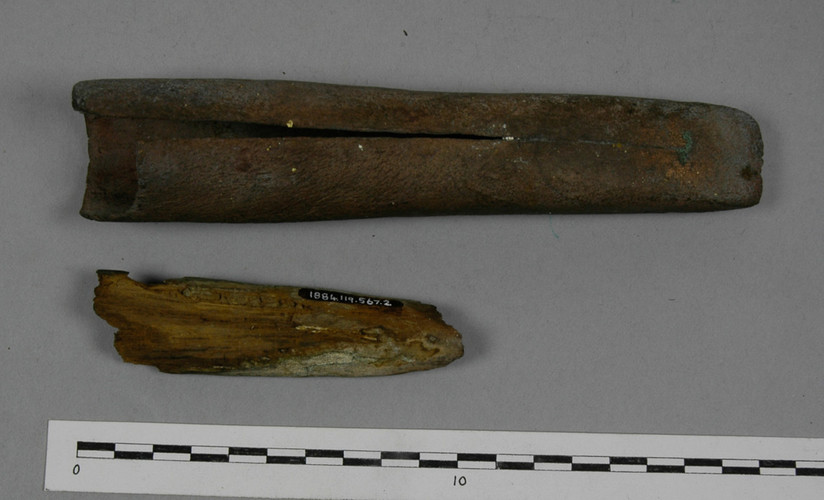 1884.119.567.1Copper chisel with remains of a wooden haft1884.119.567.1
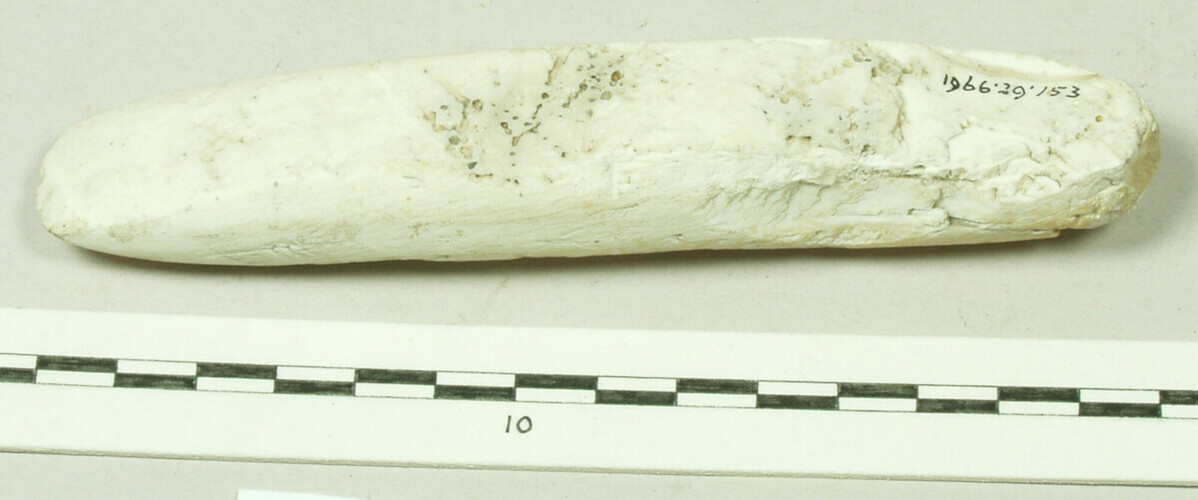 1966.29.153Shell fragment1966.29.153
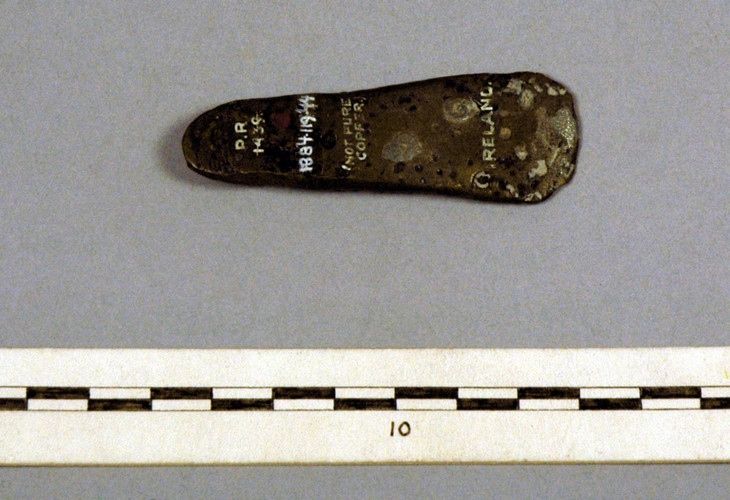 1884.119.44Bronze axe1884.119.44
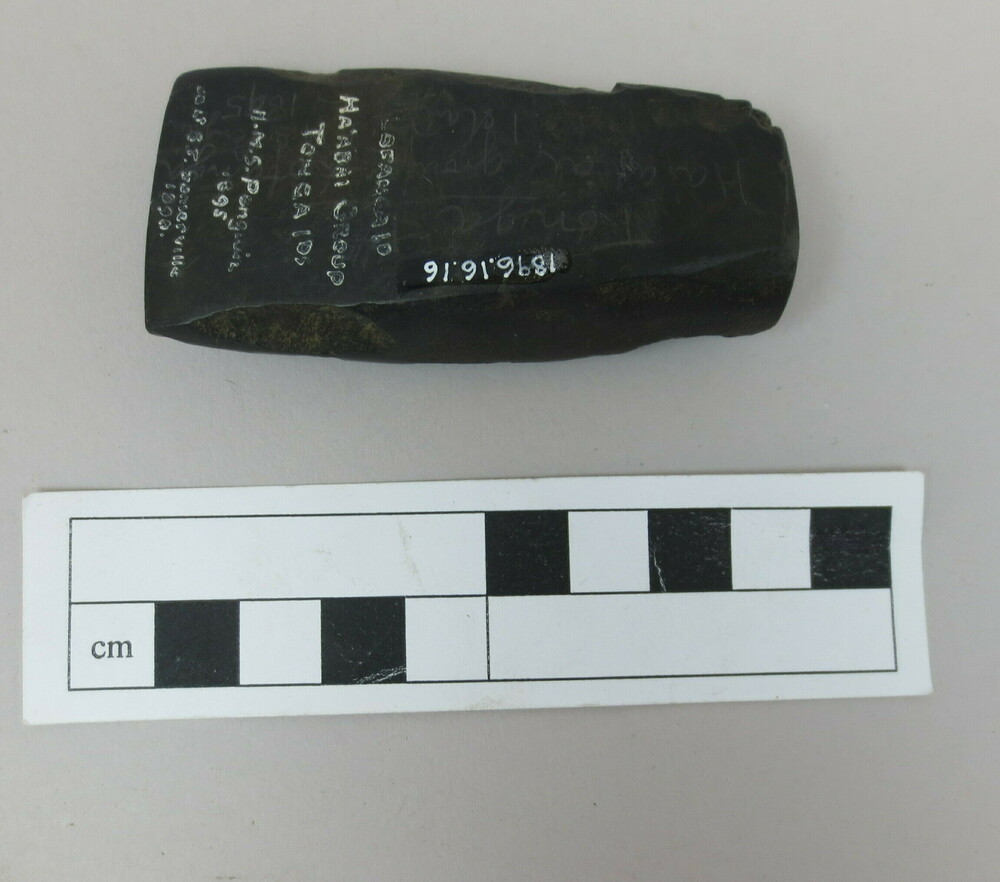 1896.16.16Stone axe.1896.16.16
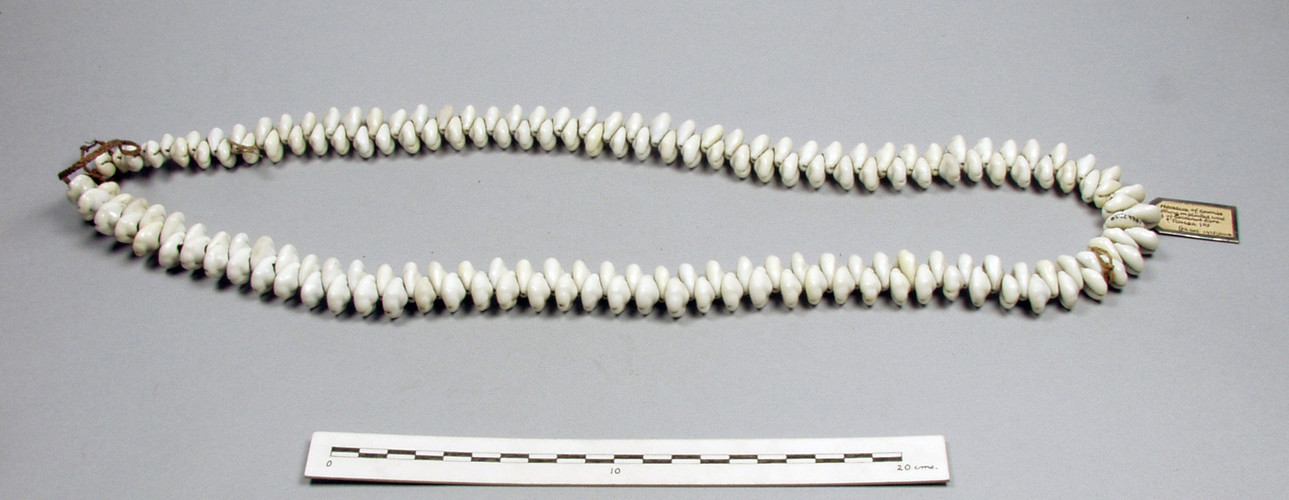 1884.73.20Necklace of cowrie shells threaded on plaited coconut fibre. [LM 'DCF 2004-2006 What's Upstairs?' 16/11/2005]1884.73.20
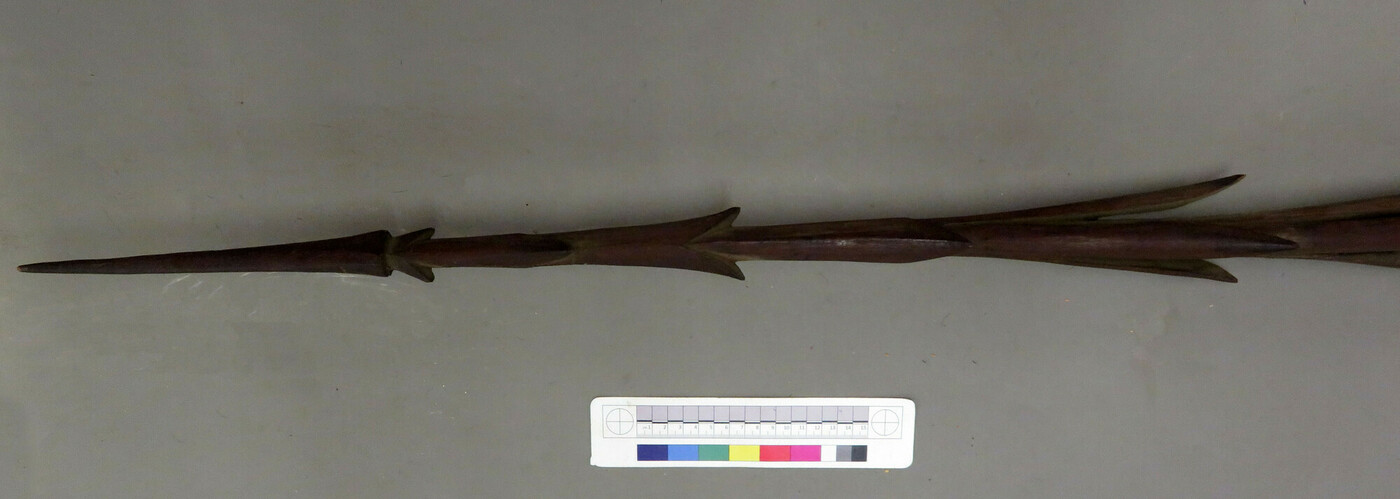 1884.19.78Stained wooden spear, tapering at both ends. The head is carved with wooden barbs in four bands of two barbs followed by three bands of three. [DV [OPS move] 26/7/2018]1884.19.78
 1884.15.63Bow, made from wood. No string attached. [ASh [OPS move] 14/8/2017]1884.15.63