
- Collection type
- Object
- Description
- 'V' shaped hook of wood with wooden point curving inwards. Snood string line, with a loop, tied to shank. [MJD 20/03/2009]
- Long description
- 'V' shaped hook of wood with wooden point curving inwards. Snood string line, with a loop, tied to shank. Line is plaited sennit fibre and bound with plant fibre. [MJD 20/03/2009]
- Geographical reference
- Tuamoto Archipelago, Vairaatea [Egmont Island]
- Person
- Field collector Frederick William Beechey
- Field collector HMS Blossom
- PRM source Ashmolean Museum, University of Oxford
- Date / Period
- Date made: Before 01/1826
- Date collected
- January 1826
- Acquisition information
- Transferred: 19/04/1886
- Materials and processes
- Material Wood Plant, Material Plant Fibre, Material Sennit Coconut Seed Fibre Plant, Process Bound, Process Carved, Process Tied, Process Twisted, Process Plaited
- Dimensions
- Length x Width: max 335 x 154 mm
- Object numbers
- Accession number: 1886.1.1308 Other numbers: 362
- Research and responses
In his account of the 1825–1828 voyage of HMS Blossom, its commander writes: 'From Thrum Cap we steered for Egmont Island, the second discovery of Captain Wallis, which we shortly saw from the mast-head, and by sunset were close to it. The next morning the shore was very carefully examined, and we found the reef so low toward the centre that in high tides there can be no communication with the extremities. The island is steep, like all the other coral islands, and well wooded with cocoa-nut and pandanus-trees, and has one of the large clumps at its N. W. extremity. [np] Upon the windward island we perceived about fifty inhabitants collected upon the beach; the men in one groupe [sic], armed in the same manner as the Lagoon [Vahitahi] Islanders, and the women in another place more inland. No boat could land on this or on any other part of the island: to leeward the S. W. rolled even more heavily upon the shore than that occasioned by the trade-wind on the opposite side: we were in consequence obliged to trade with the natives in the manner pursed at Lagoon Island. Two of the islanders, when they thought we were going to land, advanced with slow strides, and went through a number of pantomimic gestures, which we could not understand, except that they were of a friendly nature. This lasted until the boats anchored outside the reef, and they were invited to accept some pieces of "toki." Gold and silver are not more valued in European countries, than iron, even in its rudest form, is by the islanders of Polynesia. At the sound of the word, the two spokesmen, and all the natives, who had before been seated under the shade of the trees, ran off to their huts, and brought down whatever they thought likely to obtain a piece of the precious substance,—mats, bands, nets, oyster-shells, hooks, and a variety of small articles similar to those before described were offered for / sale. The only article they would not part with, though we offered a higher price than it seemed to deserve, was a stick with a bunch of black tern feathers suspended to it. At Lagoon, and other islands, which we visited both before and afterwards, the natives carried one or more of these sticks: they are mentioned as being seen by the earliest voyagers, and are probably marks of distinction or of amity. [np] These people so much resemble the Lagoon Islanders in person, manners, language, and dress, as to need no description....'. See pages 155/156 of Narrative of a Voyage to the Pacific and Beering’s Strait: to Co-Operate with the Polar Expeditions: Performed in His Majesty’s Ship Blossom, under the Command of Captain F. W. Beechey...in the years 1825, 26, 27, 28, by Frederick William Beechey (London: Henry Colburn and Richard Bentley, 1831). [JC 17 10 2013]
In his Journal of the 1825–1828 voyage of HMS Blossom (British Library, Manuscript Collections, Add. MS 35141), Lieutenant George Peard notes: 'Here again our boats layed off, and the Natives waded through the surf and exchanged Fish hooks, clubs, Spears, mats, canoe paddles, ornaments made of their own hair, and belts plaited of the pooraow tree bark, for Nails and beads. There are no Cocoa-nuts on the Island. [np] The general appearance of these people resembled those of Lagoon [Vahitahi], excepting that their hair was tied up on one side of the head, and besides they wanted that open, frank, and agreeable manner which distinguished the others. Many of them remained concealed in the woods; and those that came down to us, at first approached in a stooping posture, with various pantomime gestures, as if reconnoitring an enemy. [np] Their largest fish hooks, intended most likely for catching sharks, are composed of a small branch of a tree, naturally grown into something like the proper form, and as a substitute for point and barb, a curved piece of oyster shell is spliced on with the point towards the bend of the hook. The next size / about two Inches long are of the same form, and entirely of Mother of Pearl. A smaller kind is made from the shell of the Turtle. Besides these, there are some of Pearl with a tuft of feathers to imitate the flying Fish. Their clubs or spears are of different lengths, some merely a heavy stick 4 feet long, thick at one end and pointed at the other, whilst some have a sharp piece of Whale-bone attached like those at Lagoon Island [Vahitahi].' See pages 105-106 of To the Pacific and Arctic with Beechey: The Journal of Lieutenant George Peard of H.M.S. 'Blossom', 1825–1828 (Works Issued by the Hakluyt Society, 2nd ser., no. 143), edited by Barry M. Gough (Cambridge: At the University Press, for the Hakluyt Society, 1973). [JC 17 10 2013]
- Associated publications
- Listed (with 1886.1.1309 and 1886.1.1310) as numbers 362, 263 on page 187 of A Catalogue of the Ashmolean Museum Descriptive of the Zoological Specimens, Antiquities, Coins, and Miscellaneous Curiosities (Oxford, 1836): 'South Sea Islands, &c.... 362, 363. Shark-hooks, from Egmont Island. (Capt. B[eechey].' [JC 17 10 2013] Illustrated with 1887.1.1309 and 1886.1.1310 in black and white as Plate LXX (apparently composed of details from PRM000081278 and PRM000081285) opposite page 46 in Fish Hooks (Pacific Island Records), by Harry G. Beasley (London: Seeley, Service & Co., Ltd, 1928). Beasley writes (page 45) under the heading 'Part I. Polynesia' and sub-headings 'Paumoto Group (Low Archipelago)', 'Island of Mangareva', and 'Shark Hooks': 'A further series, showing considerable variation, is shown in the next plate (LXX.), which was collected by Captain Beechey, of H.M.S. Blossom, in 1926, from Vairatea, or Egmont Island. They are all cut from natural forks, which may possibly be roots and not branches—a practice common in Tahiti—the wood itself being of a pale colour. In all three cases the excellence of the lashings is remarkable, both in the even quality of the plaiting and the method of attachment. No. 1 [1886.1.1308] differs from the others in having the barb of the same wood as the shank. Those of Nos. 2 [1886.1.309] and 3 [1886.1.1310] are of pearl shell; in each case the snoods and lashings appear to be of sennit, the ends being finished with loops. No. 1 [1886.1.1308] measures 10 in. (25.9 cm.); Nos 2 [1886.1.1309] and 3 [1886.1.1310], 6 in. (15.3 cm.) and 6 1/2 (16.5 cm.) respectively.' [JC 24 6 2016]
Search terms: Fishing, Line, Hook, Fishing Accessory
Further items to explore
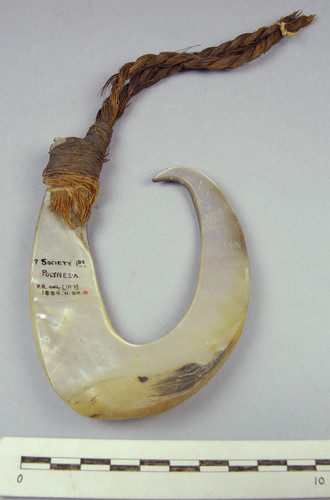 1884.11.24'U' shaped fish hook made from a single piece of pearl shell. Sennit fibre cord bound to hook.1884.11.24
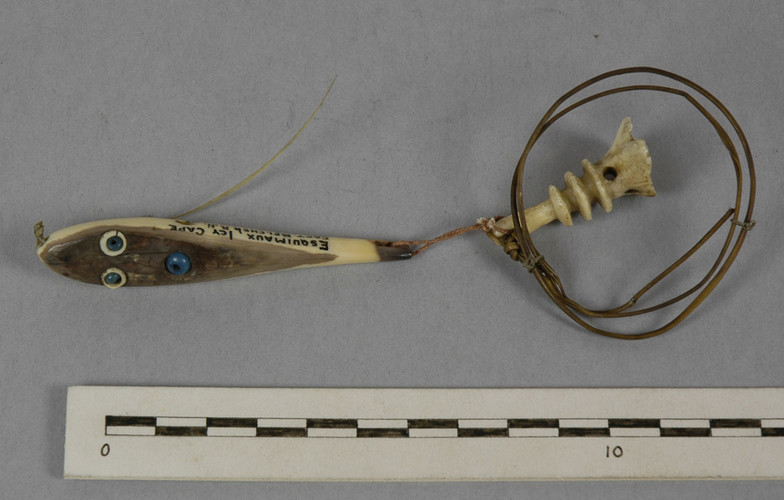 1884.11.72Fishing lure of walrus ivory.1884.11.72
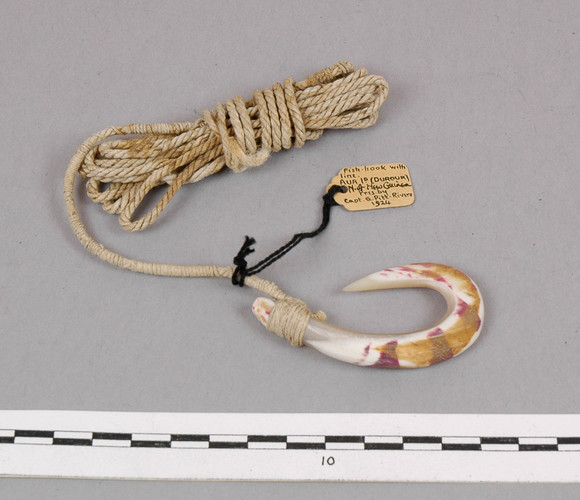 1924.51.85Shell shark-hook, tied to a length of plant fibre line. [LM 25/06/2007]1924.51.85
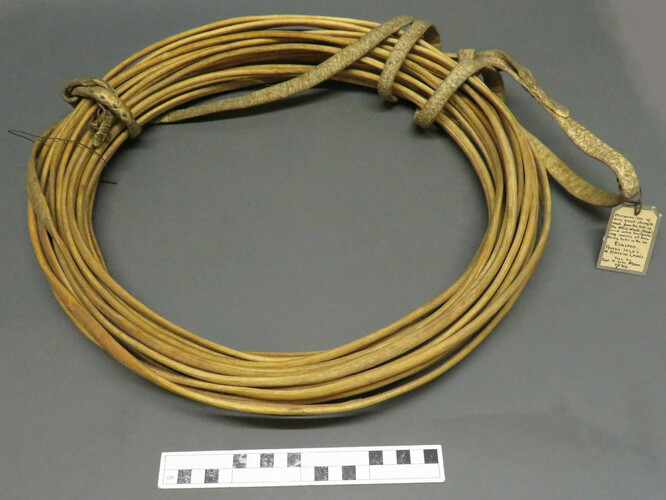 1934.13.4Whale hide harpoon-line. The harpoon-line, which is coiled, is bound together with ?seal or ?walrus hide. [SB [OPS Move] 27/6/2017]1934.13.4
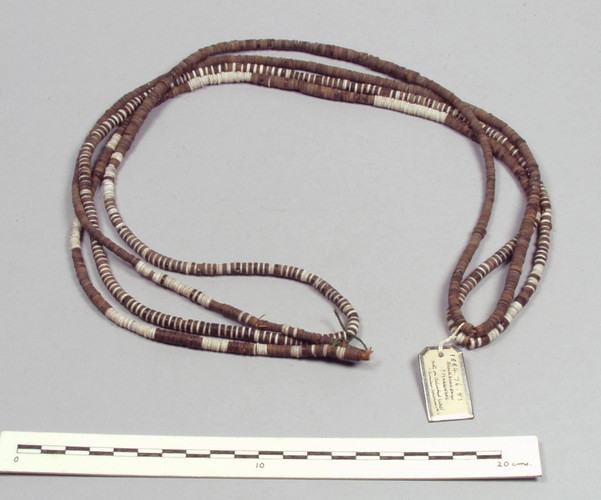 1884.76.51String of white shell and gorgonia disc beads. [LM 'DCF 2004-2006 What's Upstairs?' 22/7/2005]1884.76.51
 1884.85.3Tattooing tool1884.85.3
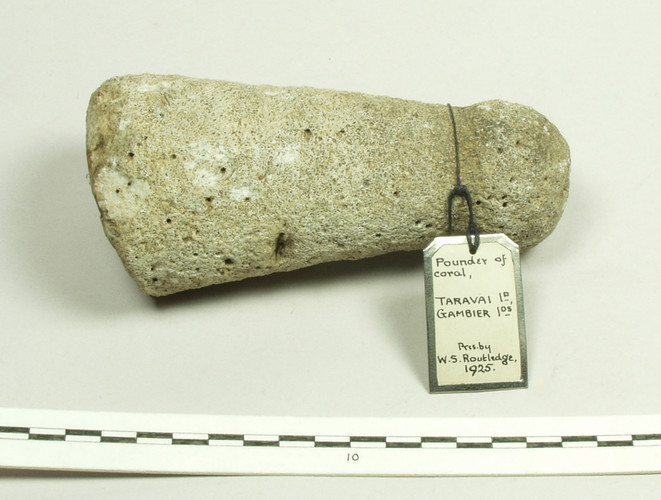 1925.29.101Coral pounder.1925.29.101
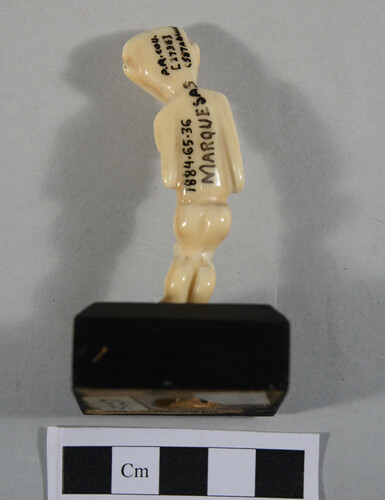 1884.65.36Small carved figure, carved of whale tooth.1884.65.36