
- Collection type
- Object
- Description
- 'U' shaped fish hook made of a single, flat piece of black shell with plant fibre snood. The barbless point curves inwards. [MJD 18/03/2009]
- Geographical reference
- Tahiti
- Person
- Field collector Johann Reinhold Forster
- Field collector Georg Forster
- Field collector HMS Resolution
- Field collector Frederick William Beechey
- Field collector HMS Blossom
- PRM source Ashmolean Museum, University of Oxford
- Date / Period
- Date made: Before 1836
- Date collected
- 1773-1774 (?) or 1806 - 1836
- Acquisition information
- Transferred: 19/04/1886
- Materials and processes
- Material Shell, Material Plant Fibre, Process Carved, Process Ground, Process Bound, Process Twisted, Process Tied
- Dimensions
- Width: max 44 mm, Length: max 66 mm
- Object numbers
- Accession number: 1886.1.1291 Other numbers: Forster 34?
- Research and responses
According to Peter Gathercole there is not enough distinctive stylistic evidence or concrete documentation to determine whether any of the fish hooks included in the Cook catalogue were collected by the Forsters or if they could even be associated with Cook voyages. [PG 26/2/97] However, a number of fish hooks have been assigned Forster numbers (1282, 1292, and 1301-1305) but these attributions are tenuous due to the above stated reasons. This object has not been designated a 'Forster' number. [undated, unsigned, but NMM; JC 9 7 2015]
Examined by Chris Paulin (Natural Environment Projects Officer at the Museum of New Zealand Te Papa Tongarewa) during a visit to the PRM 24-26 June 2009. For an account of Paulin's project, see copy of his unpublished 'Research Report: Māori Fishhooks in European Museums - Winston Churchill Fellowship 2009' in RDF: Researchers: Paulin. See also: 'Māori Fishhooks in European Museums', by Chris D. Paulin, in Tuhinga: Records of the Museum of New Zealand Te Papa Tongarewa, no. 21 (2010), pp. 13-41, esp. 27-29 (copy in RDF: Researchers: Paulin). NB Paulin does not list the item in his list of 'Hooks Examined' (see page 29 of his article), but the item is one of those made available for him to examine. [JC 12 8 2010]
This hook was thought to be from New Zealand. Microscopic examination of the fibres of the cords attached to the hook was carried out, comparing them to known fibres of New Zealand flax. Neither cord is of New Zealand flax, and the fine cord is thought to be made from olonga fibre (Pipturus argenteus). The thicker cord may also be olonga, but less processed, or it may possibly be hibiscus fibre (fau). Identical hooks are listed in 'Cook's Pacific Encounters - The Cook-Forster Collection of Georg-August University of Gottingen' (National Museum of Australia Press 2006' as being from Tahiti, which tallies with the plant fibre identification (see entries 199,199a, 200 and 201). [JU 21/11/2012]
Samples of the fibres from both cords were were given to Caroline Cartwright of the Department of Conservation and Scientific Research at the British Museum for identification. [JU 13/12/2012] The thinner cord is confirmed as olonga (Pipturus argenteus) while the thicker is hibiscus fibre (fau, Hibiscus tiliaceus). See RDF for the report [JU 13/12/2013]
- Associated publications
- Illustrated in colour on page 53 of Fish and Ships! Food on the Voyages of Captain Cook—Catalogue to the Exhibitions 2011–2012 in the Captain Cook Memorial Museum, Whitby (Whitby: Captain Cook Memorial Museum, no date [2012]. Caption (same page) reads: 'Turtleshell fishook, Polynesia / Made from a single piece of black shell, with plant fibre cord. Perhaps the hook was intended to represent a worm or similar sea creature. Such hooks might be used in deep water where the currents were strong, but also in shallow water where the fisherman might be concerned about his line catching on coral heads. Pitt Rivers Museum, University of Oxford 1886.1.1291.' (For details of Eating the Exotic!, the exhibition in which this object featured, see under 'Display History'.) [JC 6 9 2013]
Search terms: Fishing, Hook, Lure, Fishing Accessory
Further items to explore
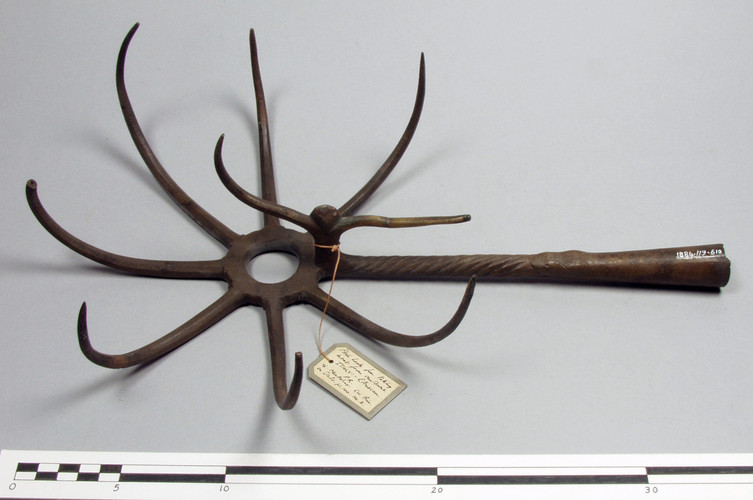 1884.119.610Copper alloy drag or grapple, probably for taking meat out of a cauldron. The object consists of seven claws in a circle and two curved prongs at the top of the socket. The base of the socket which becomes twisted is in the shape of an animal's mouth. [MdeA 15/2/2001]1884.119.610
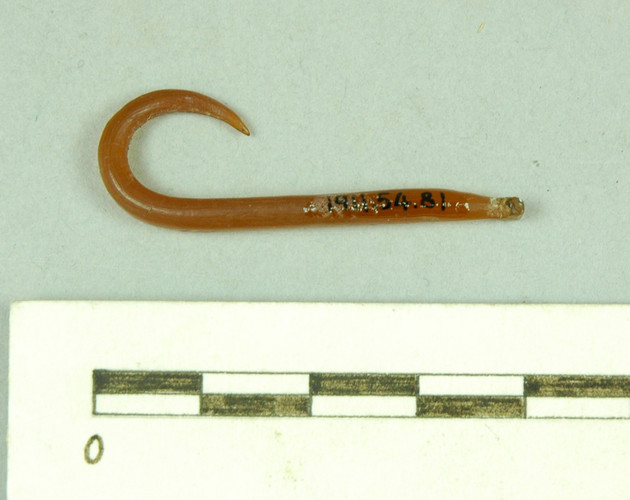 1911.54.81Fish hook of turtleshell. [MJD 21/04/2009]1911.54.81
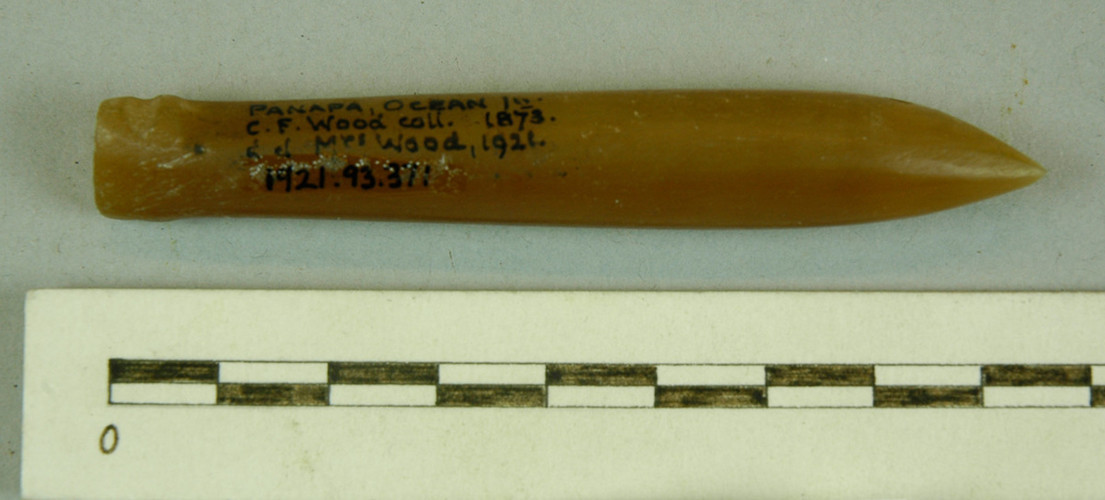 1921.93.371Shank of stalagmite stone to which bone fish-hook would be lashed. Shank is notched and perforated. [MJD 26/03/2009]1921.93.371
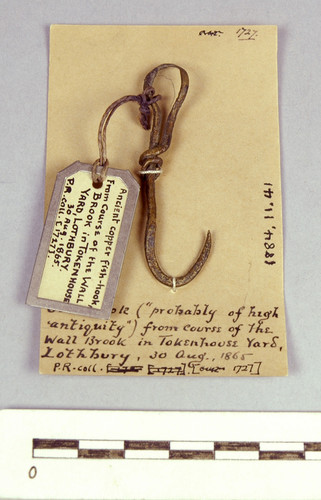 1884.11.41Bronze fish-hook1884.11.41
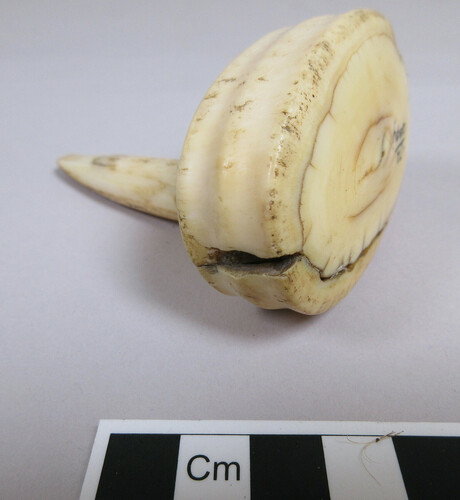 1884.84.42Heavy ear pendant with peg and disc carved in one piece. The peg is perforated.1884.84.42
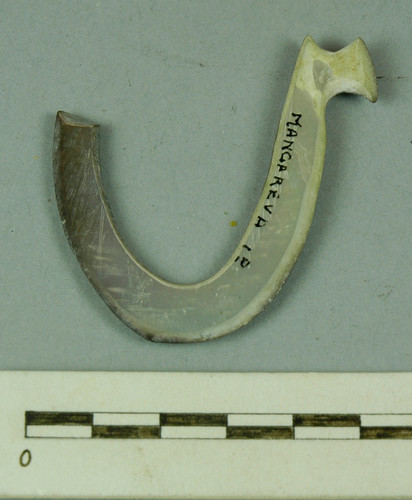 1925.29.24Pearl shell fish-hook, 'U' shaped with notch to tie line, point is broken. [MJD 16/03/2009]1925.29.24
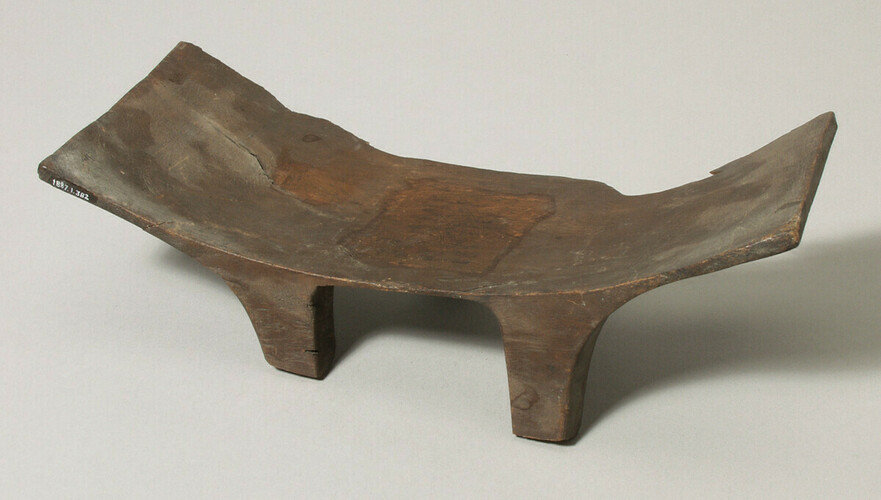 1887.1.382Part of wooden headrest with the top of two legs remaining on one side.1887.1.382