
- Collection type
- Object
- Description
- Baler carved of wood and inlaid with two pieces of haliotis shell.
- Long description
- Baler carved from a single block of wood. Carved in the form of a face, with eyes, inlaid with haliotis shell, eyebrows, nose, and mouth with six teeth. The carving appears unfinished. A local repair using plaited NZ flax fibre has been made to hold down a large flake in the wood on the underside. [JU 28/08/2013]
- Geographical reference
- Cultural groups
- Māori
- Person
- Field collector Johann Reinhold Forster
- Field collector Georg Forster
- PRM source Ashmolean Museum, University of Oxford
- Date / Period
- Date made: Before 04/06/1773?, uncertain Date made: Definitely by 10/11/1774
- Date collected
- Possibly on 4 June 1773; certainly 1773 or 1774 (between 26 March and 11 May 1773, or between 18 May and 7 June 1773, or between 3 November and 25 December 1773; or between 16 October and 10 November 1774)
- Acquisition information
- Transferred: 19/04/1886
- Materials and processes
- Material Wood Plant, Material Haliotis Shell, Material Plant Fibre, Process Carved, Process Inlaid, Process Repaired (local), Process Twisted, Process Perforated
- Dimensions
- Width 279 mm, Length 445 mm
- Object numbers
- Accession number: 1886.1.1264 Other numbers: Forster 117
- Research and responses
Drawing on George Forster's account of the voyage, Peter Gathercole has suggested that the Forsters may have acquired this object on 4 June 1773 at Queen Charlotte Sound from members of a Maori group led by a man named 'Teiratu'; see page 14 of 'The Significance for Polynesian Ethnohistory of the Reinhold Forster Collection at Oxford University', by Peter Gathercole (Paper presented at the 28th Congress of Orientalists, Canberra, 1971). [JC 22 2 2001]
- Associated publications
- Listed in the Catalogue de la Section Ethnographique de l’Exposition Internationale Coloniale et d’Exportation Générale tenue à Amsterdam du 1 Mai au 31 Octobre 1883, by L. Serrurier (Leiden: E. J. Brill, 1883) [Also published in Dutch], the accompanying catalogue to the above exhibition, as no. 15: ‘Collection of objects from Captain Cook’s second voyage, exhibited by the Ashmolean Museum, Oxford. … 15. (puisoir) Vessel for water in brown wood, in the form of a dish; the rounded part underneath is carved; the handle is attached here and curves inwards. The carving represents an animal whose eyes are made out of two shells. New Zealand.' [Translated from French by Adrienne Hopkins, 2002]. [JP 22/9/2004] Listed according to the 'Forster list' numbering system in 'From the Islands of the South Seas 1773-4': An Exhibition of a Collection Made on Capn. Cook's Second Voyage of Discovery by J.R. Forster - A Short Guide (Oxford: Pitt Rivers Museum, no date[1970]). The text from the 'Forster' manuscript is followed by the following notes: 'A well worn but attractively decorated baler. The decoration is unfinished and a jagged crack has been repaired with a flax binding. For a right-handed man. Length: 46cm.' Listed as number 1 under ‘New Zealand...Bailers’ on page 203 of 'Artificial Curiosities': Being an Exposition of Native Manufactures Collected on the Three Pacific Voyages of Captain James Cook, R.N. at the Bernice Pauahi Bishop Museum, January 18, 1978 - August 31, 1978 on the Occasion of the Bicentennial of the European Discovery of the Hawaiian Islands by Captain Cook - January 18, 1778 (Bernice P. Bishop Museum Special Publication 65), by Adrienne L. Kaeppler (Honolulu: Bishop Museum Press, 1978): '1. Bailer, Oxford (117). Length 46 cm. Figure 408. Evidence: Forster collection. Second voyage. Literature: Gathercole, n.d. (1970) [see above]'. Also reproduced in black and white as figure 408 on page 203. [JP 24/7/2002] Published as part of the Forster Collection on a dedicated website at www.prm.ox.ac.uk/forster (from February 2001). [JC 7 7 2005] For an account of the history of the collection of which this is part, see 'The Cook-Voyage Collections at Oxford, 1772–1775', by Jeremy Coote, in Jeremy Coote (ed.), Cook-Voyage Collections of 'Artificial Curiosities' in Britain and Ireland, 1771–2015 (MEG Occasional Paper No. 5), Oxford: Museum Ethnographers Group (2015), pp. 74–122. (Copy in RDF: Researchers: Jeremy Coote (Cook-Voyage Collections).) [JC 9 6 2016] This and 1887.1.381 are discussed in 'Crazy Bailers', by Hermione Waterfield, in OAS Journal [Oceanic Art Society Journal], Volume 20, number 2 (April 2015), pp. 6-7. Waterfield writes: 'Bailers are used all over the world to scoop the water from the bottom of boats, but those in the Pacific are carved in wood. Objects for practical use, but nonetheless the Maori of New Zealand often decorated them lavishly. They were prized items for those who sailed with Captain Cook on his circumnavigations, and two examples are now in the Pitt Rivers Museum, Oxford. The finest was collected by Joseph Banks on the First Voyage, beautifully balanced with fine carving it has often been published, but a very curious one was collected by the Forsters on the Second Voyage. Jeremy Coote, curator of the Pacific collections who has put all the museum’s collections on the web, is not proud of this example in his collections, in fact he can get irritated when asked for this bailer on loan rather than the handsome First Voyage example. The decoration appears to be unfinished and it might have been made for the visitors, but it is perfectly “genuine” - just the work of a quirky carver.' This is also illustrated as Figure 1 on page 6. (Copy of article in RDF.) [JC 16 6 2017]
Search terms: Navigation, Tool, Canoe Baler, Scoop
Further items to explore
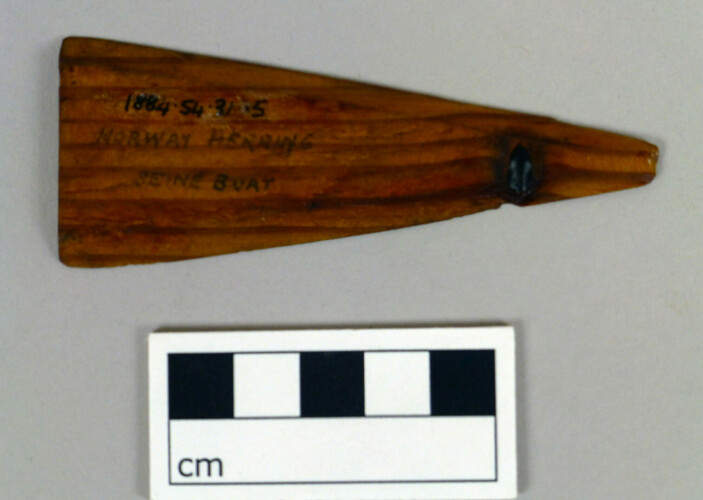 1884.54.31.5Varnished hatch to cover part of the floor of a row boat providing storage underneath, part of boat model 1884.54.31 [ZM 9/3/2016]1884.54.31.5
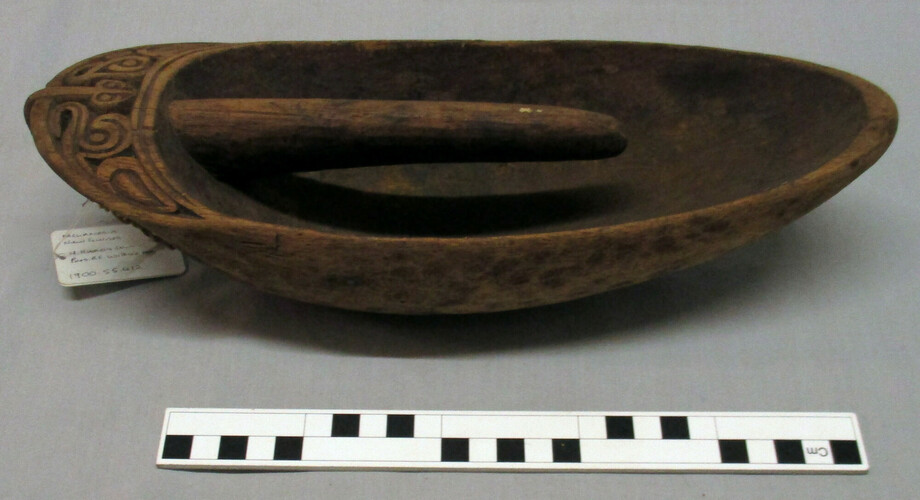 1900.55.412Canoe baler of brown wood with carved design at the heel. [MJD 06/05/2010]1900.55.412
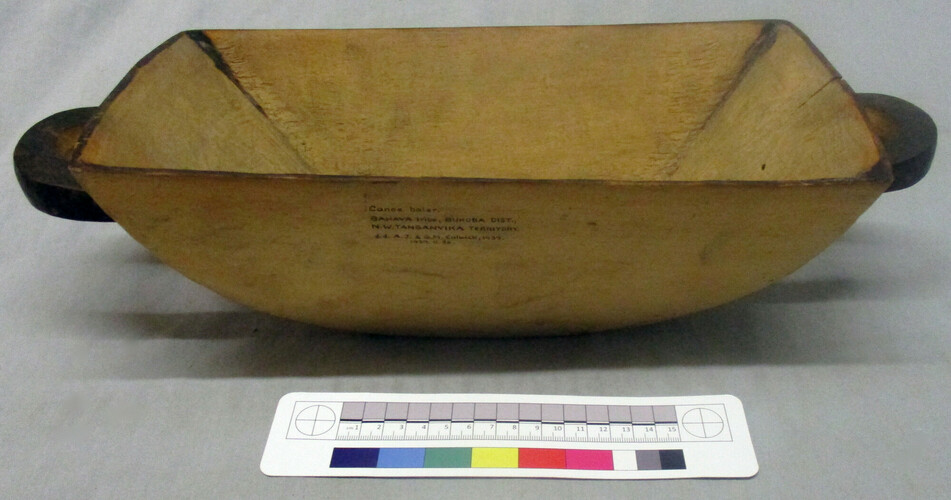 1939.11.36Canoe baler with rectangular opening and curved base. Two handles and rim varnished dark brown. [LKG 13/05/2010]1939.11.36
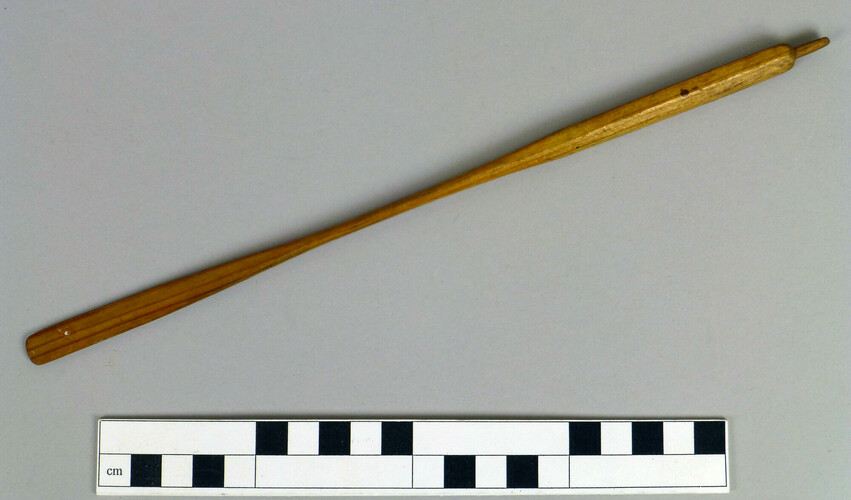 1884.54.31.7One of four oars, part of boat model 1884.54.31 [ZM 9/3/2016]1884.54.31.7
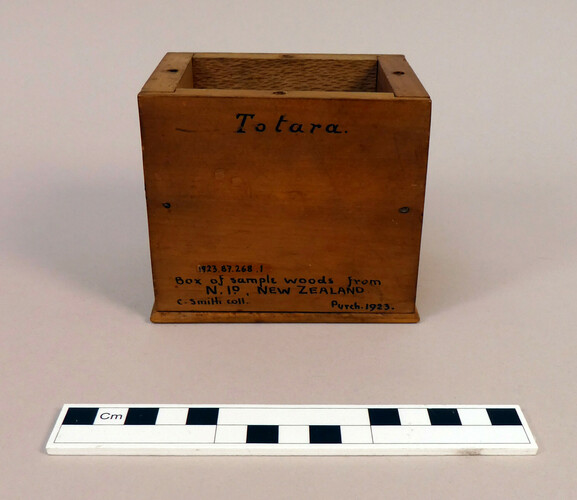 1923.87.268.1Rectangular box made from specimens of New Zealand woods. For lid see [1923.87.268 .2]. [JMC 27/6/2018]1923.87.268.1
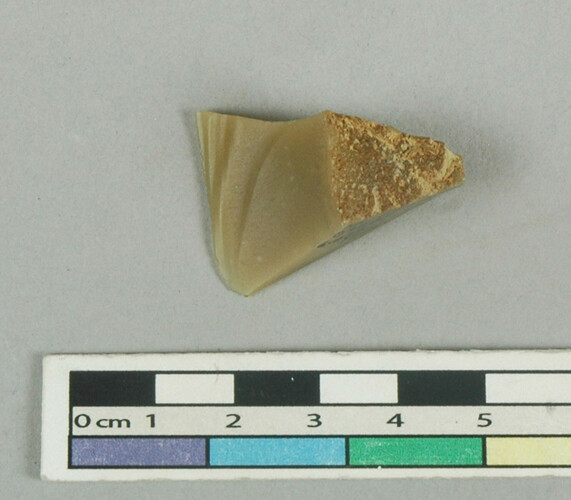 1930.14.4Flake of silicious stone. [El.B 18/05/2011]1930.14.4
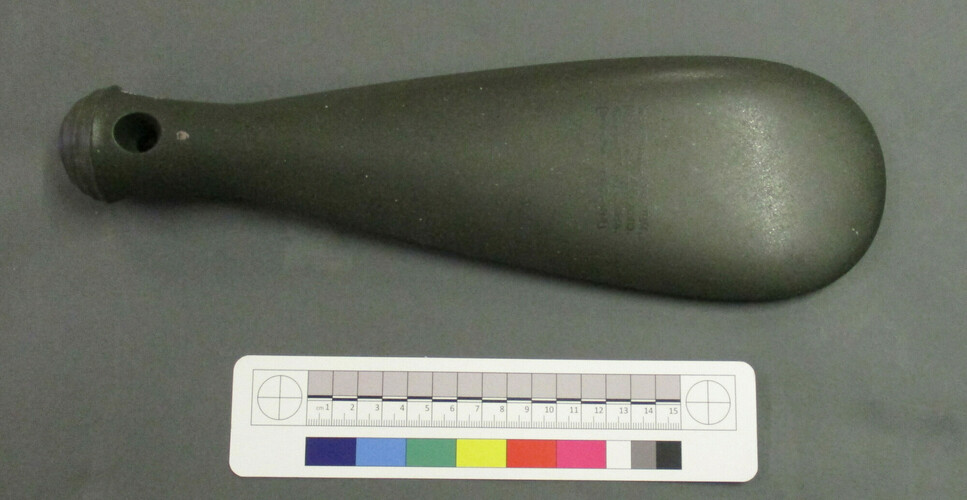 1886.1.1148Spatulate stone club with convex blade tip and tapered handle with perforated and ridge carved butt. [BS [OPS Move] 14/09/2016]1886.1.1148
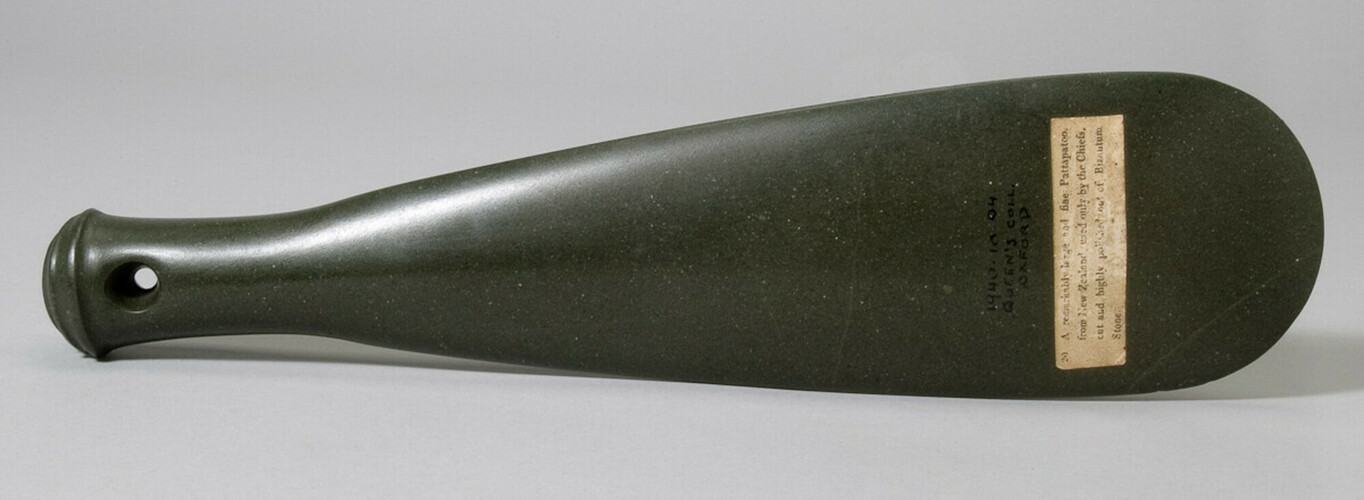 1940.10.04Cleaver of greywacke.1940.10.04