
- Collection type
- Object
- Description
- Barkcloth. Yellow with red circular design.
- Long description
- A large piece of barkcloth, of medium weight. Beater marks are visible. The surface is decorated with circles in red pigment, probably printed with the end of a reed. The circles are about 15 mm in diameter, and not evenly spaced over the surface. At one end are several linear, square motifs. [Kloe Rumsey 05//09/12; JU 05/09/2012]
- Geographical reference
- Society Islands Tahiti
- Person
- Field collector Johann Reinhold Forster
- Field collector Georg Forster
- PRM source Ashmolean Museum, University of Oxford
- Date / Period
- Date made: Before 04/06/1774?, uncertain
- Date collected
- Between 17 August and 18 September 1773, or between 22 April and 4 June 1774?
- Acquisition information
- Transferred: 19/04/1886
- Materials and processes
- Material Bark Fibre Plant, Material Mulberry Leaf Plant, Material Bark Cloth Textile Plant, Material Pigment, Process Beaten, Process Stencilled
- Dimensions
- Length x Width 5400 x 1220 mm
- Object numbers
- Accession number: 1886.1.1236 Other numbers: Forster 15
- Associated publications
- Listed according to the 'Forster list' numbering system in 'From the Islands of the South Seas 1773-4: An Exhibition of a Collection Made on Capn. Cook's Second Voyage of Discovery by J.R. Forster- -A Short Guide (Oxford: Pitt Rivers Museum, no date[1970]). The text from the 'Forster' manuscript is followed by the following notes: '15. a yellow piece with red spots. Actually three pieces. Dimensions 253cm. x 160cm.; 157cm. x 114cm.; 540cm. x 122cm. They recall the piece worn by Omai in the well known drawing by Nathaniel Dance, 1775. (See copy exhibited). Was he perhaps fitted out with items from this Collection? Apart from the tapa, he carries a headrest and sunshade (cf. Nos.30 & 136) and a headdress (cf. No.40, now lost).' Listed as one of number 3 under ‘Tahiti...Bark Cloth’ on page 130 of 'Artificial Curiosities': Being an Exposition of Native Manufactures Collected on the Three Pacific Voyages of Captain James Cook, R.N. at the Bernice Pauahi Bishop Museum, January 18, 1978 - August 31, 1978 on the Occasion of the Bicentennial of the European Discovery of the Hawaiian Islands by Captain Cook - January 18, 1778 (Bernice P. Bishop Museum Special Publication 65), by Adrienne L. Kaeppler (Honolulu: Bishop Museum Press, 1978): '3. Oxford (8-22 [This last number is incorrect and should read 20]), 13 pieces from the Forster collection including three pieces belonging to the mourning dress and a turban used to fasten the large helmet. '. [JP 23/7/2002] Listed on page 466 of 'Appendix A: Catalogue of Society Island Objects with Secure Eighteenth-Century Provenance' in 'Shaping the Body Politic: Gender, Status, and Power in the Art of Eighteenth-Century Tahiti and the Society Islands', by Anne Elizabeth D'Alleva (New York: Columbia University, Ph.D. thesis, 1997). She describes it as follows: 'Thin, stiff, pale brown bark cloth with red bamboo prints of circles interspersed with back-to-back half-circles. Probably originally yellow color background.' [JP 31/7/2002] Published as part of the Forster Collection on a dedicated website at www.prm.ox.ac.uk/forster (from February 2001). [JC 7 7 2005] For an account of the history of the collection of which this is part, see 'The Cook-Voyage Collections at Oxford, 1772–1775', by Jeremy Coote, in Jeremy Coote (ed.), Cook-Voyage Collections of 'Artificial Curiosities' in Britain and Ireland, 1771–2015 (MEG Occasional Paper No. 5), Oxford: Museum Ethnographers Group (2015), pp. 74–122. (Copy in RDF: Researchers: Jeremy Coote (Cook-Voyage Collections).) [JC 9 6 2016]
Search terms: Barkcloth
Further items to explore
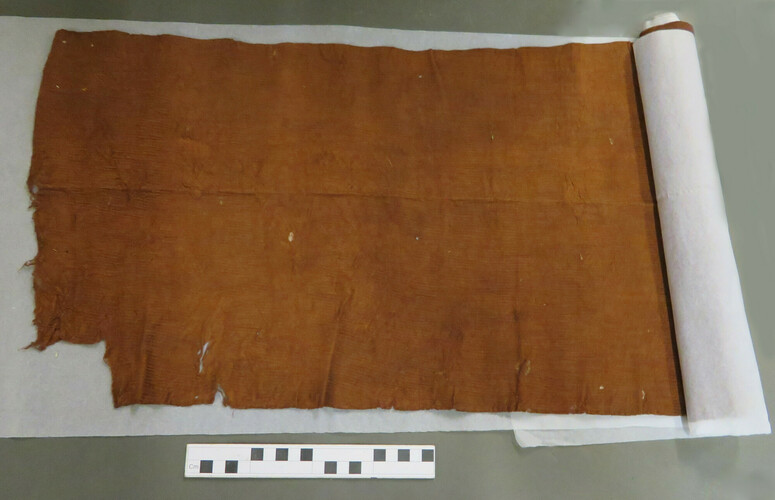 1981.8.1Barkcloth. It is dark brown in colour and dense with a smooth texture to the fibres. There are visible grooved indentations from the beater. [AF [OPS move] 1/8/2017]1981.8.1
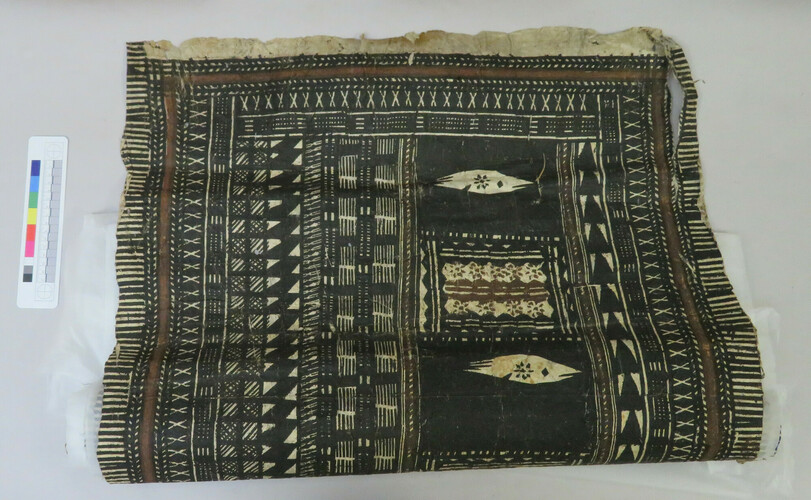 1914.56.30Barkcloth with stencil designs in black and brown pigment. [AF [OPS move] 16/8/2017]1914.56.30
 1914.15.56Stencil made of banana leaf. Used for decorating bark-cloth. [FB 28/11/2011]1914.15.56
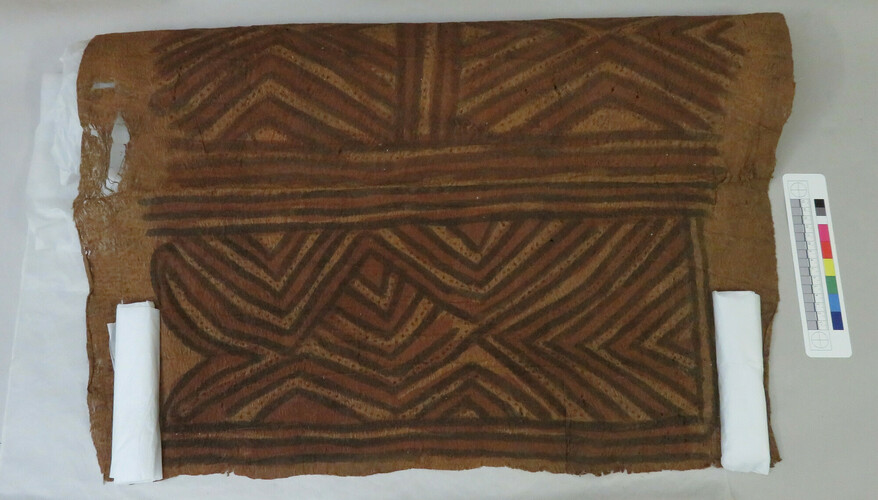 1942.1.211Piece of bark-cloth with painted designs. The cloth is brown and course in texture. The design features, triangles, chevrons and dots in brown and black pigment. [AF [OPS move] 14/8/2017]1942.1.211
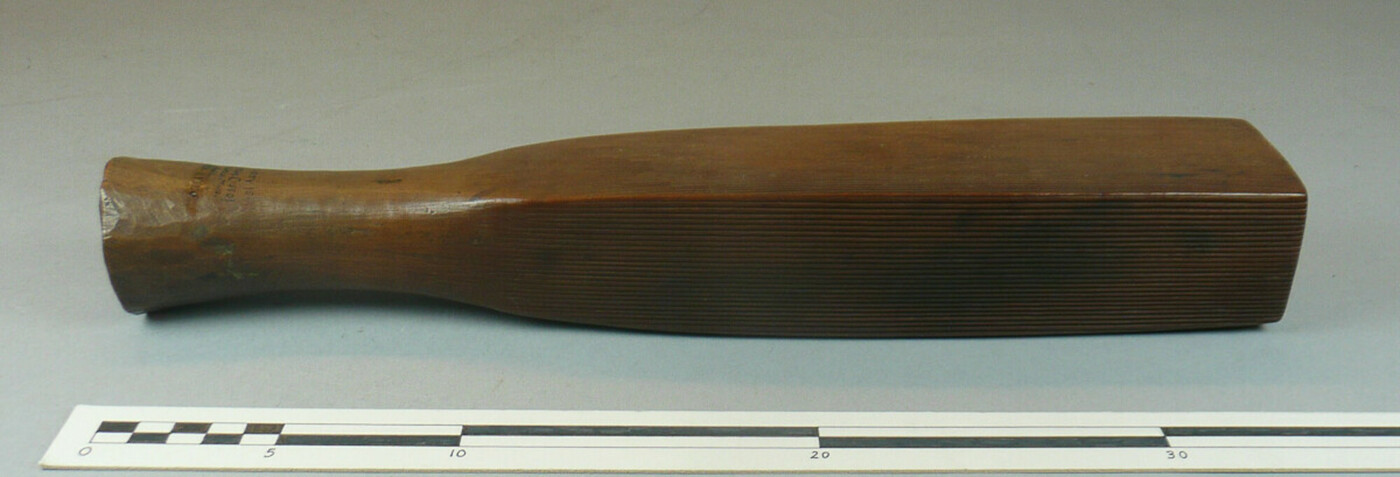 1886.1.1550Club-shaped barkcloth beater of heavy brown wood with four grooved faces of varying degrees of closeness.1886.1.1550
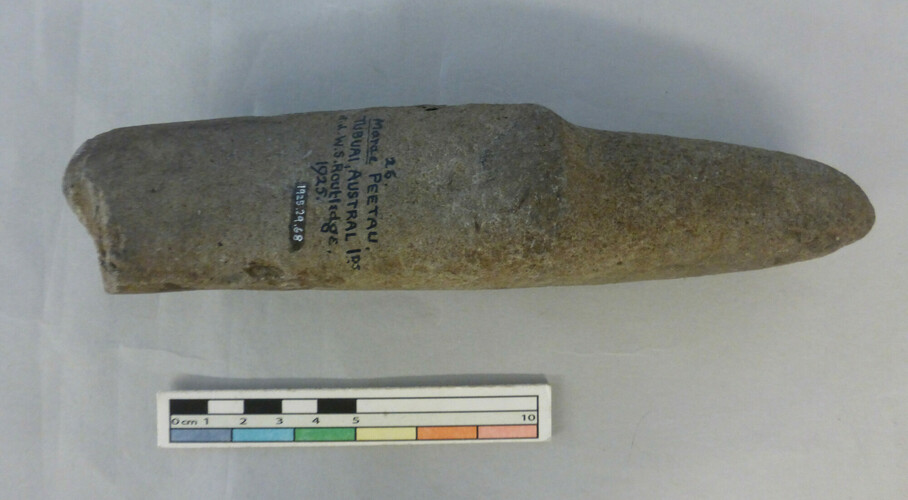 1925.29.68Stone adze blade; identified by Figueroa and Sánchez as an Eastern Polynesian Adze Type 3-F (finished). [Dan Hicks 06/06/2012]1925.29.68
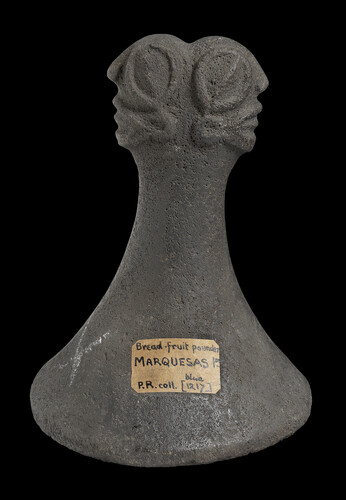 1884.128.78Stone pounder for preparing breadfruit. The pounder has a roughened base and two stylised carved heads back to back on top. [FB 04/06/2014]1884.128.78
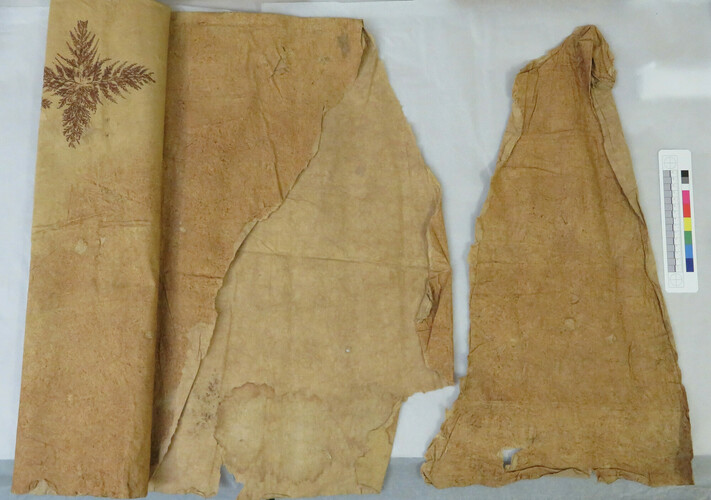 1966.21.1Piece of printed barkcloth with broken corner section. [AF [OPS move] 11/8/2017]1966.21.1