
- Collection type
- Object
- Description
- Barkcloth. Yellow with red circular design.
- Long description
- Barkcloth made from two layers, felted together at the edges. One edge has been cut, and the layers have separated. The felted edges are dyed red. The top layer of barkcloth has been dyed yellow, and decorated with circular designs in red made by dipping a stem of reed or bamboo into dye. [JU 17/12/2013]
- Geographical reference
- Society Islands Tahiti
- Person
- Field collector Johann Reinhold Forster
- Field collector Georg Forster
- PRM source Ashmolean Museum, University of Oxford
- Date / Period
- Date made: Before 04/06/1774?, uncertain
- Date collected
- Between 17 August and 18 September 1773, or between 22 April and 4 June 1774?
- Acquisition information
- Transferred: 19/04/1886
- Materials and processes
- Material Bark Fibre Plant, Material Mulberry Leaf Plant, Material Bark Cloth Textile Plant, Material Pigment, Process Beaten, Process Stencilled, Process Repaired (local)
- Dimensions
- Length x Width 2580 x 1780 mm
- Object numbers
- Accession number: 1886.1.1235 Other numbers: Forster 15
- Associated publications
- Listed according to the 'Forster list' numbering system in 'From the Islands of the South Seas 1773-4: An Exhibition of a Collection Made on Capn. Cook's Second Voyage of Discovery by J.R. Forster- -A Short Guide (Oxford: Pitt Rivers Museum, no date[1970]). The text from the 'Forster' manuscript is followed by the following notes: '15. a yellow piece with red spots. Actually three pieces. Dimensions 253cm. x 160cm.; 157cm. x 114cm.; 540cm. x 122cm. They recall the piece worn by Omai in the well known drawing by Nathaniel Dance, 1775. (See copy exhibited). Was he perhaps fitted out with items from this Collection? Apart from the tapa, he carries a headrest and sunshade (cf. Nos.30 & 136) and a headdress (cf.No.40, now lost).' Listed as one of number 3 under ‘Tahiti...Bark Cloth’ on page 130 of 'Artificial Curiosities': Being an Exposition of Native Manufactures Collected on the Three Pacific Voyages of Captain James Cook, R.N. at the Bernice Pauahi Bishop Museum, January 18, 1978 - August 31, 1978 on the Occasion of the Bicentennial of the European Discovery of the Hawaiian Islands by Captain Cook - January 18, 1778 (Bernice P. Bishop Museum Special Publication 65), by Adrienne L. Kaeppler (Honolulu: Bishop Museum Press, 1978): '3. Oxford (8-22 [This last number is incorrect and should read 20]), 13 pieces from the Forster collection including three pieces belonging to the mourning dress and a turban used to fasten the large helmet. '. [JP 23/7/2002] Illustrated in black-and-white (author's own photograph) as Figure 6 on page 42 of ‘Change and Continuity in Decorated Tahitian Barkcloth from Bligh’s Second Breadfruit Voyage, 1791-1793’, by Anne D’Alleva, in Pacific Arts, nos 11/12 (July 1995), pp. 29-42. The figure is used to illustrate 'the earlier bamboo-printed designs, which spread evenly over the surface of the cloth', in contrast to 'intensive border-patterning' that characterizes the barkcloth discussed in the article (quotations from page 35). Also referred to (as '1234/1235') in note 11 on page 37, in which she discusses examples in Cook-voyage collections of 'the use of red edges on thin barkcloth'; it is not clear why D'Alleva was unsure whether the item she wish to referred to in this note was [1886.1.]1234 or [1886.1.]1235. [JC 7 9 2001] Listed on page 467 of 'Appendix A: Catalogue of Society Island Objects with Secure Eighteenth-Century Provenance' in 'Shaping the Body Politic: Gender, Status, and Power in the Art of Eighteenth-Century Tahiti and the Society Islands', by Anne Elizabeth D'Alleva (New York: Columbia University, Ph.D. thesis, 1997). She describes it as follows: 'Large piece of pale brown (originally yellow) bark cloth with stamped bamboo patterns. Red edges all around except one short side, which appears to be cut with scissors. Cut is post printing. One area of cloth with circular bamboo prints in a grid pattern, another area with random circes [sic], filled-in circles, and back-to-back half-circles.' D'Alleva lists the inventory numer for this item as being either A.M. 1234 or 1235. From the description (above), and the label she mentions (Yellow printed label: '15') it would seem that she is referring to A.M. 1235 (1886.1.1235). However D'Alleva also appears to list this item on page 475. She again lists the inventory number as either A.M. 1234 or 1235, and describes the object as 'Large piece of pale brown (originally yellow) bark cloth with stamped bamboo patterns. Red edges all around except one short side, which appears to be cut with scissors. Cut is post printing. One area of cloth with circular bamboo prints in a grid pattern, another area with random circes [sic], filled-in circles, and back-to-back half-circles.' Whilst this last description does not closely resemble 1886.1.1235 the measurements D'Alleva gives this item (157 x 114 cm) match the dimensions on the computer record for 1886.1.1235 exactly. It is not clear why this confusion between records has arisen and why D'Alleva was unsure whether the item in either entry was [1886.1.]1234 or [1886.1.]1235. [JP 31/7/2002] Published as part of the Forster Collection on a dedicated website at < www.prm.ox.ac.uk/forster > (from February 2001). [JC 7 7 2005] For an account of the history of the collection of which this is part, see 'The Cook-Voyage Collections at Oxford, 1772–1775', by Jeremy Coote, in Jeremy Coote (ed.), Cook-Voyage Collections of 'Artificial Curiosities' in Britain and Ireland, 1771–2015 (MEG Occasional Paper No. 5), Oxford: Museum Ethnographers Group (2015), pp. 74–122. (Copy in RDF: Researchers: Jeremy Coote (Cook-Voyage Collections).) [JC 9 6 2016]
Search terms: Barkcloth
Further items to explore
 1914.56.22Barkcloth.1914.56.22
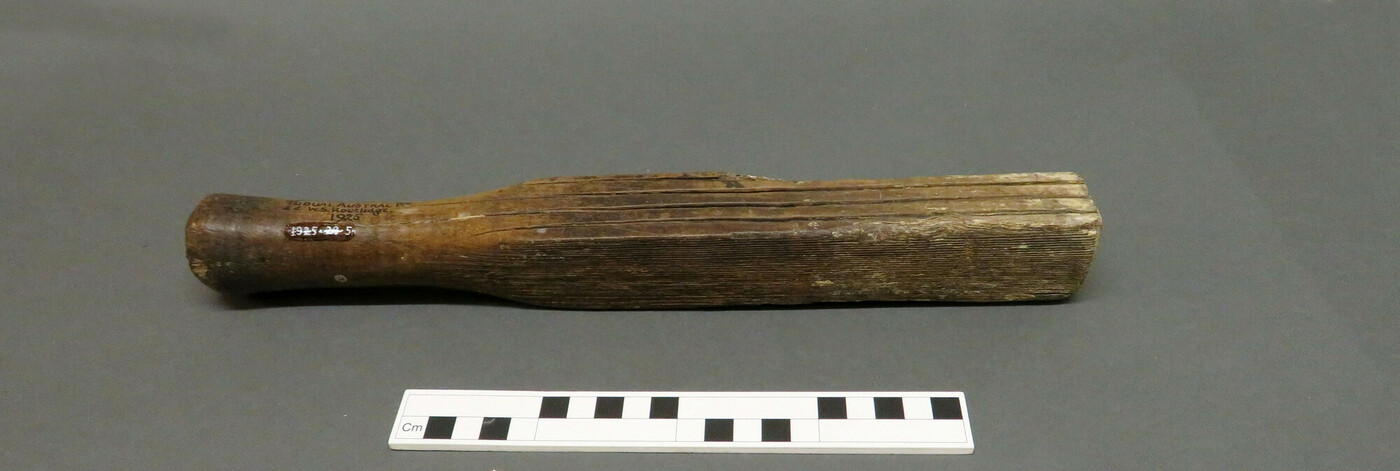 1925.29.5Wooden barkcloth beater. It comprises a cylindrical handle and long square-sectioned head. The faces of the head have longitudinal grooves of varying degrees of fineness. The distal end is incised with diagonal lines. [EH [OPS Move] 29/3/2017]1925.29.5
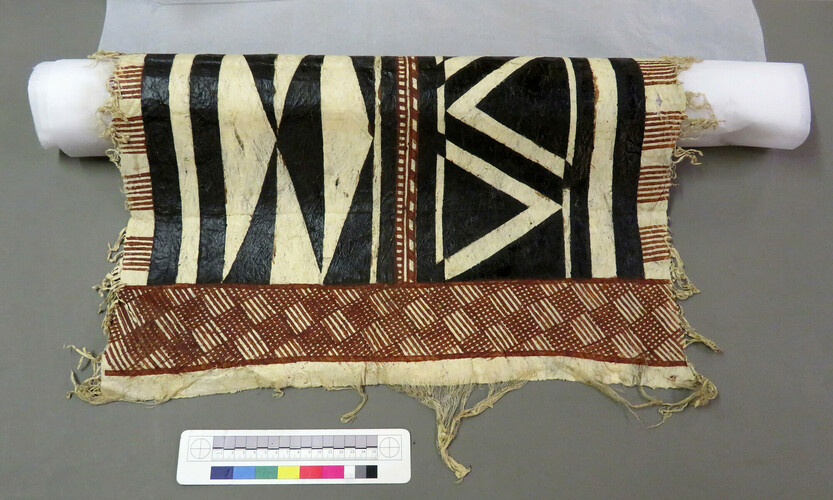 1929.12.10Sheet of decorated barkcloth with fringe. [AF [OPS move] 15/8/2017]1929.12.10
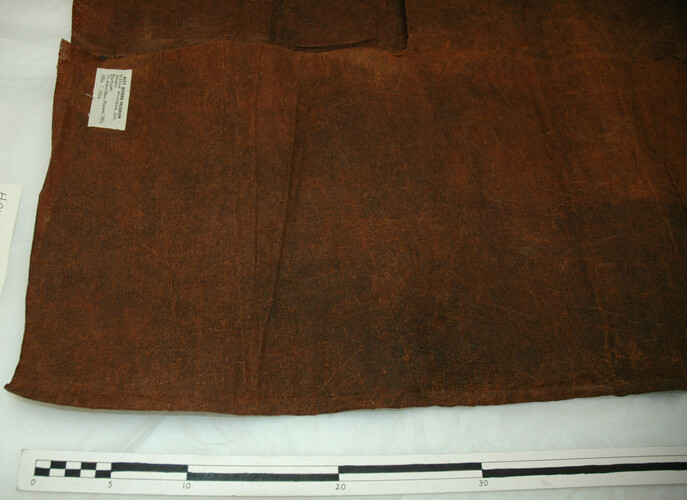 1886.1.1206Barkcloth. It is dark brown in colour, thin with a fine but dense texture. [AF [OPS move] 17/8/2017]1886.1.1206
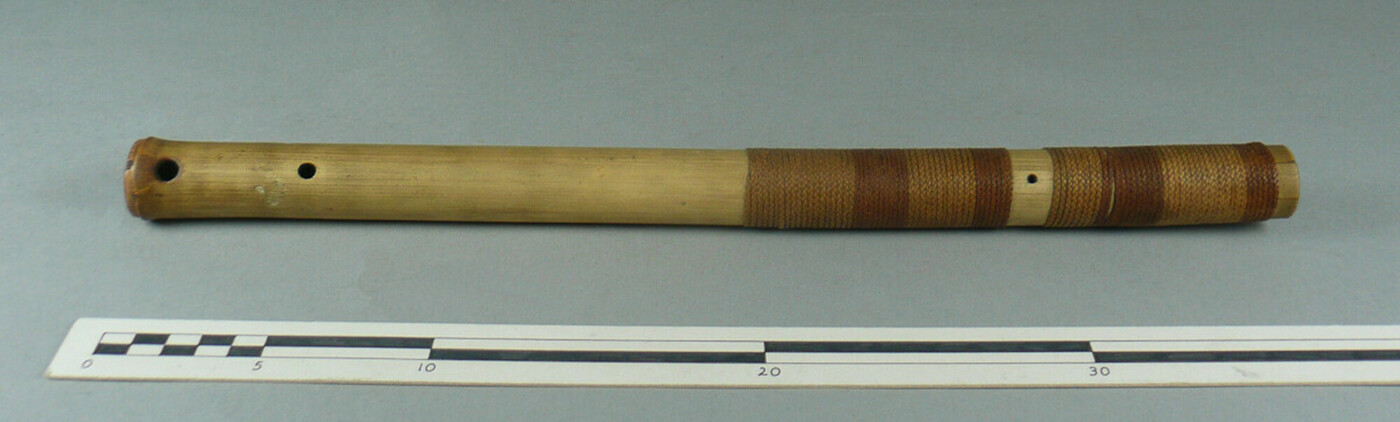 1886.1.1530Nose flute of bamboo closed by node at one end. Coconut fibre bindings.1886.1.1530
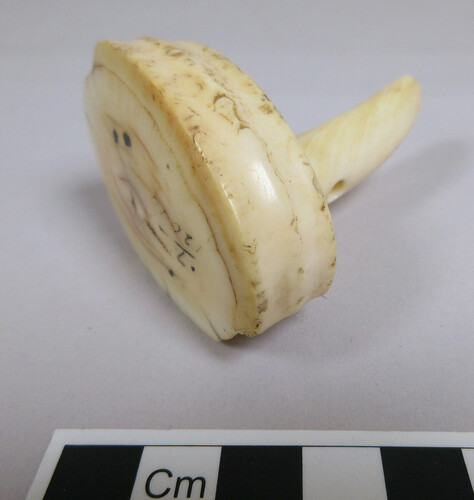 1884.84.41Heavy ear pendant with peg and disc carved in one piece. The peg is perforated.1884.84.41
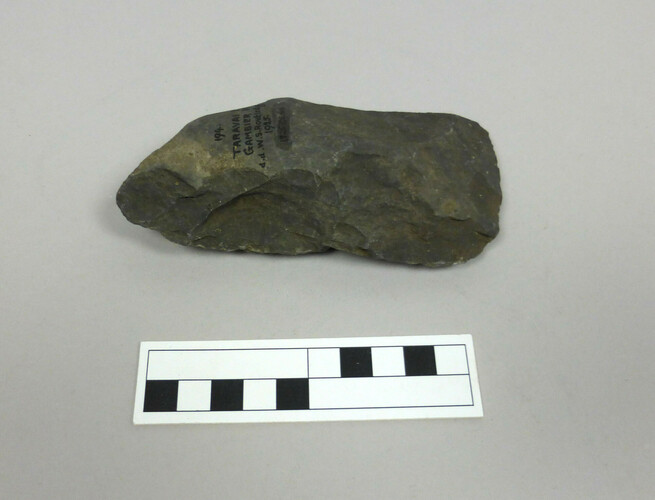 1925.29.46Ground adze-blade.1925.29.46
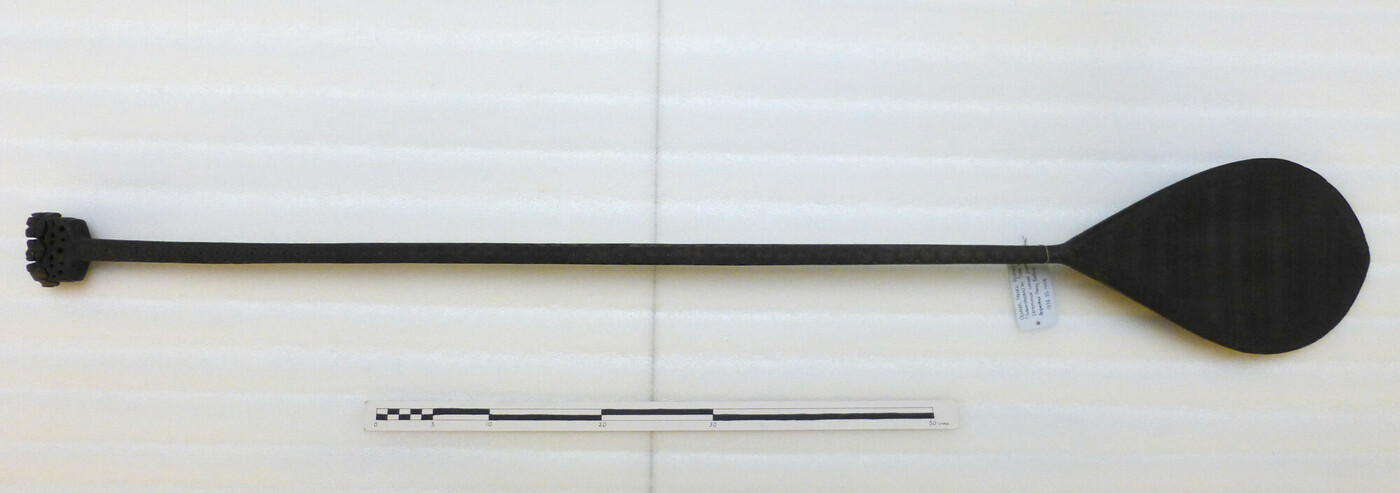 1938.35.1448Ceremonial chip-carved paddle with flat rectangular end and square shaft. [CF 26/2/2002]1938.35.1448