
- Collection type
- Object
- Description
- Overskirt with square openwork holes.
- Long description
- Waist mat or overskirt, kie fau, plaited from strips of the inner bark of the purau (Thespasia populnea) in such a way as to create a pattern of rectangular holes. A fringe of decoratively plaited tabs of the same material has been sewn on with olonga fibre (Pipturus argenteus). Worn by chiefs. [JU 17/12/2013]
- Person
- Field collector Johann Reinhold Forster
- Field collector Georg Forster
- PRM source Ashmolean Museum, University of Oxford
- Date / Period
- Date made: Before 29/06/1774
- Date collected
- Between 2 and 7 October 1773 or between 26 and 29 June 1774
- Acquisition information
- Transferred: 19/04/1886
- Materials and processes
- Material Bark Fibre Plant, Material Plant Fibre, Process Plaited, Process Stitched, Process Twisted
- Dimensions
- Length x Width 1600 x 860 mm
- Object numbers
- Accession number: 1886.1.1178 Other numbers: Forster 56
- Research and responses
A sample of the plant material from the mat was given to Dr Stephen Harris, Druce Curator of the Oxford Herbaria, for identification. He concluded that it is most probably Thespasia populnea, a type of hibiscus. The full sample report can be found in the RDF. [JU 06/02/2012]
- Associated publications
- Listed according to the 'Forster list' numbering system in 'From the Islands of the South Seas 1773–4: An Exhibition of a Collection Made on Capn. Cook's Second Voyage of Discovery by J. R. Forster—A Short Guide (Oxford: Pitt Rivers Museum, no date [1970]): 'The Friendly Isles (Tonga)...56. another pierced with holes. Made of bark strips with rows of square-holed openwork. Dimensions: 160 cm x 86 cm.' [NMM 28 11 1996; JC 29 12 1999, 14 8 2015] Illustrated as plate 2b accompanying 'Eighteenth-Century Tonga: New Interpretations of the Tongan Society and Material Culture at the Time of Captain Cook', by Adrienne L. Kaeppler, in Man, n.s., Vol. VI, no. 2 (June 1971), pp. 204-220. The skirt is discussed in detail by Kaeppler on page 211: 'Item Number 56, listed as a mat "pierced with holes" is probably one of the items George Forster described in his journal as aprons, "curiously wrought of mats in resemblance of fretwork" (1777: I, 474). This type of garment is a kie fau or teunga fau and is made of the inner bark of the hibiscus tree (fau) that has been partially rotted in sea water. The texture is fine and delicate, and the manufacture is a difficult enterprise in contrast to the plaiting of sturdy pandanus mats. Kie fau were worn as waist mats only be chiefs - kie fau indicating chiefly rank... There are three different types of kie fau. The type represented by the Pitt Rivers example (160 cm. x 86 cm.) is plaited with square holes and has a fringe of tabs sewn on with twisted 'olonga (Pipturus argentus) fibre.' [JC 29 12 1999] Listed as number 9 under ‘The Friendly Isles (Tonga)...Plaited Overskirts’ on page 216 of 'Artificial Curiosities': Being an Exposition of Native Manufactures Collected on the Three Pacific Voyages of Captain James Cook, R.N. at the Bernice Pauahi Bishop Museum, January 18, 1978 - August 31, 1978 on the Occasion of the Bicentennial of the European Discovery of the Hawaiian Islands by Captain Cook - January 18, 1778 (Bernice P. Bishop Museum Special Publication 65), by Adrienne L. Kaeppler (Honolulu: Bishop Museum Press, 1978): 'Overskirt with square openwork holes, Oxford (56). Evidence: Forster collection, second voyage. Literature: Gathercole, n.d. (1970), p. 11 [see above]; Kaeppler, 1971, p. 211 [see above]'. [JC 29 12 1999] Published as part of the Forster Collection on a dedicated website at www.prm.ox.ac.uk/forster (from February 2001). [JC 7 7 2005] Listed as catalogue number 317 and illustrated in colour on page 202 of James Cook and the Exploration of the Pacific, by Adrienne l. Kaeppler et al. (London: Thames & Hudson, 2009) with the caption: '317 Waist-mat kie fau | Tonga, by June 1774 | Bark, plant fibre, 160 x 86 cm | Pitt Rivers Museum, University of Oxford, 1886.1.1178 (Forster 56) | Plaited from strips of the inner bark of the hibiscus tree that have been softened by being partially rotted in sea water. The plaiting is done in such a way as to create a pattern of rectangular holes, reminding Georg Forster of 'fretwork' (Kaeppler 1971, p.211). Also decorated with a fringe of plaited tabs of the same material sewn on with twisted 'olongā plant fibre. Worn by chiefs. J[eremy].C[oote].' [FB 09/04/2013] For an account of the history of the collection of which this is part, see 'The Cook-Voyage Collections at Oxford, 1772–1775', by Jeremy Coote, in Jeremy Coote (ed.), Cook-Voyage Collections of 'Artificial Curiosities' in Britain and Ireland, 1771–2015 (MEG Occasional Paper No. 5), Oxford: Museum Ethnographers Group (2015), pp. 74–122. (Copy in RDF: Researchers: Jeremy Coote (Cook-Voyage Collections).) [JC 9 6 2016]
Search terms: Clothing Textile, Status, Skirt
Further items to explore
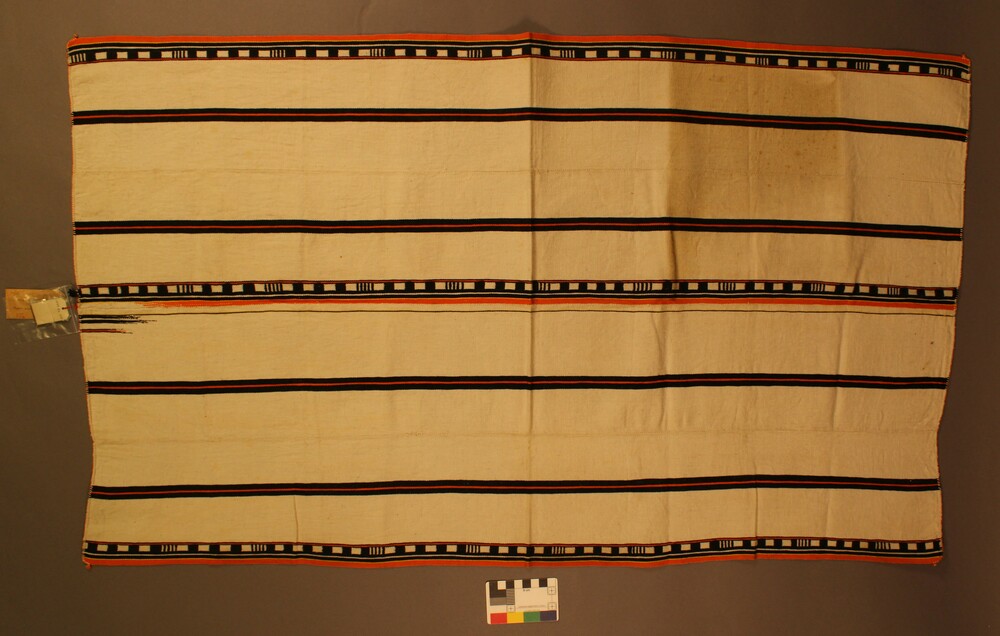 1934.82.123Girl’s skirt, worn from before puberty until after marriage1934.82.123
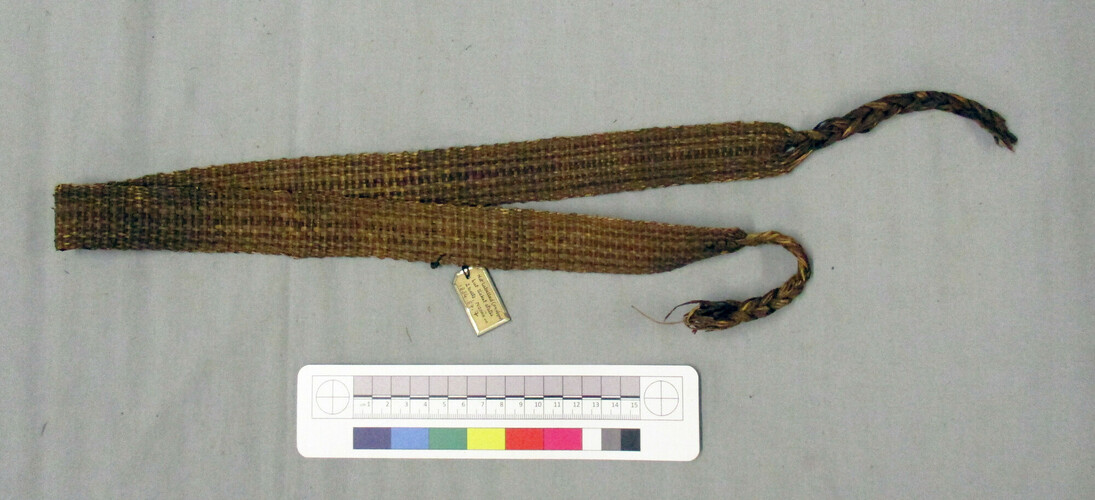 1884.87.7Belt of yellow grass band with plaited tie ends. [FB 19/02/2015]1884.87.7
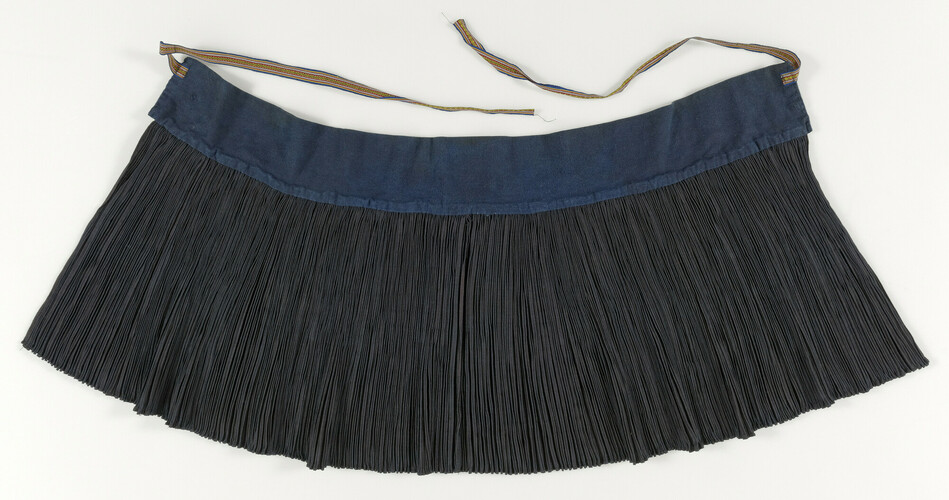 2009.135.221Woman's pleated skirt made from ramie textile. [FB 12/09/2012]2009.135.221
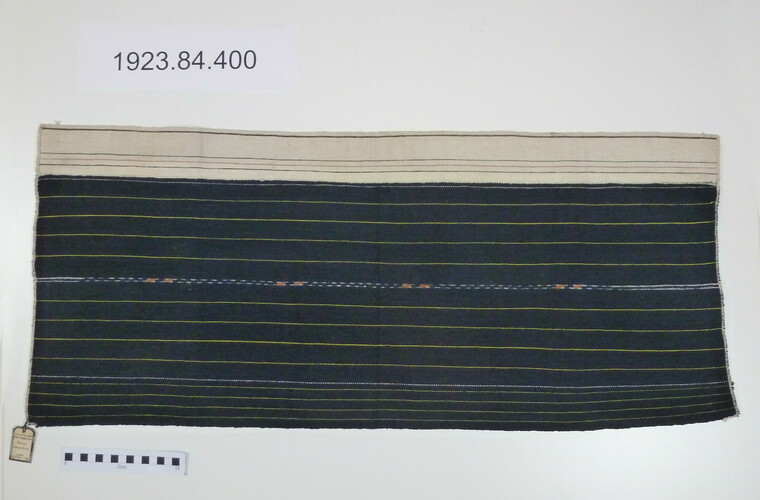 1923.84.400Textile, indigo dyed cotton with white margin on one side and yellow stripes. [MJD 02/11/2012]1923.84.400
 1884.12.159Wood club1884.12.159
 1886.1.1499Cylindrical wooden club. [BS [OPS Move] 15/08/2016]1886.1.1499
 1884.71.37Comb with 13 separate teeth: subrectangular, binding in black and yellow. [E.S-R 'DCF 2004-2006 What's Upstairs?' 15/12/2004]1884.71.37
 1886.1.1426Fishing net. Of fine olonga (Pipturus argenteus) bark fibre with wood floats and stone weights.[JU 13/12/2013]1886.1.1426