
- Collection type
- Object
- Description
- Cloak made of muka (New Zealand flax; Phormium tenax) with side taniko borders.
- Geographical reference
- Cultural groups
- Māori
- Date / Period
- Date made: Before 1886
- Date collected
- By 1886
- Acquisition information
- Transferred: 19/04/1886
- Materials and processes
- Material Flax (NZ) Plant, Process Finger Woven
- Dimensions
- Length: max 1200 mm, Width: max 1870 mm
- Object numbers
- Accession number: 1886.1.1135
- Research and responses
This was once thought to be part of the collection of objects obtained in the South Pacific by the Forsters during James Cook's second voyage and subsequently presented to the University of Oxford (Ashmolean Museum) and transferred to the PRM in 1886. On 16 April 1997, Peter Gathercole examined the object and stated that there is no clear way to determine whether this piece is 'Cook' or not, and therefore that it should NOT be considered part of the Cook/Forster collection. [NMM]
Remains of animal glue or similar substance at the top left-hand corner of the reverse of the cloak suggests that a label, about 24 mm x 12.5 mm was placed vertically in that corner at some time. If similarly placed labels can be found on other Maori cloaks (or similar objects) in the Ashmolean transfer, it might be possible to provisionally identify the source of the cloak. [JC 11 7 2001]
Note that the cloak is definitely NOT Forster No. 101, as suggested in some of the earlier documentation (see above) and by Roth (see Publications History). Forster No. 101 is 'A fly flap of the fibres of coconut' (PRM 1886.1.1369). Earlier speculation that this cloak was part of the Forster collection was a result of the fact that the Forster manuscript had been 'lost' and that it was thus was not known how many cloaks there were in the Forster collection. Speculation that it was specifically Forster 101 was due to the fact that a series of Maori cloaks bearing the Forster numbers 102 to 107 had been identified (excepting 103, which was assumed - rightly, I think - to be 1886.1.1132) and that a different type of object (a Maori belt) had been found bearing the Forster number 108 (PRM 1886.1.1182). It thus made sense to speculate that 102 was not the first in the series and that there was a further Maori cloak numbered 101. (For more information on the Forster collection and the history of its documentation, see ‘“Curiosities Sent to Oxford”: The Original Documentation of the Forster Collection at the Pitt Rivers Museum’, by Jeremy Coote, Peter Gathercole, and Nicolette Meister, in Journal of the History of Collections, Vol. XII, no. 2 (2000), pp. 177–92.) [JC 10 7 2001, 31 12 2012]
In 1978, David Simmons recorded the holdings of Māori material in a number of museums in Europe and North America including, in May 1978, the Pitt Rivers Museum. (For copies of his notes and related correspondence, see RDF: Researchers: Simmons.) In 1996, Simmons put together the ‘draft catalogues’ he had prepared, depositing copies in, at least, the National Library of New Zealand / Te Puna Mātauranga o Aotearoa and the British Museum. The ‘draft catalogue’ of the Māori material in the PRM, which includes photocopies of some of the relevant catalogue index cards and annotations supplied by PRM assistant curator Lynne Williamson in 1982, was included in ‘Draft Catalogues of Maori Material in English Museums II. Prepared by David Simmons from records made in 1978… Compiled in Auckland in 1996’. It is now widely accepted that Simmons’s assertions about the provenance and history of individual Māori objects are not to be trusted without further evidence and/or documentation. Nevertheless, as the entries in this document have been referred in the literature, in July 2016 I obtained from the British Museum scans of the pages devoted to the PRM’s collections (numbered by hand as pages 43 to 62), printing out a copy for the RDF. For the entry for this object, see page 48 (not in Simmons's original list). [JC 28 7 2016]
- Associated publications
- Listed as No. 3 in 'Appendix: Description of Individual Garments' on page 57 of The Maori Mantle, by H. Ling Roth (Halifax: Bankfield Museum, 1923), where it is described as follows: 'No. 3. Fig. 37. Mantle, No. 101 [sic; see 'Research Notes' for explanation of the misascription of the number 101 to this cloak], Pitt-Rivers Museum, Oxford. The shape of the taniko borders is exceptional but not rare. One of the black bands on the upper taniko has a short and long piece of red worsted, 1.6 and 1 cm. long, and the other black band has them 7 and 1.9 cm. long respectively, which reminds me of similar diagonal decoration on a Tongan basket in the A. W. Fuller Collection [see figure; see on]. There are two series of coloured warp stripes stretching across the mantle; one series arranged as single stripes (three warps in each) all equidistant and coloured alternately brown and black; the other series arranged in sets of two stripes (two warps in each) with twice the amount of space between the sets than between the individuals of each set.' See also detailed sketch published as figure 37 on page 59. See also detailed dimensions in table on page 120. [JC 27 4 2001, 31 12 2012] Discussed on pages 65-6 of 'Te Ao Tawhito / Te Ao Hou: Entwined Threads of Tradition and Innovation', by Maureen Lander, in Awhina Tamarapa (ed.), Whatū Kākahu / Māori Cloaks. Wellington: Te Papa Press (2011), pp. 60-73, 183-4: 'Māori desire for red cloth was well documented by early European voyagers, and it is enlightening to come across tangible examples of the ingenious ways in which weavers recycled coveted samples of wool into their own garments. In the Pitt Rivers Museum, University of Oxford, two cloaks [1886.1.1132, 1886.1.1135] thought to have been collected by J. R. Forster and his son George during Cook's second voyage (1772-75) are of interest. Each has small additions of red wool, indicating that Māori weavers had unravelled textiles obtained from the first voyage and reused the yarns in their cloaks by the time the Forsters arrived. H. Ling Roth described wool details in the tāniko, patterned borders on the first cloak as follows: "One of the black bands on the upper tāniko has a short and long piece of red worsted 1.6 and 1 cm. long, and the other black band has them 7 and 1.9 cm. long respectively." The diagonal bars of red wool have a slightly raised appearance, like that of satin stitch. Could these have been oversewn using a needle, rather than twisted in during manufacture in the customary manner?' NB Lander follows Roth in identifying this cloak as one of those collected by the Forsters, which now seems unlikely (see 'Research Notes'). [JC 31 12 2012] This text has remained the same in the 2019 edition of this book. [MOBB 6/11/2019]
Further items to explore
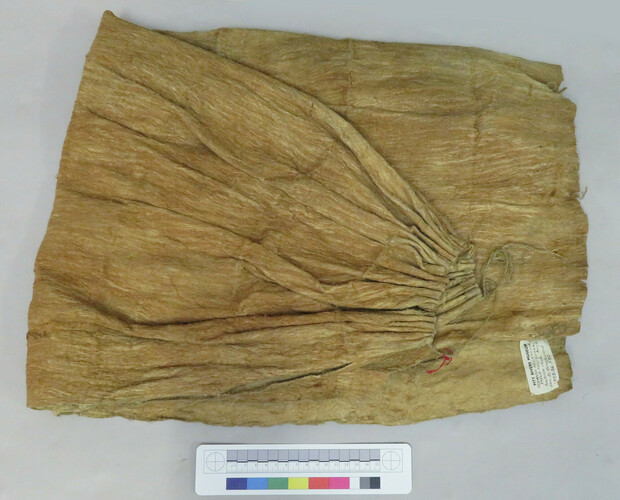 1938.36.580Barkcloth cloak. Brown in colour, stitched around the top with plant fibre yarn and drawn together to create a narrower edge. [AB [OPS move] 23/8/2017]1938.36.580
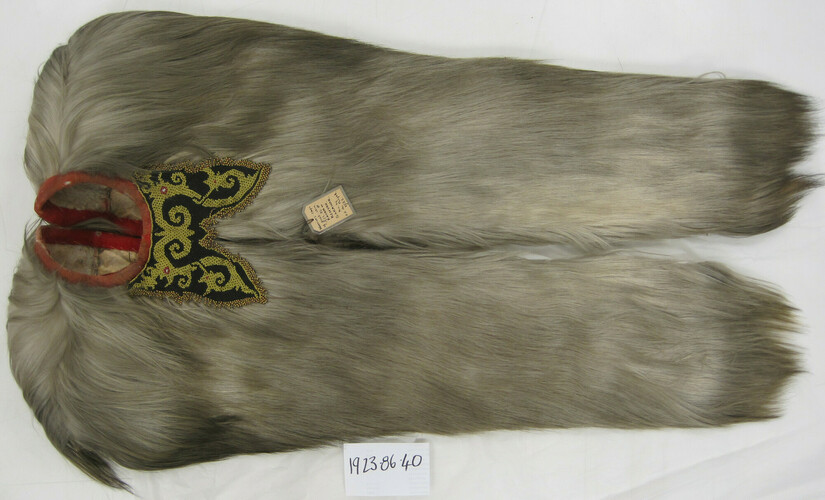 1923.86.40Warrior's cape1923.86.40
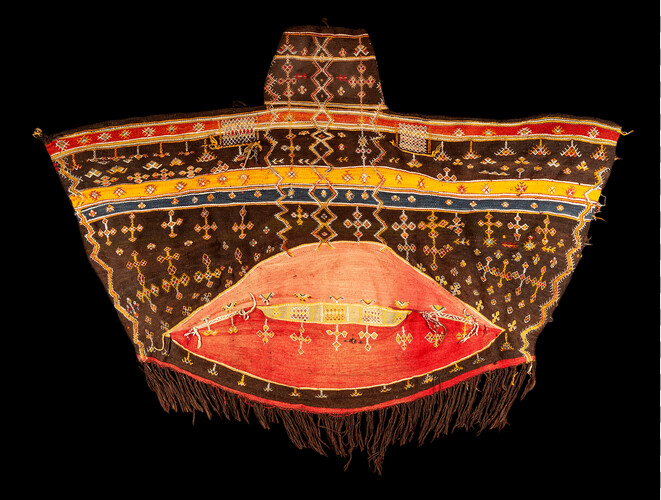 2018.37.207Woollen shepherd's cloak, woven with bands of block colours and geometric patterns all over. [AF [EFCF project] 19/8/2019]2018.37.207
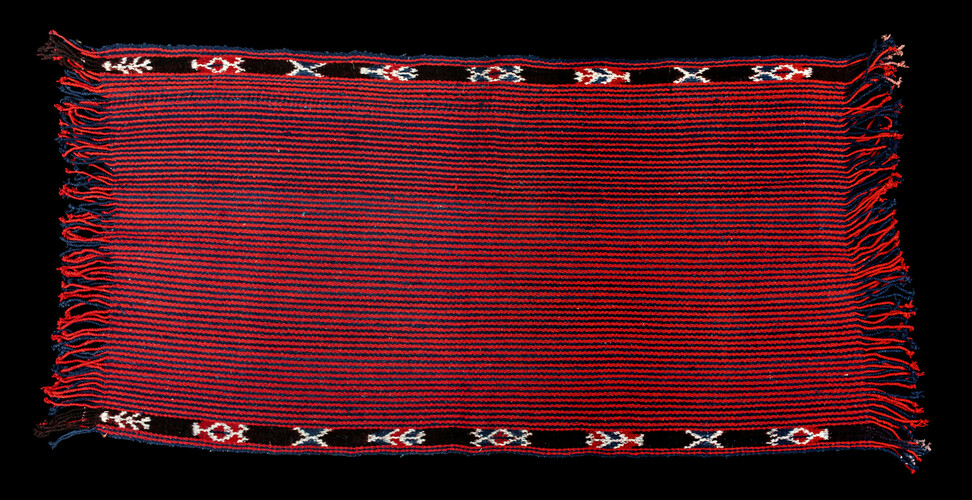 1946.6.12Coat-sized sarape. Woven without customary neck-opening, which would have to be cut before use. Cotton twill weave, aniline red and blue stripe.1946.6.12
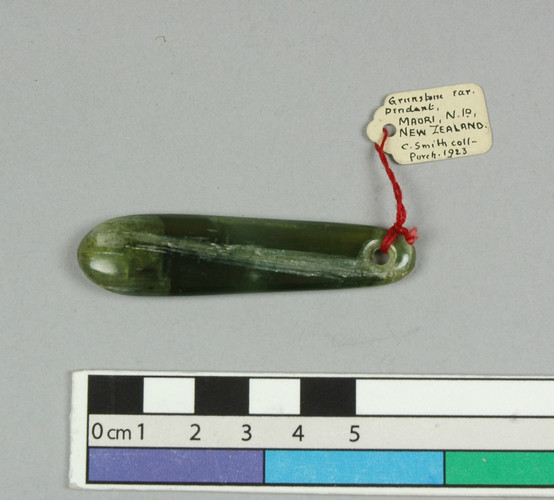 1923.87.234Greenstone ear-pendant, elongated drop form with a perforation at the narrower end [SM 17/11/2008]1923.87.234
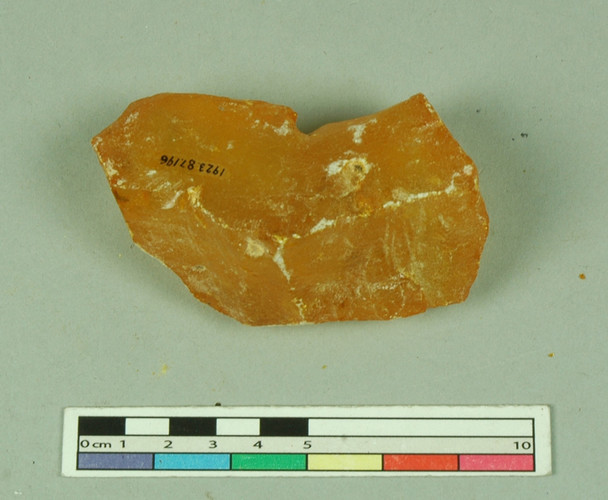 1923.87.196Piece of plant resin used for making tattooing pigment. [El.B DDF Body Arts Project 2010/2011 30/09/2010]1923.87.196
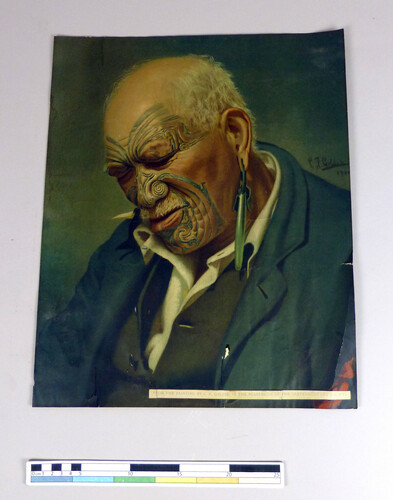 2017.28.1Print of the painting 'A Hot Day: Wiremu Pātara Te Tuhi (Ngāti Mahuta)' by Charles Frederick Goldie.2017.28.1
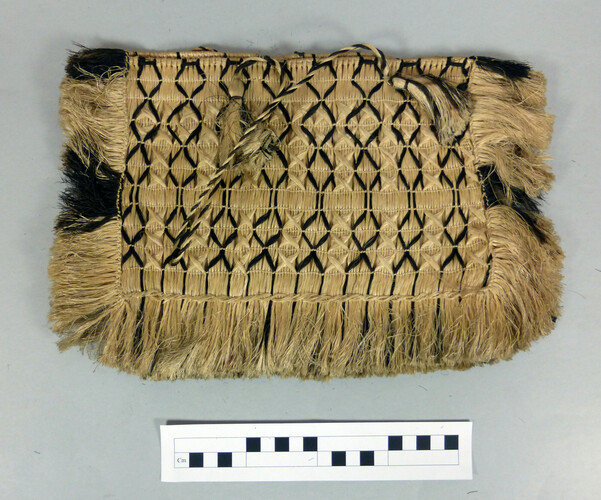 1923.87.174Bag of New Zealand flax Phormium tenax fibre in crossed-warp twining, part of the warp being dyed black. Fringed at sides and base. Twisted handles of black and natural phormium ending in tassels.1923.87.174