
- Collection type
- Object
- Description
- Fragment of carved stone female figurine
- Long description
- Part of a female figure made of stone. [DCF Court Team 25/2/2003] Upper half of female figure with mask-like animal headdress.
- Geographical reference
- Veracruz State Pánuco
- Person
- Field collector George Francis Lyon
- Field collector HMS Griper
- PRM source Ashmolean Museum, University of Oxford
- Date / Period
- Date made: Before 1825, uncertain Date made: 1825, uncertain Archaeological period: Huastec Maya
- Date collected
- ?On or before 1825
- Acquisition information
- Transferred: 1886, uncertain Transferred: 1950, uncertain Transferred: 1969, uncertain
- Dimensions
- Height: max 920 mm, Width: max 770 mm
- Object numbers
- Accession number: 1886.1.1122 Other numbers: 502a
- Research and responses
This object is not listed in the list of items donated by Lyon in Collectors Miscellaneous XI Accession Book entry page 155 [AP 21/7/99]
In October 2014, Sergio Purini (Royal Museums of Art and History, Brussels) left a note saying 'Huaxtec Sculpture Not Maya'. (For the note and a printout of Jeremy Coote's emailed reply, see RDF.) [JC 23 10 2014]
- Associated publications
- Illustrated in black and white as 'Foto 3' on page 240 of El espejismo de la plata: Viajeros en México (1882-1829), by Enrique Hugo García Valencia (Veracruz: Editora de Gobierno del Estado de Veracruz, 2010). Caption (same page) reads: 'Foto 3. Escultura huasteca del Museo Pitt Rivers, Oxford'. [JC 16 12 2010] El espejismo de la plata: Viajeros en México (1882-1829), by Enrique Hugo García Valencia (Veracruz: Editora de Gobierno del Estado de Veracruz, 2010). "Algunas de las piezas obtenidas en Pánuco y otros lugares, se perdieron irremisiblemente al naufragar uno de los barcos que las llevaba a Inglaterra; lograron salvarse dos, y llegaron a ese país como parte de las propiedades del capitán Lyon, uno de los comisionados a las minas de Real de Catorce y Bolaños. Una de las piezas entró a formar parte de las colecciones del Museo Ashmoleano. Según la entrada del Museo Pitt Rivers se encontraba enlistada como objeto no. 147 del catálogo del Museo Ashmoleano. Ingresó en 1836 y su descripción es la siguiente: La mitad superior de un ídolo antiguo mexicano de peidra, de forma ruda y aparencia grotesca. Fue encontrada por el capitán Lyon cuando hacía una exploración del rio Pánuco en la costa mexicana, en un pueblo del mismo nombre. Su antigüedad es anterior a la conquista de México. En 1886 fue transferida junto con otros objetos etnográficos, al Museo Pitt Rivers. Por la entrada registrada en el libro de acceso a este Museo, sabemos que fue encontrada y donada al Ashmoleano en 1825. Podemos inferir que el interés de Lyon en donar esta pieza al Museo Ashmoleano, dependiente e la Universidad de Oxford, estaba relacionado con el hecho de que en ese ano recibió un Doctor of Civil Law (D.C.L.) honorario de dicha Universidad (Alumni Oxonienses, 1715-1816, III: 886; Laughton, 1893: 346). La incongruencia entre las fechas de donación y acceso al mismo museo tal vez se deba al proceso de catalogación de los objetos. Es interesante notar que esta pieza fue donada el mismo año en que se casara, y que, según sus biógrafos, visitara México por primera vez a fines de 1825, o principios de 1826, lo cual indicaría que no fue Lyon quien encontró esta pieza, o que había realizado un viaje previo con el objeto de hacer un sondeo del río Pánuco, que no fuera registrado por sus biógrafos y seguramente habría encontrado que en el estas piezas; la segunda donada al Museo Real de Edimburgo." [MdeA 14/01/2011] Rough translation of the above : 'Some of the pieces acquired in Pánuco and other places were when one of the ships carrying them to England was sunk. Two pieces were saved and they arrived in England as part of the property of Captain Lyon, a commissioner of the mines of Real de Catorce and Bolaños. One of the pieces became part of the collections of the Ashmolean Museum. According to the entry in the Pitt Rivers Museum it was listed as object number 147 in the catalogue of the Ashmolean Museum. The object was entered in 1836 and the description is as follows: "Upper half of an Ancient Mexican idol of stone of rude form and grotesque appearance. It was found by Capt. Lyon whilst making a survey of the river Panuco on the Mexican coast, at a town or village of the same name. Its date is prior to the conquest of Mexico." In 1886 this piece was transferred, along with other ethnographic objects, to the Pitt Rivers Museum. From the entry in the accession book of this museum we know that it was found and donated to the Ashmolean in 1825. One may deduce that Lyon's interest in donating this piece to the Ashmolean Museum, part of the University of Oxford, is linked to the fact that in 1825 he was made an honorary Doctor of Civil Law by the University. The differing dates of donation and of accession can perhaps be explained by the cataloguing process. It is interesting to note that this piece was donated in the same year as Lyon's marriage and also, according to his biographers, of his first visit to Mexico. This took place at the end of 1925 or beginning of 1826, which would suggest that it was either not Lyon who found this piece, or that he had made a prior journey to Mexico to survey the River Panuco, a journey which was not registered by his biographers and where he surely would have found these pieces, the second of which was donated to the Royal Museum of Edinburgh.' [MdeA 14/01/2011] Illustrated in colour as Figure 18.3 on page 391 of 'Central America', by Elizabeth Graham, Dan Hicks and Alice Stevenson, in World Archaeology at the Pitt Rivers Museum: A Characterization, edited by Dan Hicks and Alice Stevenson (Oxford: Archaeopress, 2013), pp. 383-400. Caption (same page): 'Figure 18.3 Fragment of a carved stone female figurine donated by Captain George Francis Lyon (1795-1832) in 1825, having been found by him 'whilst making a survey of the River Pánuco, on the eastern coast of Mexico, at a town or village of the same name' (PRM Accession Numbers 1886.1.1122).'. [MJD 04/07/2014]
Search terms: Figure, Religion, Animal Figure
Further items to explore
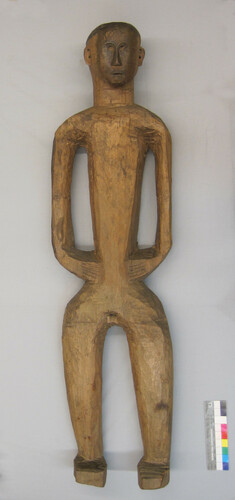 1923.84.688Large carved wooden male figure. [SM (Verve) 18/04/2013]1923.84.688
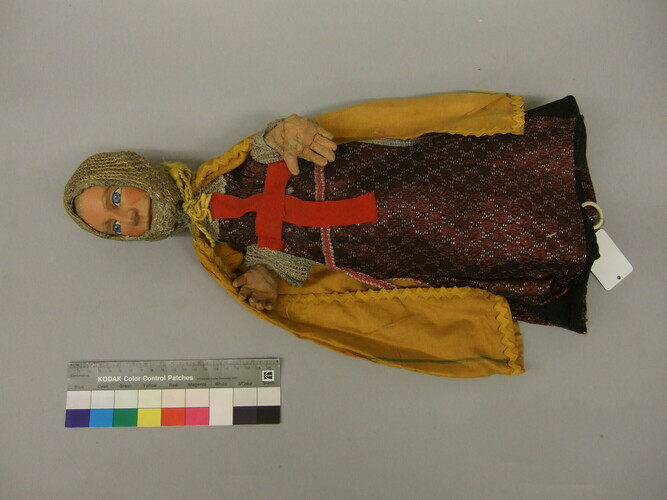 1985.36.4Hand puppet of a knight. From the play 'Thersites'. Dressed in gold painted string, yellow cloak and maroon over garment emblazoned with large red cross. [Alicia Bell [OPS move] 01/07/2016]1985.36.4
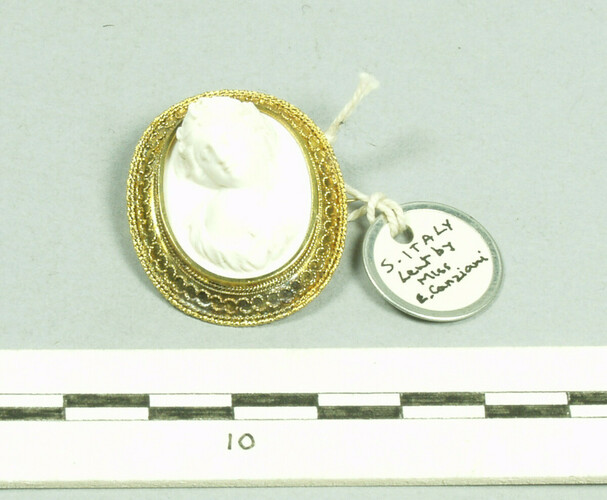 1961.2.015Cameo brooch, consisting of an oval piece of white stone from which the head of a woman is carved in high relief, which sits in a golden frame. [N.B. 'DCF 2004-2006 What's Upstairs?' 10/6/2005]1961.2.015
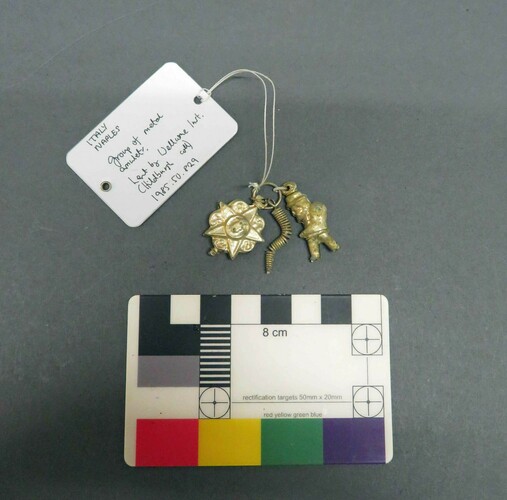 1985.50.829Amulet of white metal. A 'hunchback' human figure, five-pointed star and rosette, and a coiled horn have been attached to a metal ring. [BA [OPS move] 20/9/2017]1985.50.829