
- Collection type
- Object
- Description
- Club with ball-shaped head and flat haft with a pointed butt. The haft is decorated with painted designs. [SM 17/04/2007]
- Long description
- Club with ball-shaped head and flat haft with a pointed butt. The haft is decorated with painted designs. The club head has a small, flat, pointed iron blade protruding from it. The haft is decorated along one side with a painted blue zigzag pattern and a red line. The handle section of the haft has been cut to fit the hand. The butt is decorated with red painted dots. The butt has a hole through it for attaching a carrying loop, or decoration to. [SM 17/04/2007]
- Geographical reference
- Rocky Mountains
- Cultural groups
- Native American
- Date / Period
- Date made: On or before 1866
- Date collected
- ?On or before 1866
- Acquisition information
- Transferred: 17/02/1886
- Materials and processes
- Material Wood Plant, Material Iron Metal, Material Pigment, Process Carved, Process Painted, Process Perforated, Process Forged (Metal), Process Decorated
- Dimensions
- Length: max 710 mm, Width: max 178 mm
- Object numbers
- Accession number: 1886.1.815 Other numbers: 815
- Research and responses
For an account of the Charles A. Pope Collection, see Speaking for Themselves: The Pope Collection of Native American Artifacts in the Pitt Rivers Museum, by Lindsey Richardson (University of Oxford: M.Sc. dissertation in Material Anthropology and Museum Ethnography, 2001); copy in RDF (Collectors: Pope). [JC 6 1 2004]
'The clubs (of the Native Americans) are short, seldom exceeding a yard in length and mostly eight or nine inches shorter. They are almost invariably made upon one or other of two models (this one and the gunstock club). The primitive idea of a club is evidently derived from a stick with a knob on the end and that is the form which is most in vogue. In the common kind of club, the whole of the weapon is quite plain, but in many specimens, the native has embedded a piece of bone or spike of iron in the ball or bulb at the enf of the club, and has decorated the handle with feathers, bits of cloth, scalps and similar ornaments.' From Wood, J. G. (1875), Natural History of Man, Vol.2, London: Routledge, p.650. [HA 27/02/2008]
The following notes are drawn from research compiled by Andy Mills as part of the DCF Cutting Edge Project in 2006-2007. Ball-headed clubs of this form are generally described as ‘Iroquoian’, but had a much wider distribution than the Iroquois nation alone, across the entire Eastern Woodlands and Plains regions. They were commonly in use at the time of first European contact in the 16th century, and were known as cunsenagwus among the Renape Indians, aka the Powhatans.
The ball-headed form is highly ergonomic, and parallels similar club forms in Southern and Central Africa, and Oceania. The asymmetrical attachment of the head to the shaft is distinctively Native American, however. The form emerges from the selection of a sapling for the weapon, which had grown obliquely out of the side of a river bank. As a result, the weapon retains the integrity of the tree’s natural grain structure, which is always a principal concern in the selection of wood for clubs. The Iroquoian peoples often carved such clubs to resemble a human head, or a ball held in the claws of an eagle. They were frequently incised and painted (as our example is) with designs in black and red, and the more elaborate examples bear images of horned serpents, thunderbirds, aquatic panthers, and a range of marks that have been variously interpreted as tallies of kills, coups counted, scalps taken, and so on. Our example is rather plain by comparison to several illustrated in the literature; it bears a single red backline, and a black zigzag that fringes it.
The insertion of blades into these ball-headed clubs arose as a practice in the Eastern Woodlands region, and can also be found on ‘gunstock’ club forms from the same area ( see Native American Weapons. by C. F. Taylor, published 2001. pp. 6-34). The blade is of poor-quality metal, and seems to have been the broken blade of a spontoon-type trade tomahawk. Taylor illustrates a number of examples bearing similarities to our example, which seems on stylistic grounds to have probably come from the Northern Plains, and may be Sioux in origin. [SM 17/03/2008]
Further items to explore
 1927.4.6Club with long spatulate blade, pointed at the distal end. The long handle is restricted from the blade and terminates in a knobbed expansion and pointed butt. The handle is decorated at both ends with rings of plaited plant fibre, grass and feathers. [JC [OPS Move] 17/08/2016]1927.4.6
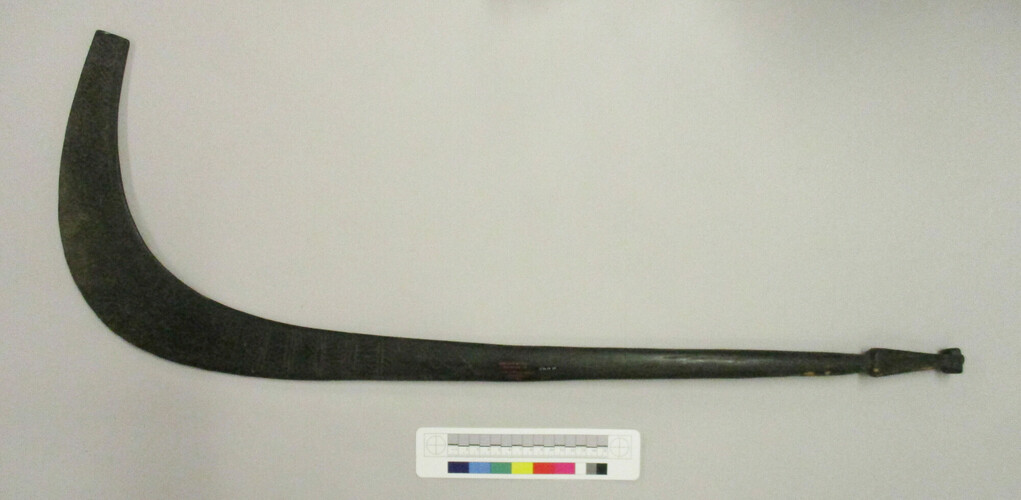 1899.62.735Wooden glaive club with curved, flattened blade, long cylindrical shaft and carved pyramidal terminal with a cuboid expanded knob. Incised decoration on the blade consists of curved bands of chevrons, transverse grooves and a possible stylised bird. [JC [OPS Move] 26/07/2016]1899.62.735
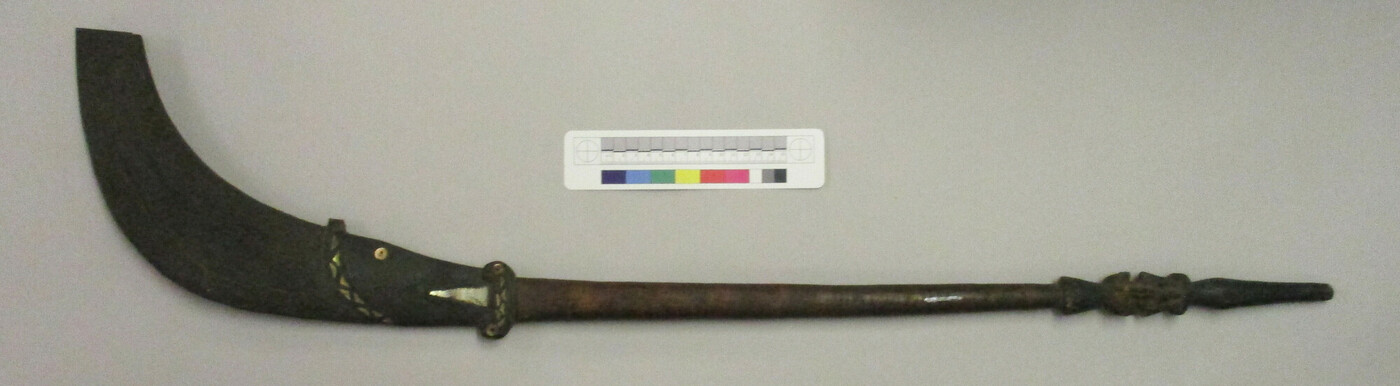 1884.12.255Wood club. Blade head is made of two separate blades in the shape of fish with incised and inlaid shell decoration. The lower handle features two carved human figures back to back. Incised decoration on the head features zig zag designs and a stylised bird near the mouth of the carved fish. [BS [OPS Move] 26/07/2016]1884.12.255
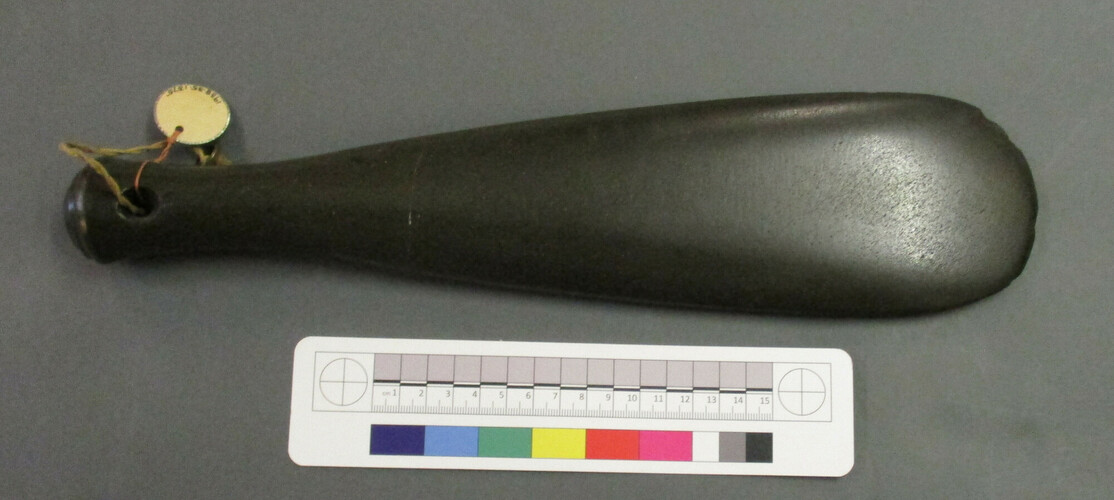 1938.35.1375Spatulate stone club with convex blade tip and tapered handle with perforated and ridge carved butt. [BS [OPS Move] 14/09/2016]1938.35.1375
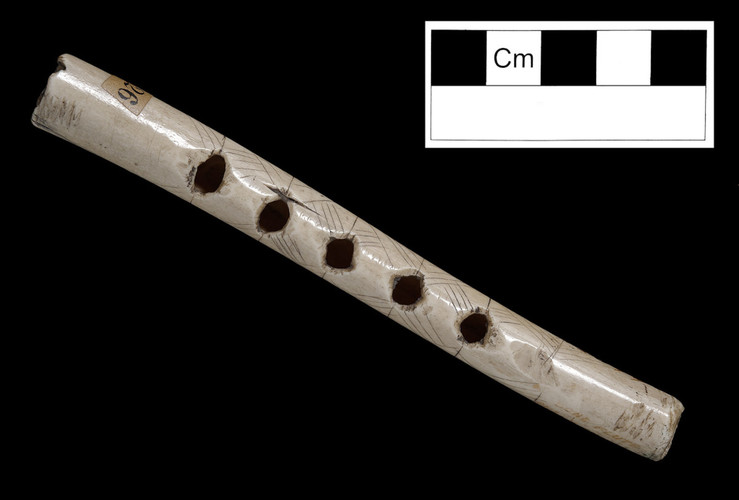 1884.111.30Flute made from an eagle's wing bone and incised with geometric designs. [CAK 24/02/2010]1884.111.30
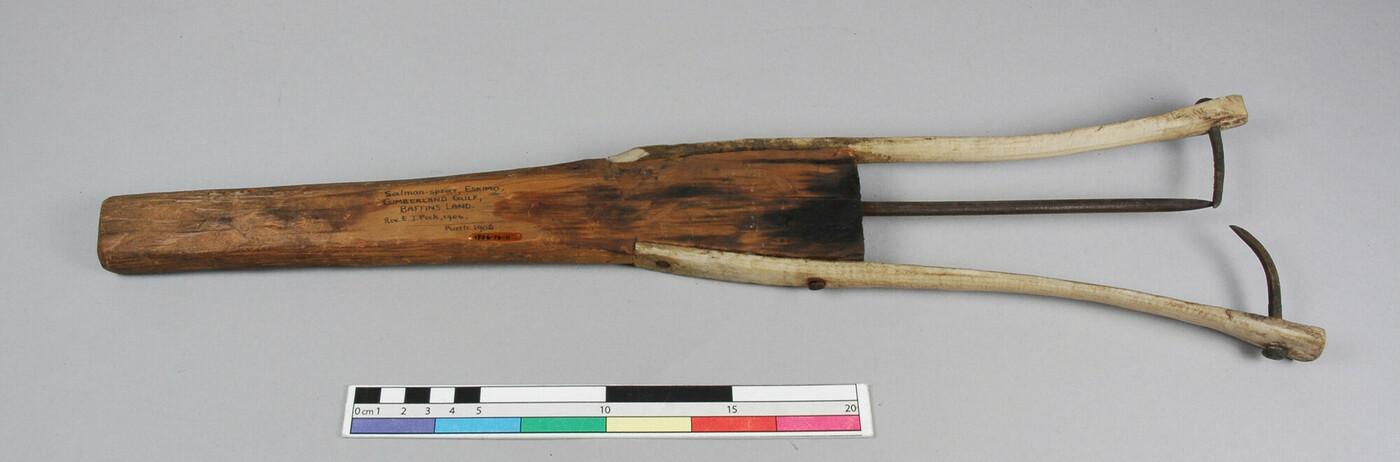 1906.76.11Head of salmon spear. [El.B 14/10/2011]1906.76.11
 2017.103.32.6Russian faceted bead of black glass, found inside beaded pouch [2017.103.32 .1]. [JMC 21/2/2019]2017.103.32.6
 1887.32.2Wampum belt, purple and white beads, the design reads 1766.1887.32.2