
- Collection type
- Object
- Description
- Curved ivory hair pin, undecorated.
- Long description
- Hair pin carved from a single piece of ivory consisting of a slightly convex top and slender body with round section, tapering to a point at the other end. The body has a slight curve, is somewhat irregular in shape, and has been polished. The pin is complete, but has a number of cracks running down its length; it is currently a yellowish cream colour (Pantone 7401C). It has a length of 285 mm, a diameter of 5.5 mm at the head and 4 mm midway down the body, with a weight of 6.4 grams [RTS 27/4/2004].
- Geographical reference
- Cultural groups
- Zande
- Date / Period
- Date made: On or before 1858
- Date collected
- 1858
- Acquisition information
- Transferred: 10/02/1886
- Materials and processes
- Material Animal Ivory Tooth, Process Carved, Process Polished
- Dimensions
- Length: max 285 mm, Diameter: max 4 mm mid body, Diameter: max 5.5 mm head, Weight 6.4 g
- Object numbers
- Accession number: 1886.1.523.3
- Research and responses
Petherick lived in Khartoum from 1853-1858, mounting several trading expeditions into the Sudanese interior during this period. He entered Zande territory for the first time on 24th February 1858, while on his fifth such expedition, visiting the villages of Mundo, Kangamboo and Baranj. This object was probably collected during that trip, as Petherick did not venture into this region again. His collection was shipped back to England in 1859. Petherick most probably put this material up for auction, as some Petherick material in the PRM appears to have lot numbers associated with it; known buyers include Pitt Rivers, Henry Christie, and J.G. Wood. It was not auctioned via Sotheby's, and there is no evidence that it was ever owned by the Royal United Services Institution [RTS 26/4/2004].
The use of these pins are described in Petherick's 1861 volume, Egypt, The Sudan and Central Africa, p. 466: ‘Both men and women wore their hair plaited in thick masses, covering the neck to the shoulders. This they combed out with long ivory pins, from six inches to upwards of a foot in length - one extremity pointed, the other increasing in thickness like a cone, three or four inches of which were carved into pretty patterns, and dyed black with the decoction of a root. When the hair had been arranged, two of the largest of these pins were stuck horizontally through it at the back of the head; between these smaller ones were inserted, forming a semicircle similar to a Spanish lady’s comb’. These pins are also described in J.G. Wood, 1968, The Natural History of Man vol. I, p. 489, while Schweinfurth describes Zande men using hair pins of iron, copper or ivory tipped with various devices to fasten cylindrical straw hats in place (G. Schweinfurth, 1873, The Heart of Africa Volume II, p. 8]. For similar pins, see E. Castelli, 1984, Orazio Antinori in Africa Centrale 1859-1861, cat. no. 98, p 72, attributed to the 'Mangbetu, Zande etc' (Museum of Perugia 49650-7). The practice of wearing these pins was still common in the 1920's (P.M. Larken, 1926, "An Account of the Zande", Sudan Notes and Records IX no. 1, p. 32).
For other pins of this type, see 1884.71.10-13 and 1886.1.523.1-2. This example was identified as ivory, not bone, by conservation [RTS 8/12/2004].
- Associated publications
- The Accession book entry is published in A. MacGregor et al., 2000, Manuscript Catalogues of the Early Museum Collections 1683-1886 (Part I), p. 297, cat. 523 [RTS 26/1/2004].
Search terms: Ornament, Toilet, Hair Ornament, Toilet Article, Pin
Further items to explore
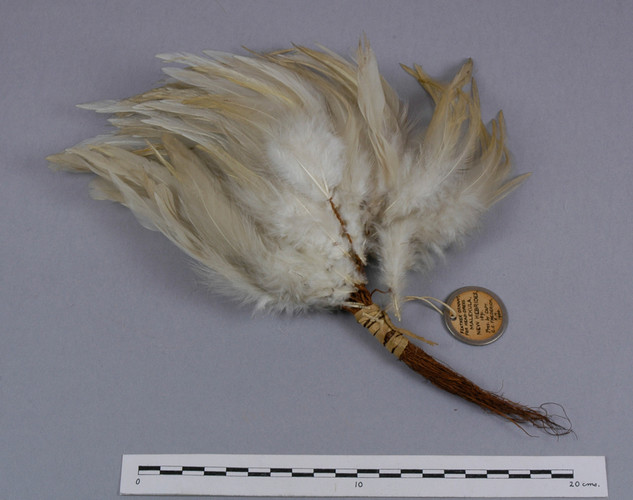 1900.49.15Head ornament of grey and white feathers tied to lengths of twisted plant fibre tied into a bundle with a strip of ?dried grass [SM 10/06/2008]1900.49.15
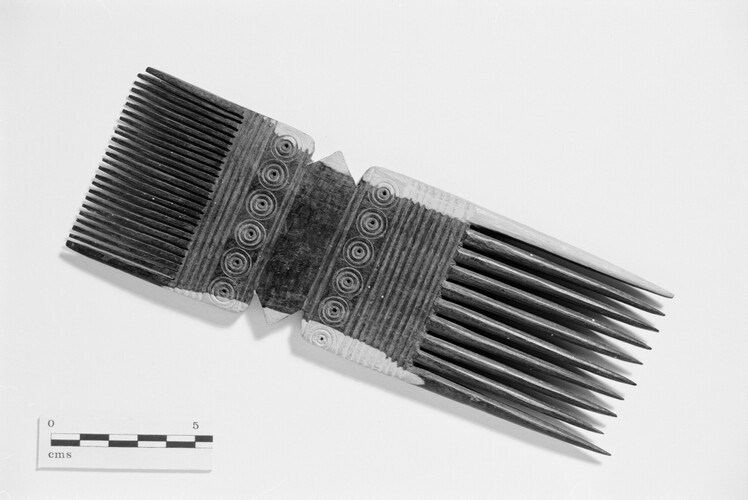 1996.21.19Double ended comb of dark wood, with shorter fine teeth on one side and longer coarse teeth on the other. Incised with lines and concentric circles. [El.B 'DCF 2004-2006 What's Upstairs?' 31/1/2006]1996.21.19
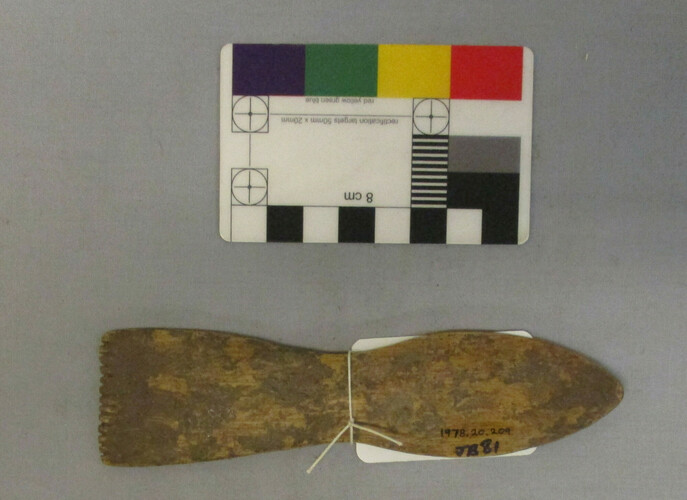 1978.20.209Wooden comb for mudpack hairdressing. The comb has the remains of clay on it.1978.20.209
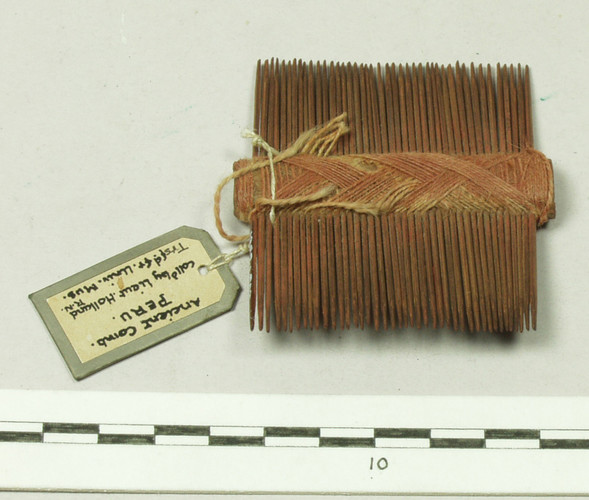 1887.1.508Double composite comb lashed with thread and coloured dark red. [E.S-R 'DCF 2004-2006 What's Upstairs?' 15/12/2004]1887.1.508
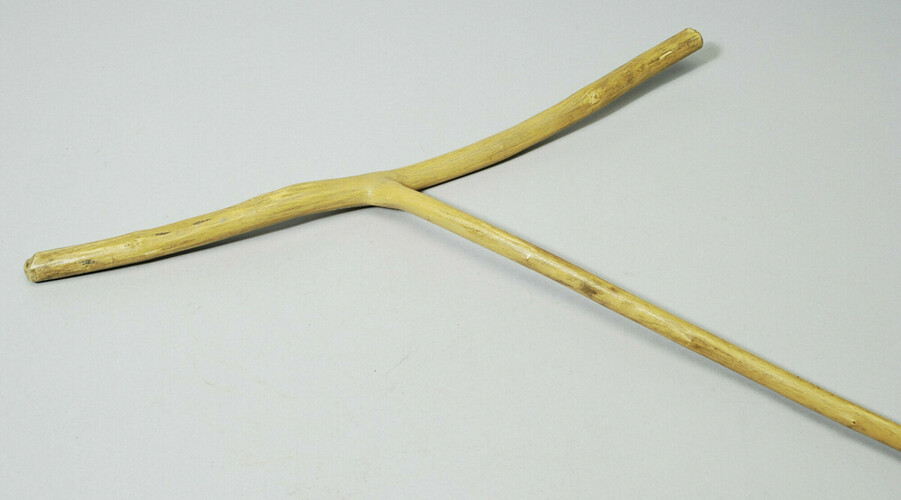 1979.20.99Wooden staff with a cross bar top, used to discipline cattle and keep dogs at bay [RTS 12/1/2005].1979.20.99
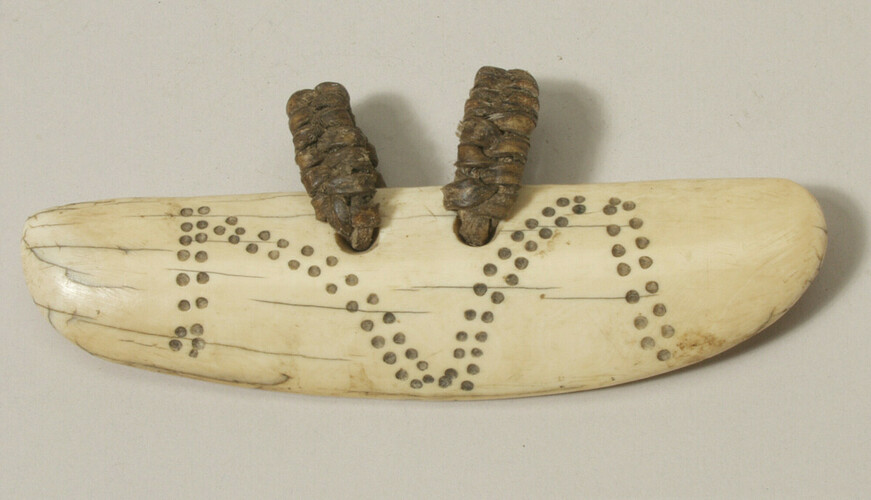 1979.20.147Ivory pendant with plaited hide suspension loops, hung from the horns of a man's favourite bull [RTS 25/6/2004].1979.20.147
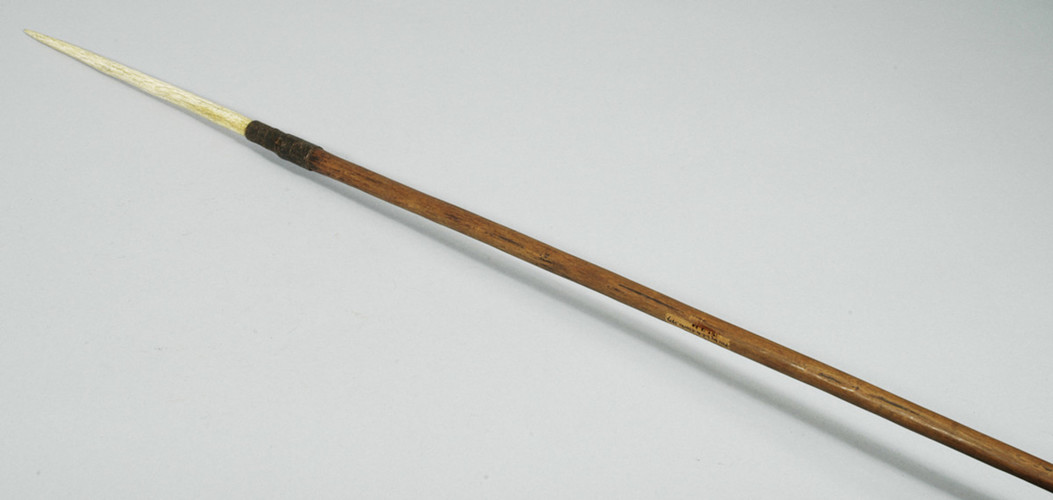 1919.13.20Spear with giraffe bone point set into a long wooden shaft, with a hide sheath covering the junction [RTS 12/1/2005].1919.13.20
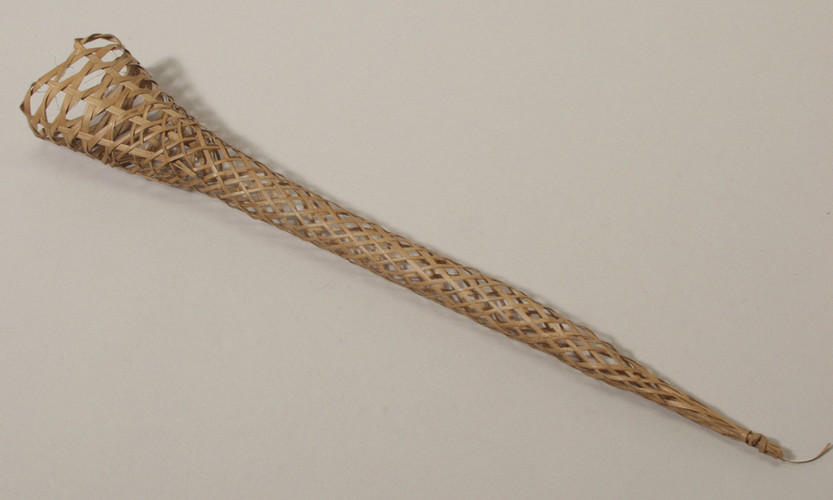 1931.59.5Flexible tubular basketry rat trap with narrow, tapering body and oval mouth [RTS 26/5/2004].1931.59.5