
- Collection type
- Object
- Description
- Woven banana fibre sash known as a tor [ZM 6/6/2016]
- Geographical reference
- Date / Period
- Date made: Before 1878
- Date collected
- By 1878
- Acquisition information
- Transferred: 04/03/1886
- Materials and processes
- Material Banana Wood Plant, Material Pigment, Process Woven, Process Dyed
- Dimensions
- Width: max 135 mm, Length: max 1835 mm
- Object numbers
- Accession number: 1886.1.255
- Research and responses
Related Documents File - Further information from Don Rubinstein from the University of Guam: 'Sash called "tol" or "Tor" worn by men, usually titled chiefs, made from the ... banana stalk, warp is mainly a deep red, weft is both dyed red (ground weave) and undyed (supplementary weft). Three sections of undyed warp tied in (knotted warp technique). Considerable fading of red dye on one side. Note that this object is not mentioned in Collectors VIII Ramsden [AP 21/7/99]
Examined on 5 July 2016 by Helen Alderson as PhD student from Cambridge University researching Micronesian loincloths who noted that these sashes can either be called dohr or tor. [ZM 30/8/2016]
Tor are discussed on page 100 of Barbara Wavell, Arts and Crafts of Micronesia Trading with Tradition, (Honolulu: Bess Press, 2010). The author notes: 'In Pohnpei, a finely woven textile called a tor was used as a sash mainly by high-ranking or prominent men. It was woven on a backstrap loom from banana or possibly hibiscus fiber...tor continued to be made into the first decade of the twentieth century. Early examples were said to have had rows of pink, white, and grey shell beads incorporated into the weaving...Later examples can be identified by the inclusion of western materials such as yearn into the weave. The sash is generally a dark red with intricately patterned stripes at intervals.' [ZM 30/8/2016]
Search terms: Clothing Textile, Status, Sash Belt, Waist Ornament, Status Object
Further items to explore
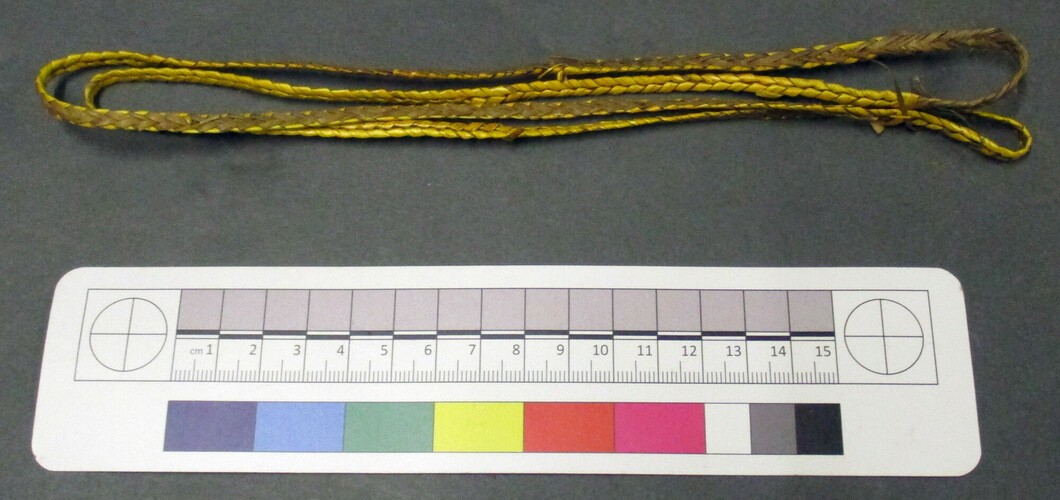 1938.36.703Baldric of plaited pandanus leaf with decoration of yellow strands of orchid stem. [BS [OPS move] 11/11/2016]1938.36.703
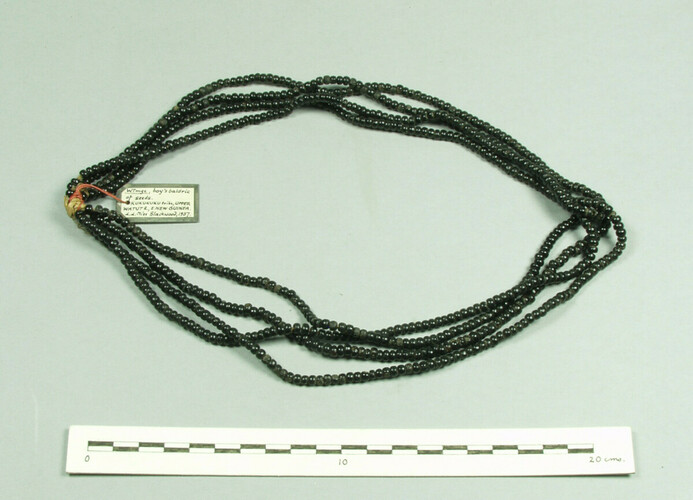 1938.36.626Baldric of shiny round black seeds; tied to form 4 loops [EC 'DCF 2004-2006 What's Upstairs?' 26/7/2005]1938.36.626
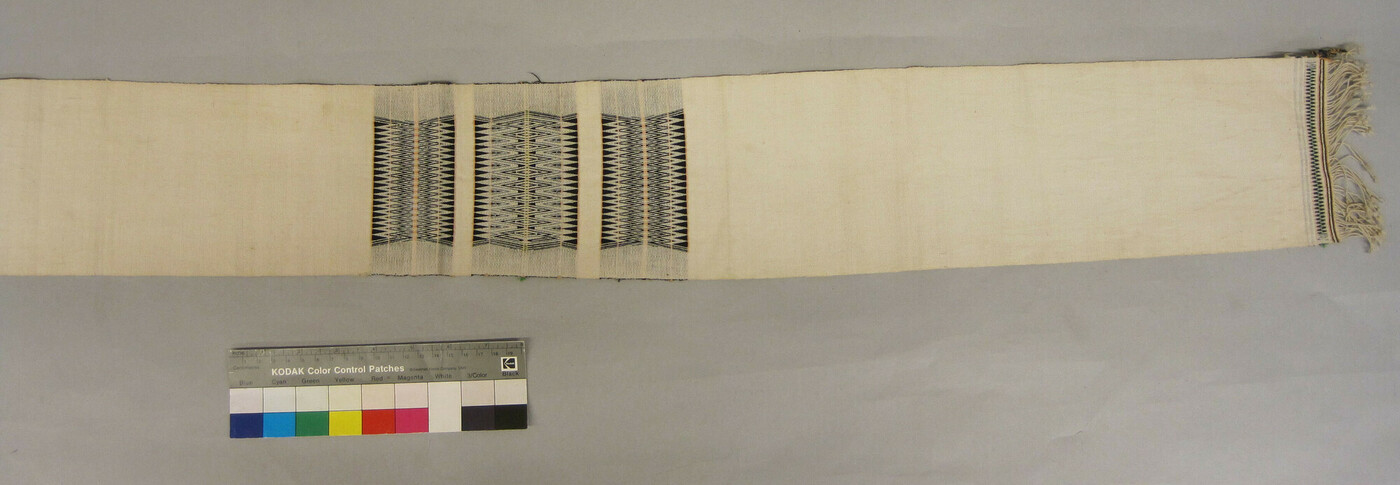 1955.11.22White shoulder cloth, baldric, with pattern of black diamonds at centre. [SM 04/05/2007]1955.11.22
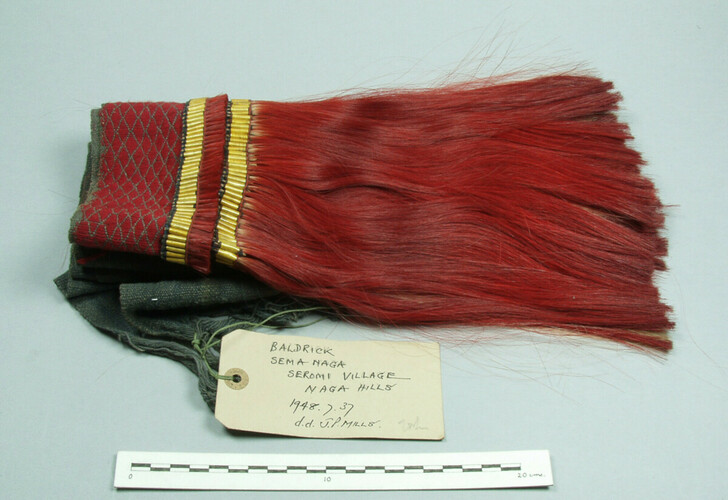 1948.7.37Baldric, embroidered on the front with a red lozenge pattern, and decorated with both a short and a long fringe of red and white (goat?) hair, both rows bound with yellow orchid stem; dark blue reverse and bands for fastening. [N.B. 'DCF 2004-2006 What's Upstairs?' 12/8/2005]1948.7.37
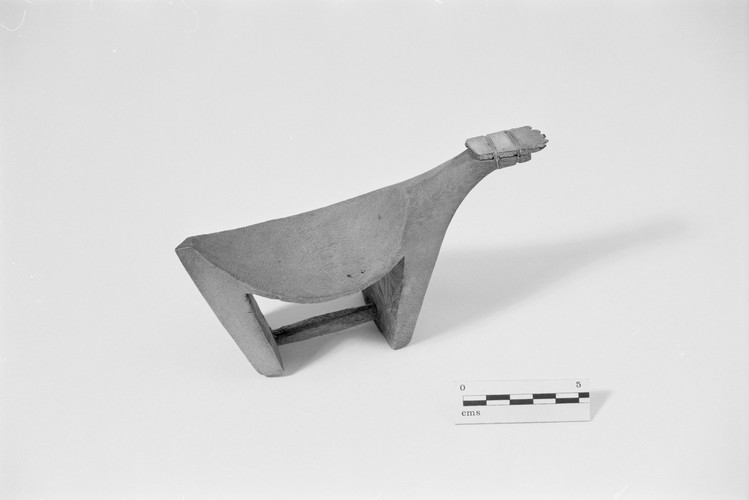 1998.10.20Coconut shell grater, with a wooden handle and serrated piece of white-grey shell bound using yarn to the handle. [L.Ph 'DCF 2004-2006 What's Upstairs?' 21/4/2005]1998.10.20
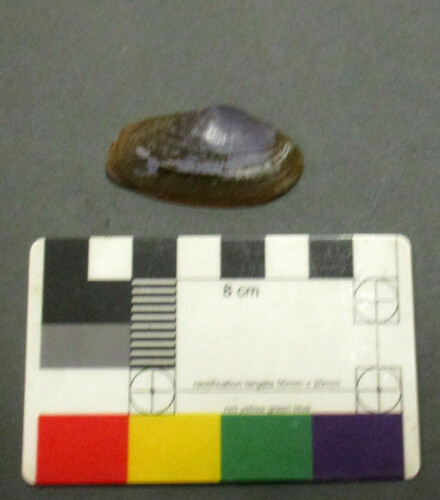 1921.93.289Valve of bivalve shell used in weaving. [BS [OPS Move] 3/4/2017]1921.93.289
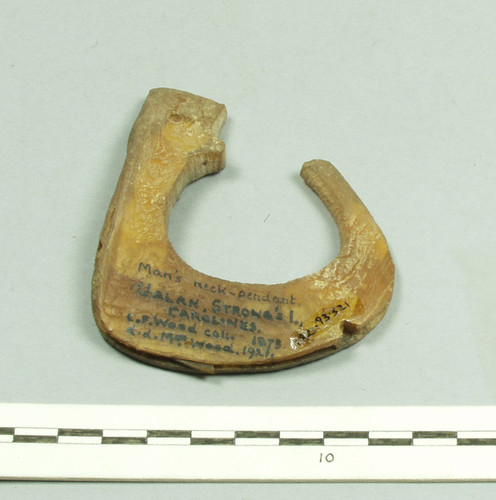 1921.93.321Fish hook pendant of turtleshell. [El.B 'DCF 2004-2006 What's Upstairs?' 12/8/2005]1921.93.321
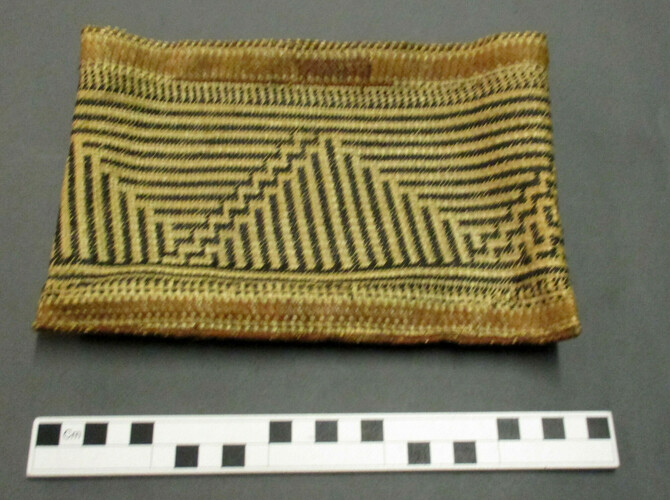 1921.93.260Basket to hold weaving accessories. [BS [OPS Move] 3/4/2017]1921.93.260