
- Collection type
- Object
- Description
- Chinese carved ball, containing ten smaller ones, cut from a solid piece of Indian elephant ivory. It was worked from the outside of the solid ivory towards the centre. [DCF Court Team 9/12/2002] [JN 1/2/2006]
- Long description
- Chinese carved ball, containing ten smaller ones, cut from a solid piece of Indian elephant ivory. It was worked from the outside of the solid ivory towards the centre. The outer ball is carved with hunting scenes. The ball has a tassel of orange silk attached to one end, with decorative Chinese knot in blue silk at the top. The silk is much faded. [DCF Court Team 9/12/2002] [JN 1/2/2006]
- Geographical reference
- Date / Period
- Date made: On or before 1827
- Date collected
- ?On or before 1827
- Acquisition information
- Transferred: 08/03/1886
- Materials and processes
- Material Animal Ivory Tooth, Material Silk Yarn Animal, Process Carved, Process Perforated, Process Tied, Process Knotted
- Dimensions
- Diameter 90 mm
- Object numbers
- Accession number: 1886.1.93 Other numbers: 43
- Research and responses
In order to ascertain the source of the ivory used in this ball, the Pitt Rivers Museum sought advice from staff at the Oxford University Museum of Natural History. As a result this object was examined in its case by Mrs M. Nowak-Kemp in February 2006. She is almost certain from the colour that the ivory is from an Indian elephant rather than an African elephant. She explained how the outer layers of the tusk are removed to get to the ivory layers in the centre. She confirmed that to carve this set of balls the carver would have started from the outside layer of the solid ivory and then worked in to carve the smaller balls inside. [JN 1/2/2006]
- Associated publications
- This object features in the Museum's audio tour produced in 2010. Transcription as follows: “This case contains both practical and ornamental objects made of ivory, bone, horn and antler. Strictly speaking, ivory refers to the material from elephant tusks, but it is also used to refer to the teeth and tusks of other animals such as the sperm whale and the walrus. Ivory is valued and appreciated for its hardness, colour and even structure. The absence of a grain makes it easy to carve and its strength and endurance allow for detail and precision. The surface can be polished to a high degree setting off its colour, which ranges from bright white through to shades of yellow. Due its relative scarcity, it was often used by indigenous peoples religious or special objects. However, before the invention of plastics, it was exported to the developed world in huge quantities where it was used to make things like snooker balls, piano keys, cutlery handles, and buttons. The trade endangered many of the animals killed for their tusks, so now synthetic materials are used for these things instead, and the importation and sale of ivory is banned or severely restricted in many countries. Ivory expands slightly when soaked in warm water, making it easier to carve. Master craftsmen in China may have used this process to ease the manufacture of this multi-layered ‘puzzle’ ball. It was carved from a single piece of Indian elephant ivory but all of the 11 concentric balls are fully detached and free-moving within the others. There is some mystery about how this was done but it was probably by boring conical holes from the circumference of the ball to the centre and detaching successive layers using curved tools on a turning lathe. Each sphere is decorated with meticulous open-work carvings, such as plants and animals and here the outermost sphere shows a hunting scene. The largest puzzle ball in the world consisted of 42 spheres and examples have been known to have been made from other materials such as jade, soapstone and resin. Such puzzle balls are more than just intriguing toys and wonders of craftsmanship however - the layers are said to represent the principles of Chinese philosophy so that, when placed in the home, the whole object exerts a strengthening influence on family unity.” (Written by Helen Hales) References • All about China – Culture: Chinese Puzzle Balls, accessed at: http://www.radio86.co.uk/explore-learn/culture/997/chinese-puzzle-balls-a-dazzling-example-of-superior-craftsmanship • Wood, J. G., Natural History of Man… Vol. II., Routledge (1870), p. 828 • PRM Introductory Guide: Ivory, bone antler and horn, accessed at: http://www.prm.ox.ac.uk/ivory.html [HH 25/10/2010] Apparently described in Wood's NATURAL HISTORY OF MAN, II.828. NB The object is not illustrated, but the type of object is briefly discussed (see 'Research Notes' for further information). [unsigned, undated; JC 22 2 2006, 6 7 2006] Illustrated in black and white in 'Writers Inspired - The Pitt Rivers: A Literary Bibliography', by Elizabeth Gatland, in Newsletter of the Friends of the Pitt Rivers Museum, Oxford, no. 47 (January 2004), p. 7. Caption (same page) reads: '1940.12.143 carved ivory sphere China, Hong Kong region. See it in the ivories case in the Court.' NB The wrong accession number (referring to a similar carved ivory sphere not on display) is given here. The record for 1940.12.143 was presumably also the source of 'Hong Kong region' as the object's provenance. Gatland writes: 'Tony Radmore, in the first Friends Newsletter, named his favourite item in the museum as "a small Chinese ivory sphere containing ten more smaller spheres, one within another." I am convinced this sphere inspired the chess set in Dorothy Sayers's Gaudy Night, each piece of which she describes as "a complicated nest of little revolving balls, delicate as fine lace" (p. 269) and again as "an intricate and delicate carved sphere...as your turned it in your fingers, you found another inside that, and within that, another again" (p. 373). Gaudy Night is a novel of Oxford; it seems appropriate that hidden in the heart of the real city is an object that echoes the imagery Sayers uses as the emotional heart of her novel.' [JC 20 2 2006, 22 2 2006] Illustrated in colour on page 26 of Pitt Rivers Museum: An Introduction, by Julia Cousins (Oxford: Pitt Rivers Museum, University of Oxford, 2004). Caption (same page) reads: 'Sphere, containing eleven smaller ones, elaborately carved from a single piece of ivory.' [JC 8 10 2004] Illustrated in colour on page 56 of The Pitt Rivers Museum: A World Within, by Michael O’Hanlon (London: Scala, 2014). Caption (same page) reads: ‘39 Ivory puzzle ball of nested spheres. China Diameter 90 mm Donated by Reverend F. Spring to the Ashmolean Museum in 1827; transferred to the Pitt Rivers Museum in 1886 1886.1.93’ [MJD (Verve) 18/2/2016]
Search terms: Carving, Toy and Game, Figure, Toy, Animal Figure
Further items to explore
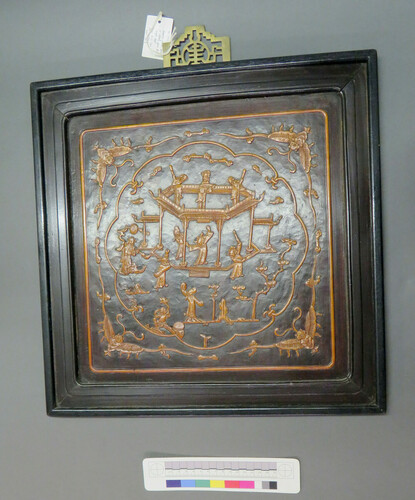 2008.135.2Wooden panel, carved in relief, part of a temple door. [MdeA 21/05/2009]2008.135.2
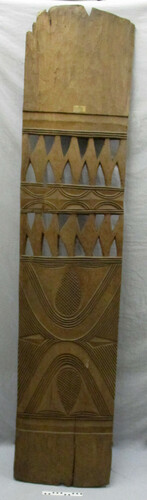 1942.13.1678Carved wooden panel. [RH [OPS Move] 13/7/2017]1942.13.1678
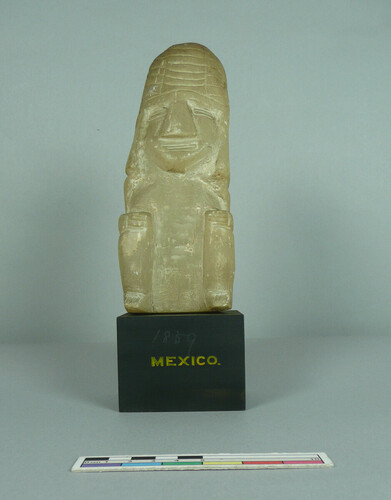 2010.78.9Stone carved figure, of a human in a seated position, with bent knees and arms. The figure is resting its hands around its knees. The figure is wearing a head-dress. [IL [OPS Move] 29/6/2017]2010.78.9
 1884.67.135Rectangular wooden panel, carved and painted with a heraldic coat of arms in green, white, blue and gold. [EH [OPS Move] 14/7/2017]1884.67.135