
- Collection type
- Object
- Description
- Bow harp with wooden tuning pegs, hide covered resonator and 10 strings [1], with loose tuning peg [.2] [RTS 29/9/2005]
- Long description
- Bow harp consisting of a curved neck carved from a lightweight yellow branch (Pantone 7509C), stripped of its surface bark, with bevelled upper end and a tapering shaft that fits into the side of a wooden soundbox. The neck has been perforated with a row of 10 holes, bored through the wood from one side. Faint impressed lines have been cut around the back of these holes, in this case possibly from having tightly tensioned strings drawn around the wood at this point. The holes have been fitted with solid wooden tuning pegs carved from orangey brown (Pantone 729C), roughly shaped with unevenly cut tops. The pegs have a rectangular upper body with a cylindrical, peg-like base that fits through the tuning hole. Some have a shallow groove running around the upper body, to seat the end of the string. 9 pegs are of a similar size; the lowest peg has a much longer body and is more irregular in shape. The uppermost peg has broken off in its hole, and its upper part and a length of string attached to it are currently loose; these have been numbered 1998.9.1.2; the rest of the instrument is 1998.9.1.1. The harp body has been carved from a piece of yellow wood (Pantone 7509C), and consists of a bowl with flat-topped rim, upright sides and a flattened base. The body has a sub-rectangular plan view with a curved back and straight front end. This has been covered with a piece of yellow hide (Pantone 7508C) with a rough surface and traces of bristly buff coloured hair, stretched tightly over the mouth and down the sides, to form the sound table; a similar but smaller piece covers the base. Both pieces have been perforated around their edges, and stitched together using narrow hide strips that form a zigzag pattern around the sides of the soundbox. Two large circular sound holes have been cut in opposite corners of the sound table, with a row of 10 string holes running down the middle; there are some horizontal lines to the side of several of these holes, probably representing marks placed there to guide the craftsmen during manufacture. The line of the string carrier can be detected underneath the sound table, where it has distorted the shape of the hide, but neither end protrudes from the surface, as is more usually the case with this type of harp. This is made of wood, and runs beneath the line of string holes, where it is used to secure the strings. The strings have been made from lengths of a pale cream coloured twisted nylon (Pantone 7506C), and have been tied around the waisted part of each tuning peg, then wound several times around the shaft in a clockwise direction, before passing around the back of the neck, over the protruding peg end on this side of the neck, then down towards the soundbox, where they pass through the string holes and pierced sound carrier, to be secured on the other side. The 5 upper strings have broken part way along their lengths. The harp is complete, but damaged. It has a weight of 763.9 grams. It measures 620 mm from the top of the neck to the end of the soundbox; the neck has a diameter of 30 mm; a typical tuning peg has a head width of 12 by 10.5 mm, is 63.5 mm long, and has a base diameter of 4.2 mm. The soundbox is 250 mm long, with a maximum width of 122 mm, and is 85 mm high; the sound holes have a diameter of 30 by 25 mm, the string holes have a diameter of 2 mm and the string a diameter of 0.5 mm [RTS 29/9/2005].
- Geographical reference
- Cultural groups
- Acholi
- Date / Period
- Date made: Before 1997
- Date collected
- 1997
- Acquisition information
- Purchased: 19/01/1998
- Materials and processes
- Material Wood Plant, Material Animal Hide Skin, Material Nylon Synthetic, Process Carved, Process Perforated, Process Stretched, Process Covered, Process Twisted, Process Strung, Process Grooved
- Dimensions
- Length x Width x Depth: max 635 x 130 x 90 mm, Weight 763.9 g total 1. and .2
- Object numbers
- Accession number: 1998.9.1.1 Other numbers: Kaiser no. 1 Other numbers: PRM invoice item 1 (see RDF)
- Research and responses
This instrument was made by Joseph Oryem; its manufacture was observed and photographed by Tania Kaiser, who then acquired the item. Kaiser was a D.Phil. student of Linacre College, conducting fieldwork in the Kiryandongo Refugee Settlement from October 1996 to March 1997, and between June and November 1997.
This object is said to be called adungu, which is an Acholi word, and should therefore be a type of bow harp. According to Kaiser, "music and dance are both common and important within the community, regardless of whether the context is 'traditional' or modern, religious or secular".
The population of the camp had originally come from Parajok in the Torit district of Southern Sudan, and was a mix of Acholi from that area and previously displaced Sudanese refugees. For details of her work, see: T. Kaiser, 1999, Living in Limbo: Insecurity and the Settlement of Sudanese Refugees in Northern Uganda (Unpublished PhD); T. Kaiser, "Making Do and Making Beautiful: Recycling in an African Refugee Settlement", in: J. Coote, C. Morton and J. Nicholson (eds), Transformations, the Art of Recycling, 44-47; T. Kaiser, 2000, UNHCR's Withdrawal from Kiryandongo: Anatomy of a Handover, New Issues in Refugee Research Working Paper No. 32, 1, 3.
For other adungu in the collection, see 1985.24.1-5, and 1994.60.1-2. [RTS 18/7/2005].
Search terms: Music, Musical Instrument, Harp
Further items to explore
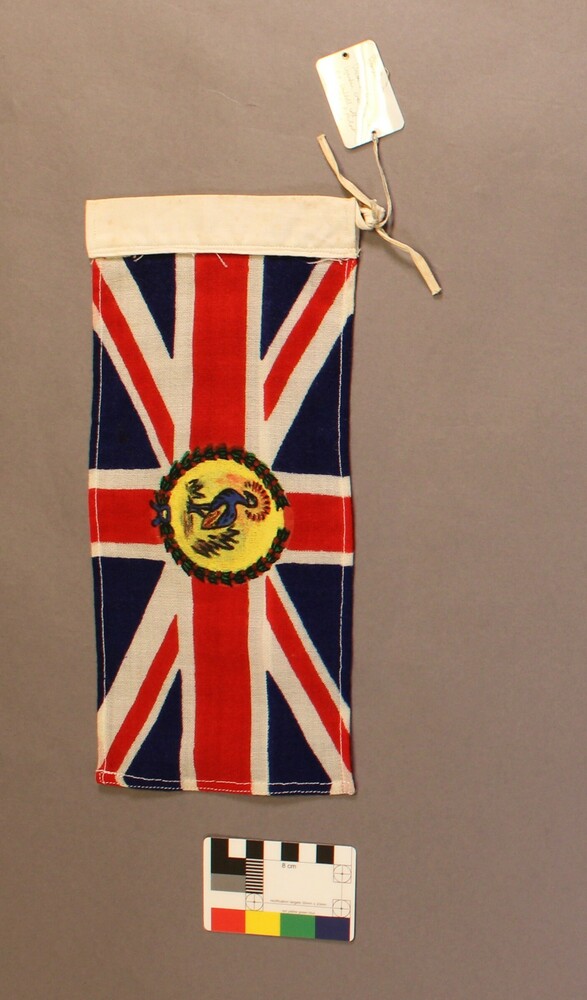 1992.19.42Printed Union Jack with the Ugandan crested crane motif overprinted in the centre.1992.19.42
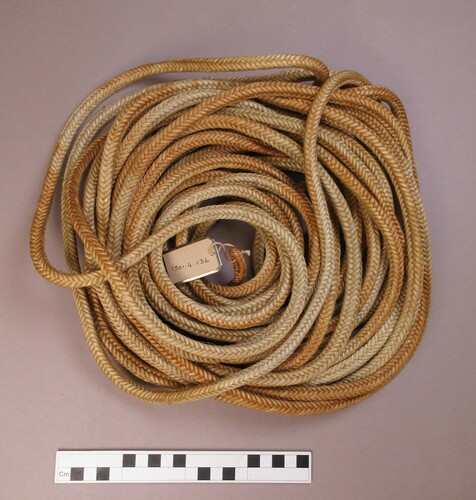 1901.4.136Length of rope.1901.4.136
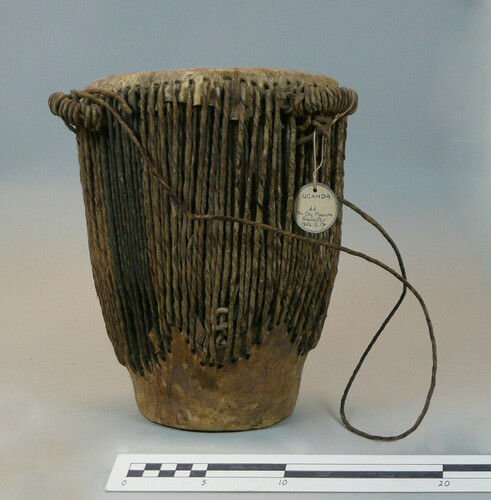 1954.12.17Wooden double membrane cow skin drum with twisted sinew loops and cords. [FC 09/09/2008]1954.12.17
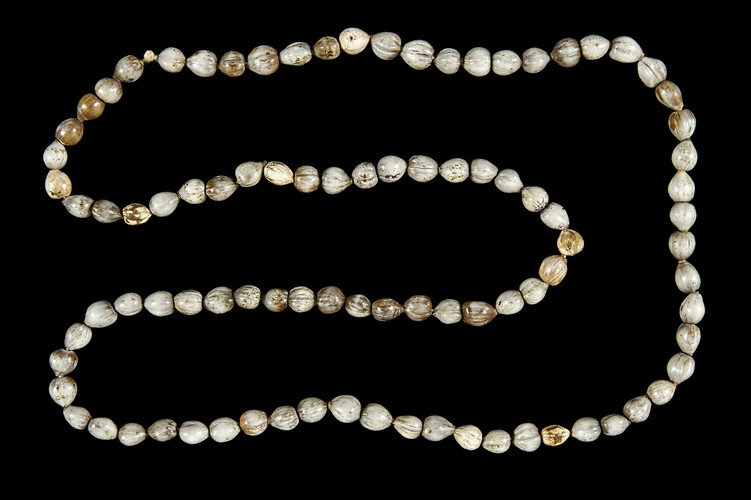 2006.93.11Neck ornament of plant seeds strung on a cotton yarn. Worn by young men during circumcision ceremonies. [MdeA 22/01/2008]2006.93.11