
- Collection type
- Object
- Description
- Lyre with wooden frame, bowl-shaped tortoiseshell resonator and six strings, two broken [RTS 21/9/2005].
- Long description
- Bowl lyre, consisting of a wooden frame or string bearer made from 3 branches with their bark removed and the surface stained a yellowish brown colour (Pantone 730C). One piece rests horizontally across the top to form a cross-bar; this has been pierced near either rounded end. Two longer pieces of wood extend down at an acute angle from this to form the sides of the frame; their tops have been whittled down to points that have been slotted into the cross-bar holes. The space between the wooden arms gradually lessens as one approaches the soundbox; they are 326 mm apart at their top ends, and almost touching at their bases. These arms have been laid across the rim of the soundbox or resonator bowl, which is made from a dark reddish brown tortoise shell with convex back (Pantone 439C); both bowl and lower arms were then covered with a piece of yellowish brown hide, which has been stretched tight across the surface and over to the underside of the bowl (Pantone 7508C). The upper surface of the hide has been perforated with a circular sound hole near the upper end of the bowl; this has a denticulated edge. On the underside, the cover have been pierced around its edge, and hide thongs with traces of buff hair run between here and a circular hide ring near the centre of the back, lashing the two tightly together and keeping the cover taut. Two further thongs have been threaded through these ties as they run around the circumference between these two sections. There are no sound holes visible in the underside of the carapace. The lyre has four strings surviving intact, and 2 additional strings that have broken near their centres. These have been made from a twisted 3-ply greenish brown sinew cord (Pantone 7502C), and lie in the same plane as the resonator. These were wound round the cross-bar at the top, over padding made from additional string binding, and in one case, frm recycled buff coloured cloth (Pantone 7506C). The strings extend down from this point to near the lower edge of the bowl, where they pass through a hole in the hide surface, then out again through the side wall of the bowl, where they are tied to a short orangey brown wooden peg with a groove cut around its centre (Pantone 729C). The object is complete, but the strings are frayed, some have broken, and there is wear across the top of the sound board where the strings have rubbed into the surface. It has a weight of 742.1 grams, and a total length of 558 mm; the cross bar is 396 mm long and 15.5 mm in diameter; the arms are 16.5 mm in diameter and around 580 mm long; the soundbox is 228 mm long, 193 mm wide and 67 mm deep; the sound hole has a diameter of 10 mm; the strings have a diameter of 2 mm and a length, from crossbar to lower sound box, of 520 mm [RTS 21/9/2005].
- Cultural groups
- Nuer
- Person
- Field collector Charles Packard
- PRM source Ipswich Museum
- PRM source Patricia Margaret Maclaren Butler
- Date / Period
- Date made: Before 1928
- Date collected
- By 1928
- Acquisition information
- Purchased: 1966
- Materials and processes
- Material Wood Plant, Material Animal Hide Skin, Material Tortoiseshell Reptile, Material Sinew, Material Textile, Process Carved, Process Stained, Process Twisted, Process Strung, Process Perforated, Process Woven, Process Recycled
- Dimensions
- Height: max 558 mm, Width 193 mm resonator, Width 396 mm cross bar, Height 67 mm resonator, Height 228 mm resonator, Length 580 mm each arm, Weight 742.1 g
- Object numbers
- Accession number: 1966.1.1055 Other numbers: 1928.81.23
- Research and responses
Although the provenance is given as BAHR EL ZENAF in the accessions register, this is most probably an error for Bahr el Zeraf (the 'River of the Giraffes'). The lists in the RDF indicate that this spelling was that used by the Ipswich Museum, prior to the object coming to the PRM. The attribution to the Nuer may have been given because of the provenance; similar lyres in the Pitt Rivers Museum are attributed to other groups such as the Jur and Zande (see 1917.25.75-76, and 1961.9.3). However although the construction method is similar to these, there are some differences - the arms are angled more strongly outwards at the top, and are less visible through the bowl cover, while the bowl has been oriented with its length in the same line as the frame, not at right angles to it as seen on the others.
Larken states that the Zande call this type of instrument kundi, and that it was played by both men and women. Bowl lyres are also popular in Uganda; see M. Trowell & K.P. Wachsmann, 1953, Tribal Crafts of Uganda, pl. 95B-D, for examples from the Madi, Luo and Gwe. They comment that tortoise carapaces are commonly used to form the bowl, and that amongst the Ganda, Soga, Lugbara and Luo the skin cover is laced to a central ring, as seen in the PRM examples; amongst Nilotic groups, it is common to have the arms of the frame placed above the level of the rim so that they leave tell-tale bulges, as seen here, although less markedly so than in some of the other museum examples (op.cit., p. 400) [RTS 21/9/2005].
Search terms: Music, Musical Instrument, Lyre
Further items to explore
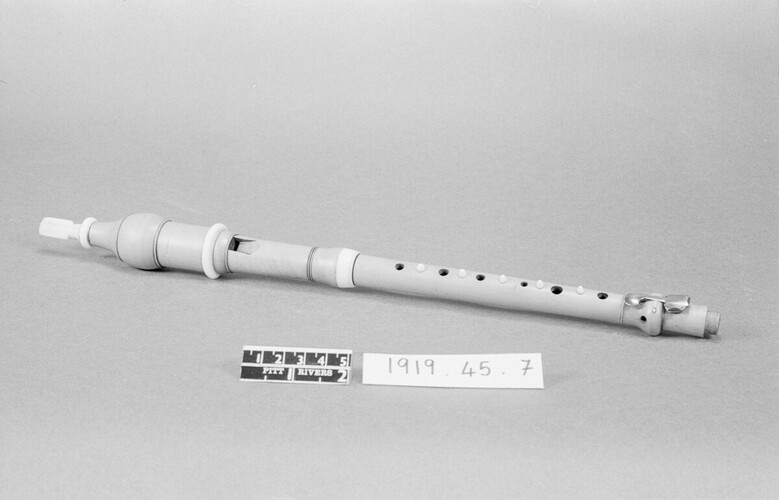 1919.45.7Flageolet1919.45.7
 1938.34.134.2Reed for bagpipes. Down cut.1938.34.134.2
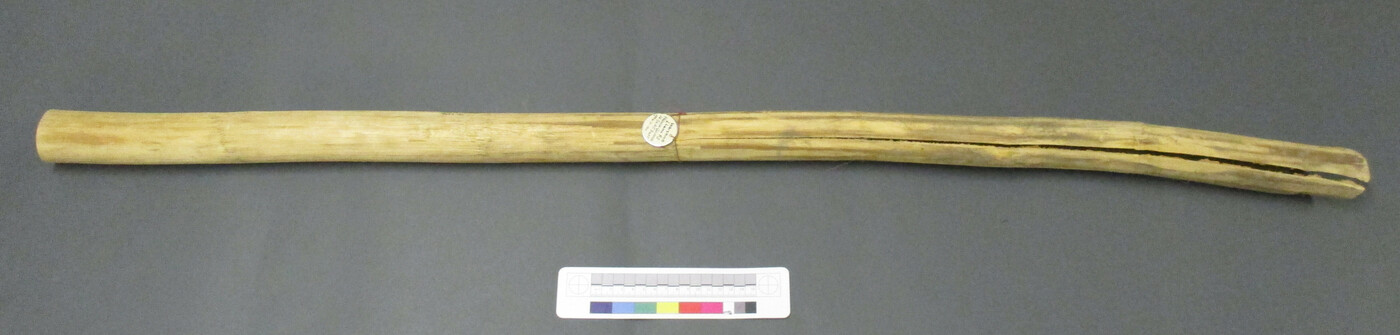 1964.2.100Single reed clarinet. Made from a hollow length of wood from the "congo pump" tree. It is cylindrical, one end is oblique, this end is split. Please note that there is no reed for this clarinet. [AB [OPS Move] 17/2/2017]1964.2.100
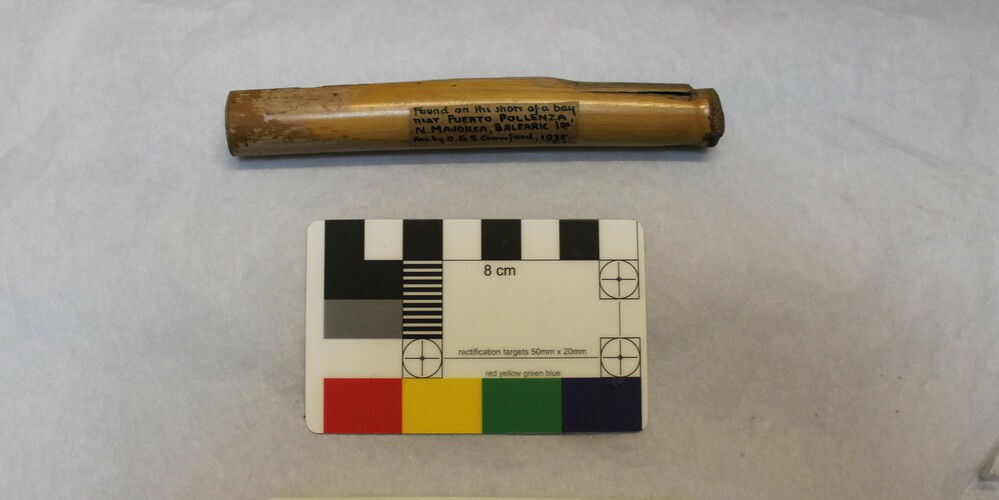 1925.7.1Primitive clarinet, cut from a piece of reed, closed by a node above, open below. A vibrating tongue is cut below the node; 2 rectangular finger holes.1925.7.1
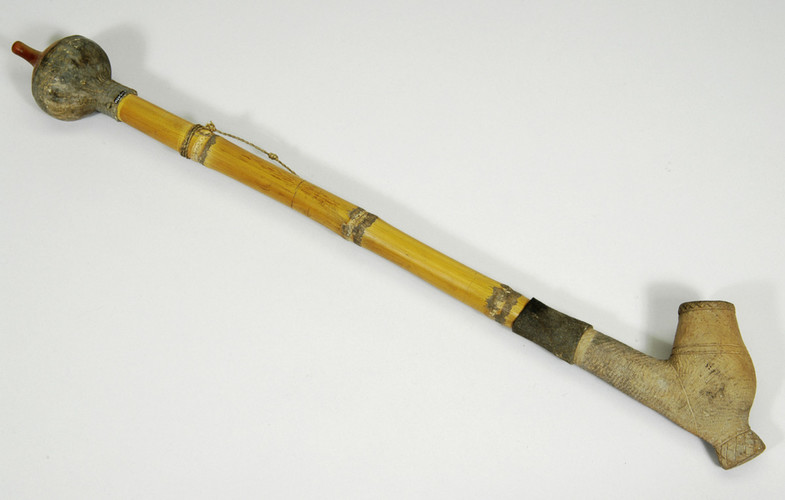 1903.2.1.1Pipe for smoking tobacco, consisting of a gourd and hide mouthpiece [.3] on bamboo stem [.2] with a pottery bowl at the base [.1] [RTS 1/10/2004].1903.2.1.1
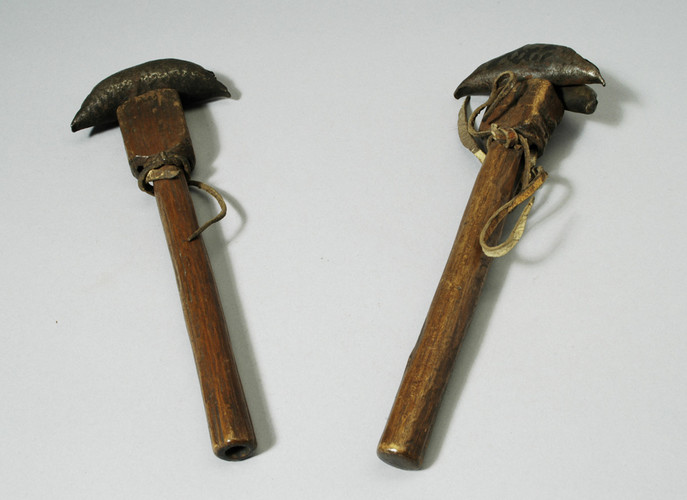 1931.66.4Witchdoctor's rattle, with a single iron pellet bell mounted on a wooden handle [RTS 6/9/2005].1931.66.4
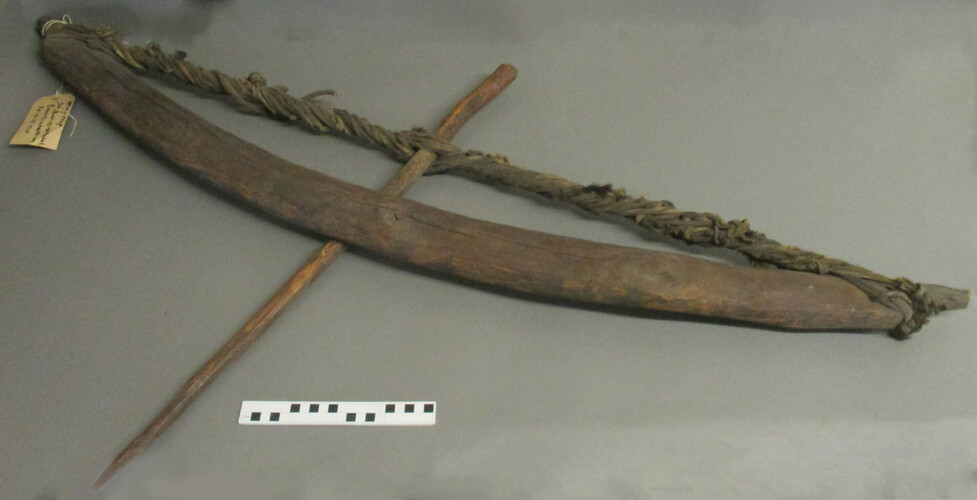 1930.86.24Spring bow trap, made from a carved section of wood, slightly curved with notches cut at either end. [CW [OPS Move] 18/7/2017]1930.86.24
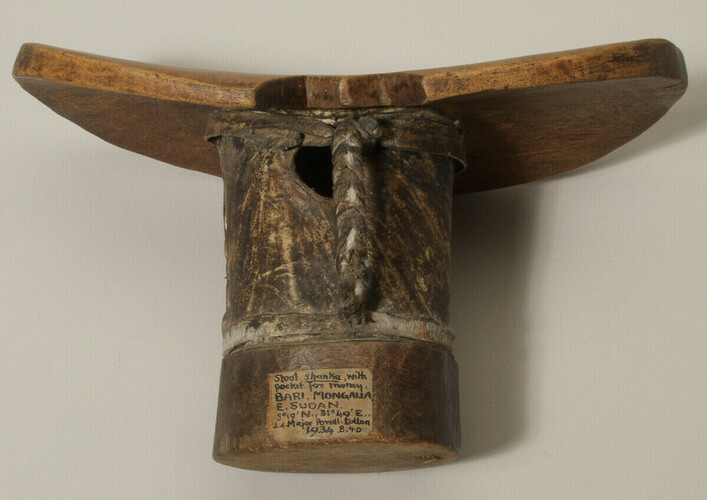 1934.8.40Wooden stool with oval seat and hollowed pedestal covered with hide and with a plaited hide carrying loop [RTS 12/8/2004].1934.8.40