
- Collection type
- Object
- Description
- Bow harp with iron tuning pegs, hide-covered resonator and 9 strings [RTS 23/9/2005].
- Long description
- Bow harp consisting of a curved neck [.2] carved from a yellowish branch (Pantone 7510C), stripped of its surface bark, with bevelled upper end and a round sectioned shaft. The lower end tapers and has been fitted into the side of a wooden soundbox; the fit is a poor one and the neck is able to move from side to side and can be easily detached. The upper part of this neck has been perforated with a row of 9 holes, burnt through the wood and blackened on their interiors. Impressed lines run around the back of each hole, possibly a side-effect of the manufacturing process, a guide to marking out the holes, or for the position of the string. However the third hole from the top was misjudged, despite this, and has a double boring, one side of which has been plugged up with a piece of wood. The tuning pegs have been made from recycled iron rods, round in section, with one end bent over to form a hook. They are said to be made from reused nails, and fit very loosely in the peg holes; at present, none are in place. The harp body [.2] carved from the same type of wood, and consists of a narrow flat-topped rim, on upright sides and a flat base, with a large hole just above the base at the front, curved end, which receives the neck. It has a rectangular plan view. A piece of yellow hide with traces of buff hair on the surface has been stretched tightly over the mouth of this bowl (Pantone 7508C) and down over its sides, forming the sound table. A second piece of hide has been used to cover the base. Both piece have been perforated around their edges, and stitched together using narrow hide strips, knotted in places. There is a large, circular sound hole cut near one long edge of the sound table, 2 groups of 3 small sound holes on either side of the string carrier near the front end, and a row of 10 string holes running in a line down the centre, only 9 of which have actually been used. The string carrier is clearly visible, carved from orangey brown wood with a pointed top, narrow rectangular body and flat cut lower end (Pantone 729C). This extends from beyond the front end of the sound box, passes through a hole cut into the skin sound table to run beneath the line of string holes, where it is used to secure the strings, then extending out through a slit in the hide cover on the other side. The strings have been made from lengths of a pale cream coloured twisted nylon (Pantone 7401C). At the upper end, each string has been tied onto the upper body of its tuning peg, while the other end passes through the string hole, through the pierced body of the string carrier, and then is knotted onto a short wooden twig that holds it securely in place on the other side. The strings have cut into the top of each string hole, giving them a keyhole shape. Some of these strings have knots along their length. There appears to be a few letters scratched into the surface of the sound table, near the central string holes, possibly reading 'IKUF'. The meaning of this is not known. The harp is complete and in good condition. It has a weight in excess of 1000 grams. It measures 875 mm from the top of the neck to the end of the soundbox; the neck piece is 716 mm long (including the area normally obscured by the body of the soundbox), and has a diameter of 30 by 27.4 mm; the peg holes have a diameter of 7 mm; a typical tuning peg has a diameter of 4.2 mm and is 67 mm long. The soundbox is 346 mm long, with a maximum width of 120 mm, and is 107 mm high; the large sound hole has a diameter of 36 mm, the smaller sound holes and string holes have diameters of 4 mm and the strings have a diameter of 1 mm [RTS 23/9/2005].
- Geographical reference
- Bahr el Jebel near Yei Alero
- Person
- Field collector Lutaya Expedition
- PRM source Lutaya Expedition
- PRM source Barbara Elaine Harrell-Bond
- Date / Period
- Date made: Before 1984
- Date collected
- July to September 1984
- Acquisition information
- Purchased: 1985
- Materials and processes
- Material Wood Plant, Material Iron Metal, Material Nylon Synthetic, Material Animal Hide Skin, Material Goat Skin Animal, Process Carved, Process Perforated, Process Stretched, Process Strung, Process Tied, Process Incised
- Dimensions
- Length: max 346 mm resonator, Width: max 120 mm, Length: max 880 mm, Length: max 716 mm neck, Depth: max 100 mm resonator, Weight 1000 g
- Object numbers
- Accession number: 1985.24.5.1 Accession number: 1985.24.5.2
- Research and responses
A province known as 'Equatoria' or 'Al Istiwa'iyah' was in existance from some time in the 1940's to 1981, after which point it was divided into the districts of Eastern and Western Equatoria; in the 1990's these were subdivided further into the modern administrative districts of Western Equatoria, Bahr el Jebel, and Eastern Equatoria. Yei is located in the Bahr el Jebel district. There is an Alero (or Aloro) refugee camp, apparently located in northern Uganda; it is not clear if this is the one mentioned, as it does not seem particularly close to Yei (Times Atlas, 1987).
Although the pegs are said to be made from nails, they seem to be thicker iron rods, and there are no nail heads or other features distinctive to a nail preserved on them.
Note that adungu is given elsewhere as an Acholi word for this instrument (see 1994.60.1-2, 1998.9.1).
Compare this with 1985.24.1, 1985.24.5 (with different shaped resonator bowls), and 1994.60.1-2 (from the Acholi) [RTS 16/1/2004].
Search terms: Music, Dance, Religion, Musical Instrument, Harp
Further items to explore
 1913.77.49Wooden gong1913.77.49
 1940.9.40.7BOne of 22 musical discs to be played on musical box 1940.9.40.1B1940.9.40.7B
 1930.4.1Small end-flute of reed, bound with brass wire.1930.4.1
 1902.39.3Fiddle bow.1902.39.3
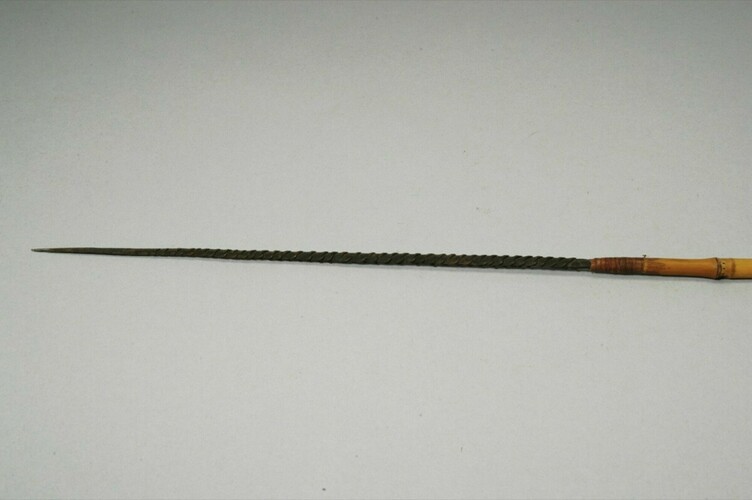 1910.4.5Arrow with narrow barbed iron arrowhead on a cane shaft with nocked and bound end [RTS 7/7/2005].1910.4.5
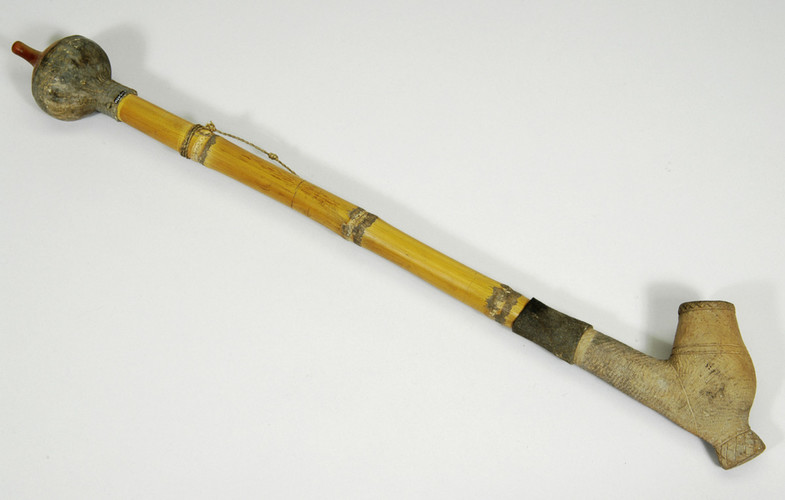 1903.2.1.1Pipe for smoking tobacco, consisting of a gourd and hide mouthpiece [.3] on bamboo stem [.2] with a pottery bowl at the base [.1] [RTS 1/10/2004].1903.2.1.1
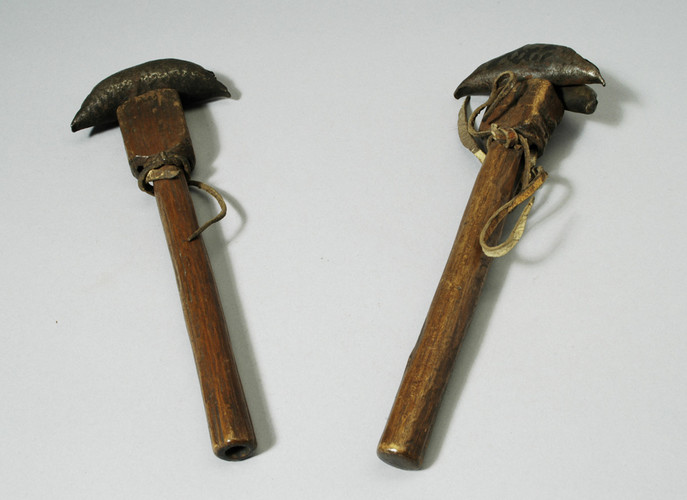 1931.66.4Witchdoctor's rattle, with a single iron pellet bell mounted on a wooden handle [RTS 6/9/2005].1931.66.4
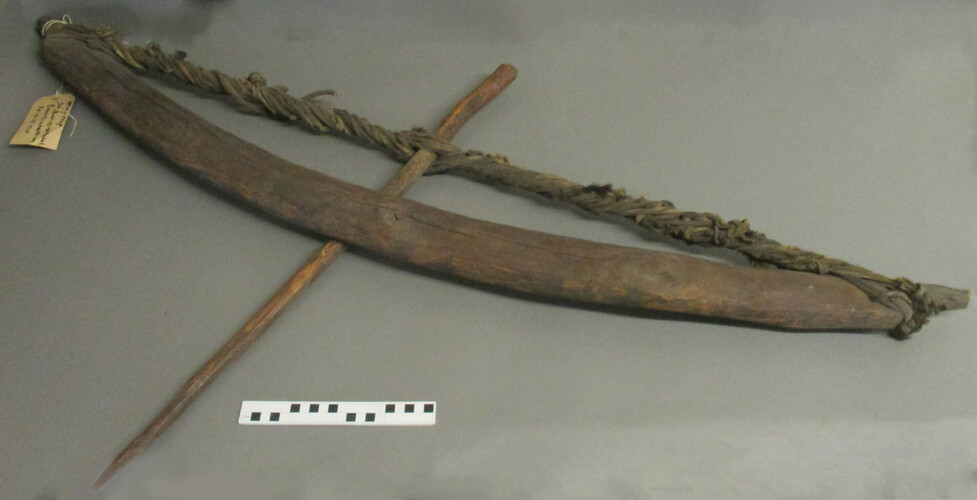 1930.86.24Spring bow trap, made from a carved section of wood, slightly curved with notches cut at either end. [CW [OPS Move] 18/7/2017]1930.86.24