
- Collection type
- Object
- Description
- Sansa.
- Long description
- Sansa. Backrest and bridge are small thin lengths of reed. The bar is a piece of vegetable fibre tied down by another between each tongue holding each firmly in place. The box is pinned together with wooden pins and painted green. There is a sound hole in the board under the central tongues. [HLR]
- Geographical reference
- Date / Period
- Date made: Before 1917
- Date collected
- circa 1800 - 1850
- Acquisition information
- Donated: 07/1917
- Materials and processes
- Material Wood Plant, Material Bamboo Plant, Material Reed Plant, Material Pigment, Process Carpentered, Process Tied, Process Painted, Process Incised
- Dimensions
- Length: max 188 mm, Width 118 mm, Depth 46 mm
- Object numbers
- Accession number: 1917.14.6
- Associated publications
- Illustrated in black and white (top and bottom views) as figure 1.35a,b on page 55 of 'African and African American Lamellophones: History, Typology, Nomenclature, Performers, and Intracultural Concepts', by Gerhard Kubik, in Turn Up the Volume: A Celebration of African Music, edited by Jacqueline Cogdell DjeDje (Los Angeles: UCLA Fowler Museum of Cultural History, 1999), pp. 20-57. Caption reads: 'Lamellophone with box resonator, nine notes of bamboo in VI-shape layout, and decorative engravings collected in northern South America, probably Dutch Guiana (Suriname).' Text (same page) reads (but see original for diacritics): 'In the nineteenth century there existed many more types of lamellophones in the Americas. One remarkable specimen was collected by Mrs Braithwaite Batty in northern South America, probably Dutch Guiana (Suriname) in the early twentieth century...; it was acquired by the Museum in July 1917.... This instrument has nine bamboo lamellae in a characteristic VI-shaped layout, mounted on a small rectangular soundboard nailed to a box. Bridge and bracket are identical horizontal bars, also of vegetable material, and the straining bar is bound to the soundboard in the same manner as some Calabar lamellophones, the Edo asolugun, and the Igbo ubo aka. This establishes convincingly the ancestry of this specimen in southeastern Nigeria or any other place on the West African coast where southeastern Nigerian lamellophone technology had spread before this type became known in Suriname. Only the decoration carved into the balsa-type wood of the soundbox with a shell shows a pattern that may be based in local (Suriname) decorative art. This does not exclude the possibility that a comparable southeastern Nigerian decorative style might still be found.' [JC 26 5 2000]
Search terms: Music, Musical Instrument, Lamellophone
Further items to explore
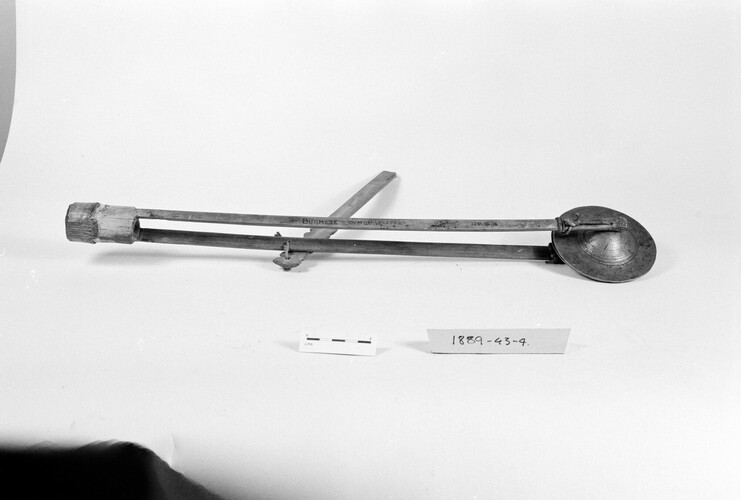 1889.43.4Small cymbals, inserted into piece of bamboo. [DCF Court Team 7/2/2003]1889.43.4
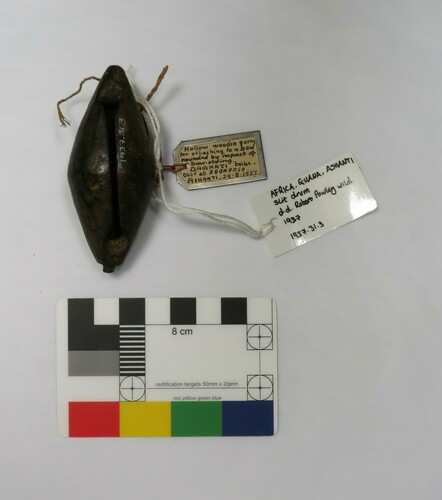 1937.31.3Very small wooden slit drum designed to be attached to an archer's bow. [JID 7/1/2020]1937.31.3
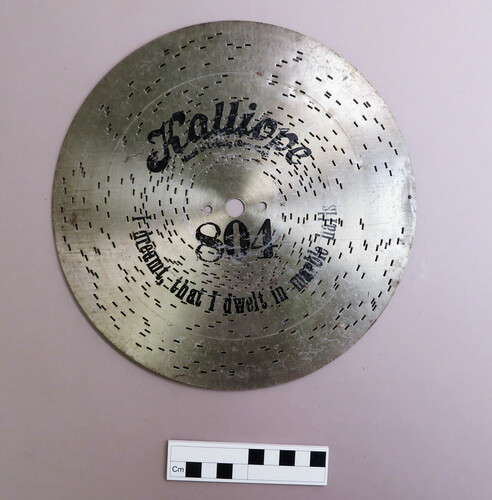 1982.5.1.6Metal music disc to be played on musical box 1982.5.1.11982.5.1.6
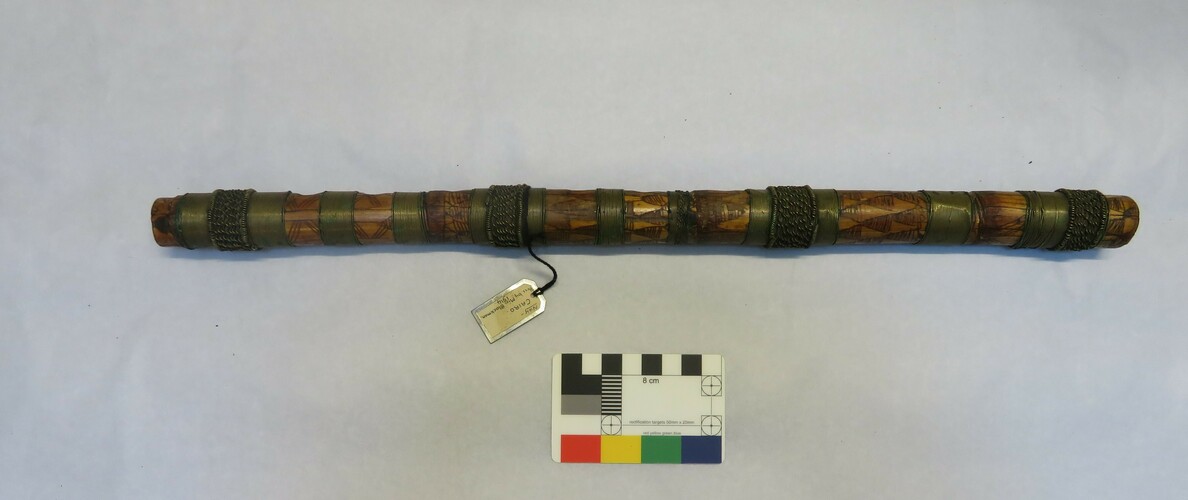 1914.14.6End-flute, nay1914.14.6
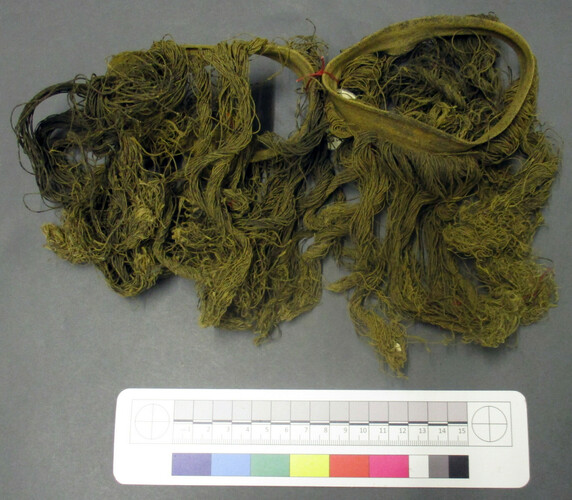 1964.2.65.1One of a pair of leg bands. Brown green in colour, with woven band from which fibre fringing hangs. For the matching leg band see 1964.2.65 .2 [BS [OPS Move] 16/11/2016]1964.2.65.1
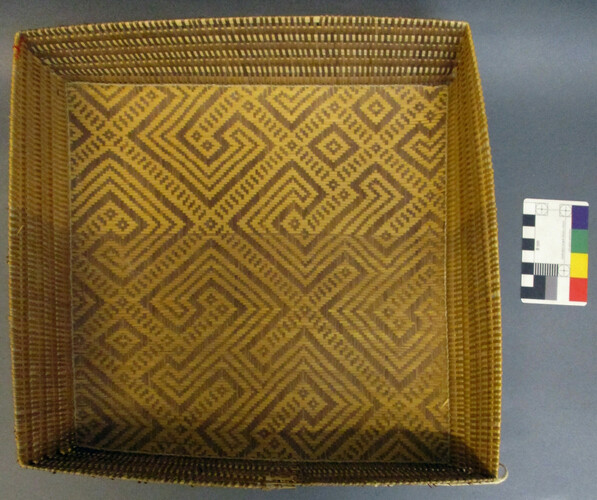 1964.2.45Square basketry tray, with a loose weave on the walls and a cord of stitched string attaching the sides to the base, which is decorated with geometric shapes. [BH [OPS move] 17/11/2016]1964.2.45
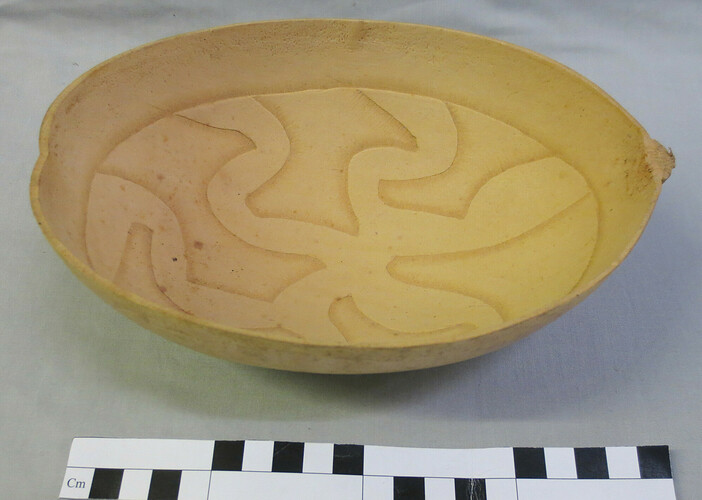 1965.12.27Calabash spoon with an incised design on the inside surface. [NC 02/07/2015]1965.12.27
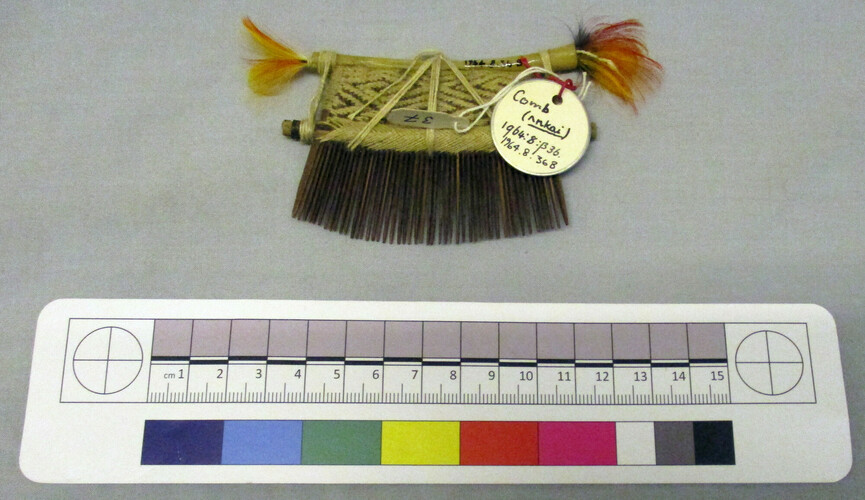 1964.8.36BComb, the base of which is a monkey bone, into the length of which are set many splinters from the palm tree, forming the teeth. The top half of the splinters are firmly laced with cotton thread and an attached wooden splint. At either end of the bone rib are small tufts of yellow and red toucan feathers. [ASh [OPS move] 18/5/2016]1964.8.36B