
- Collection type
- Object
- Description
- Jew’s harp
- Geographical reference
- England
- Cultural groups
- English
- Date / Period
- Date made: Before 1899?, uncertain
- Date collected
- ?1890s
- Acquisition information
- Donated: 1903
- Materials and processes
- Material Iron Metal, Material Steel Metal, Process Cast
- Object numbers
- Accession number: 1903.129.30
- Associated publications
- This object features in the Museum's audio tour produced in 2010. Part transcription as follows: “The Jew’s harp is one of the world’s oldest instruments. It is thought to have originated in China in ancient times, but it has now become part of musical traditions across Asia, Oceania and northern Europe. It is played near the mouth but it is not a wind instrument. Instead, it is pressed against the teeth or lips and the other hand plucks the central ‘tongue’ to produce a sound, the player’s open mouth acting as a resonator. Alternatively, as you can see on some examples from Indonesia, the tongue is sometimes attached to a toggle, which is jerked to produce a similar effect. In this case you can see different types Jew’s harps… The Jew’s harp is predominantly thought of as a folk instrument but German and Austrian composers of the C18th incorporated it into classical pieces, and John Lennon also played one on the 1960s Beatles song, ‘The Fool on the Hill’. The instrument is known by different names in every country. We now know that the earliest recorded use for the term ‘Jew’s harp’ in England was in the late 15th century. No-one really knows where the name comes from – it is likely that the instruments were first made or sold in Plantagenet and Tudor England by Jewish pedlars. Another, less likely explanation is that it derives from the Dutch word ‘Jeudgetrompe’ meaning ‘boy’s trumpet’. By the mid-18th century, the name was often corrupted into ‘jaw harp’ or ‘juice harp’. European Jew’s harps, such as those displayed to the right (1903.129.30, 1938.34.516), tend to be made of steel with a distinctive rounded end, and sound like this… [music insert] The Jew’s harp is an instrument that’s easy to get a sound from, but it requires a lot of skill to play melodically. The pitch is constant but the player can change the tone and volume by subtly changing the shape of their mouth, the position of the tongue, and their breathing patterns. The basic drone sound often accompanies dancing or shamanic rituals in some cultures. For the Naga people of Assam in north-east India, the sound is thought to be rather seductive and it is used in serenades. Among some indigenous tribes of Taiwan, the Jew’s harp actually constitutes a love letter. A man plays the instrument in front of a girl’s house and if he leaves it with her, it is considered a proposal of marriage. By accepting the Jew’s harp, she accepts him as her husband.” (Written by Helen Hales) References: Wright, Michael, ‘How to Play the Jew’s Harp’, English Dance and Song magazine (2002), accessed at: http://www.jewsharper.info/?s=teach; Wright, Michael, ‘Jue Harpes & Jue Trumpes, 1481’, Journal of the International Jew’s Harp Society (2004), p. 7–10; Steafel, Harold, ‘Jew's Harp’, The Galpin Society Journal, Vol. 29, (May, 1976), pp. 122–123; Jenkins, J. L., Musical Instruments, London: Horniman Museum (1970), pp. 36–37; Fox, L. (ed), The Jew’s Harp: a Comprehensive Anthology, Cranbury, NJ: Associated University Presses (1988); Montagu, Jeremy, ‘The Crozier of William of Wykeham’, Early Music (November 2002), Oxford, pp. 541–562 (Jew’s harp discussed on page 554) [HH 26/10/2010]
Search terms: Music, Musical Instrument, Jews Harp
Further items to explore
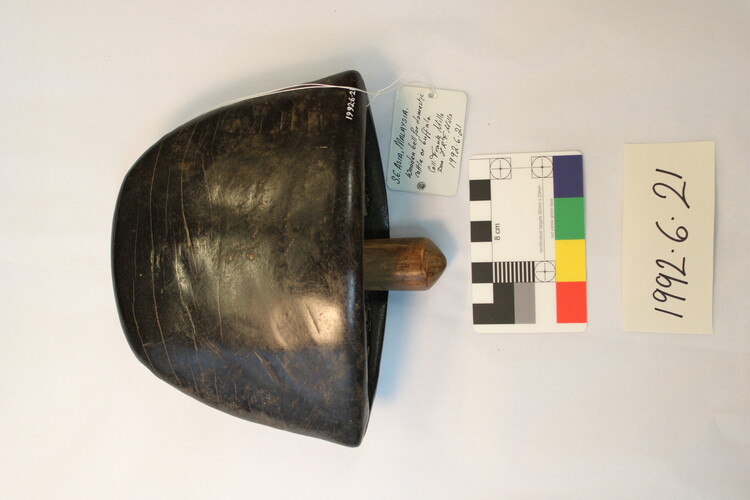 1992.6.21One of six wooden animal bells1992.6.21
 1938.34.619.2Bow to be used with fiddle 1938.34.619 .11938.34.619.2
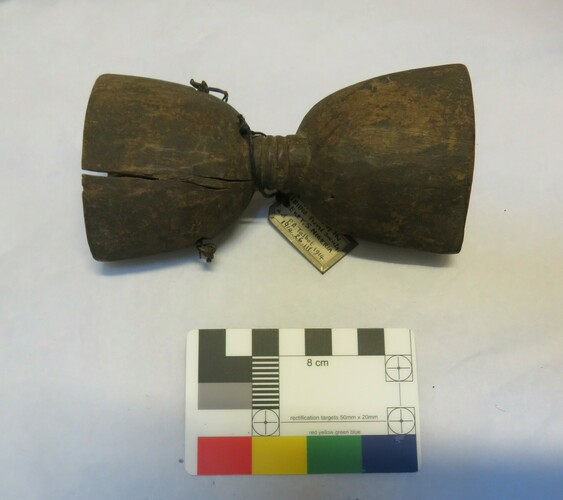 1914.26.111Clapper bell1914.26.111
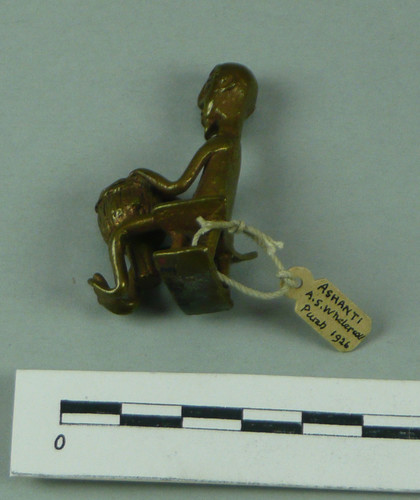 1926.85.3Copper alloy weight, in the form of a man sitting on a stool drumming, for weighing gold. [MdeA 4/10/2000]1926.85.3
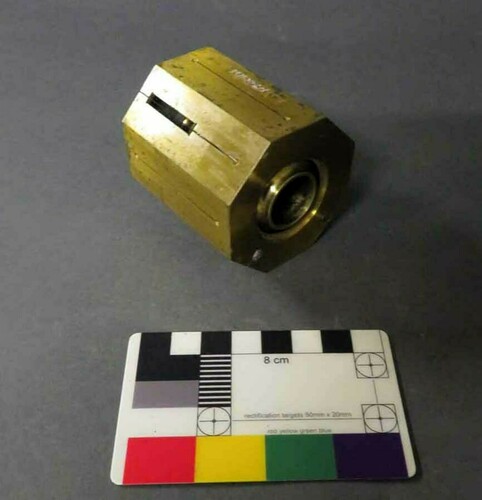 1971.30.2.1Surveyor's cross of copper alloy metal; hexagonal in shape with rectangular perforations on alternating sides. Stored in its wooden box [1971.30.2 .2]. [MOBB [OPS move] 12/6/2018]1971.30.2.1
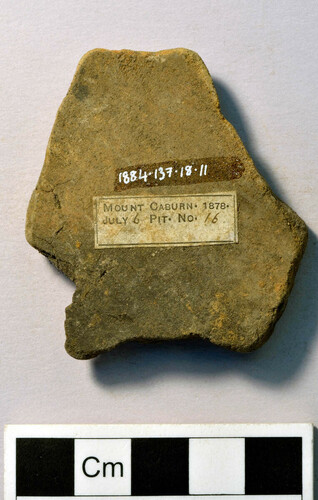 1884.137.18.11Ceramic sherd1884.137.18.11
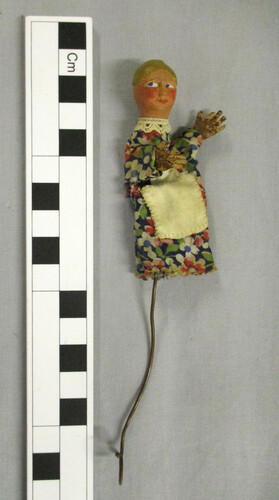 1985.36.166One of four original characters for the 'Peep Show' puppet show, made by Walter Wilkinson. Puppet is made from a painted head attached to a wire, wearing a multi-coloured flowery dress. This character is called 'Sally'. See also numbers 1985.36.165 to 168.1985.36.166
 1886.12.3Old flambeau holder consisting of a long wooden pole painted light grey with a metal section at the top. The metal section is square where it attaches to the pole. The top is rounded with oblong holes. [AF [OPS Move] 6/7/2017]1886.12.3