
- Collection type
- Object
- Description
- Jew's harp made of Mammoth ivory
- Person
- Field collector Maria Antonina Czaplicka
- PRM source Maria Antonina Czaplicka
- PRM source Committee for Anthropology, University of Oxford
- Date / Period
- Date made: Before 1914
- Date collected
- 1914
- Acquisition information
- Donated: 1915
- Materials and processes
- Material Mammoth Ivory Tooth Animal, Material Reindeer Bone Animal, Process Carved
- Dimensions
- Length: max 89 mm
- Object numbers
- Accession number: 1915.50.101
- Research and responses
Research notes from Alexander Nikolaevich Varlamov, expert in Evenki culture and consultant for the project 'Wandering in Other Worlds', (translated by Anya Gleizer): Pәnngipkәwun is the Evenki name for a musical instrument ( a vargan) made of wood or bone. Pengӈipkevun is formed from the root base peӈ - the phonetic imitation of playing the vargan [Comparative Dictionary of Tunguso-Manchurian languages, 1977, p. 47]. The metal vargan has another name - keӈgipkevun,(kengipkevun) from keӈgi - to ring (as metal rings) [Comparative Dictionary of Tunguso-Manchurian languages, 1975, p. 450].
A vargan made from a mammoth tusk is the most ancient/traditional form of this Evenki musical instrument. An Evenki penӈipkevun was considered a female ritual instrument. The techniques used for playing this instrument were specific to the Evenki, as the Evenki penӈipkevun had a specific technical feature: an ancient penӈipkevun (as is in the samples presented in the PRM museum) was shaped like a flattened surface with a narrow "tongue", cut from the middle. A tendon thread was tied to the base of the "tongue". The instrument was placed between the teeth with the base of the "tongue" facing into the mouth. The vibration was caused by the stretching of the tendon thread. The variety of sounds was produced by the rhythm of the tension of the string and the play of the muscles of the mouth; the larynx produced the sound passing through which was then warped by the vibrating instrument [Vasilevich 1969, p. 209]. Here in these collections are two penӈipkevun of the same type.
Numerous samples of Evenki vargan made of bone, wood and metal are stored in the collections of many Russian museums. Some of them can be seen at the link of the museum portal goskatalog.ru. https://goskatalog.ru/portal/#/collections?
- Associated publications
- This object features in the Museum's audio tour produced in 2010. Part transcription as follows: “The Jew’s harp is one of the world’s oldest instruments. It is thought to have originated in China in ancient times, but it has now become part of musical traditions across Asia, Oceania and northern Europe. It is played near the mouth but it is not a wind instrument. Instead, it is pressed against the teeth or lips and the other hand plucks the central ‘tongue’ to produce a sound, the player’s open mouth acting as a resonator. Alternatively, as you can see on some examples from Indonesia (1938.34.508), the tongue is sometimes attached to a toggle, which is jerked to produce a similar effect. In this case you can see different types Jew’s harps, including, on the upper right, one from Russia made from a prehistoric woolly mammoth tusk (1915.50.101). Ones made from bamboo and palm, popular in South Asia (1928.69.880–.881), Cambodia and Papua New Guinea (1913.88.292), sound like this…[music insert] ...The Jew’s harp is an instrument that’s easy to get a sound from, but it requires a lot of skill to play melodically. The pitch is constant but the player can change the tone and volume by subtly changing the shape of their mouth, the position of the tongue, and their breathing patterns. The basic drone sound often accompanies dancing or shamanic rituals in some cultures. For the Naga people of Assam in north-east India, the sound is thought to be rather seductive and it is used in serenades. Among some indigenous tribes of Taiwan, the Jew’s harp actually constitutes a love letter. A man plays the instrument in front of a girl’s house and if he leaves it with her, it is considered a proposal of marriage. By accepting the Jew’s harp, she accepts him as her husband.” (Written by Helen Hales) References: Wright, Michael, ‘How to Play the Jew’s Harp’, English Dance and Song magazine (2002), accessed at: http://www.jewsharper.info/?s=teach; Wright, Michael, ‘Jue Harpes & Jue Trumpes, 1481’, Journal of the International Jew’s Harp Society (2004), p. 7–10; Steafel, Harold, ‘Jew's Harp’, The Galpin Society Journal, Vol. 29, (May, 1976), pp. 122–123; Jenkins, J. L., Musical Instruments, London: Horniman Museum (1970), pp. 36–37; Fox, L. (ed), The Jew’s Harp: a Comprehensive Anthology, Cranbury, NJ: Associated University Presses (1988); Montagu, Jeremy, ‘The Crozier of William of Wykeham’, Early Music (November 2002), Oxford, pp. 541–562 (Jew’s harp discussed on page 554) [HH 26/10/2010]
Search terms: Music, Musical Instrument, Jews Harp
Further items to explore
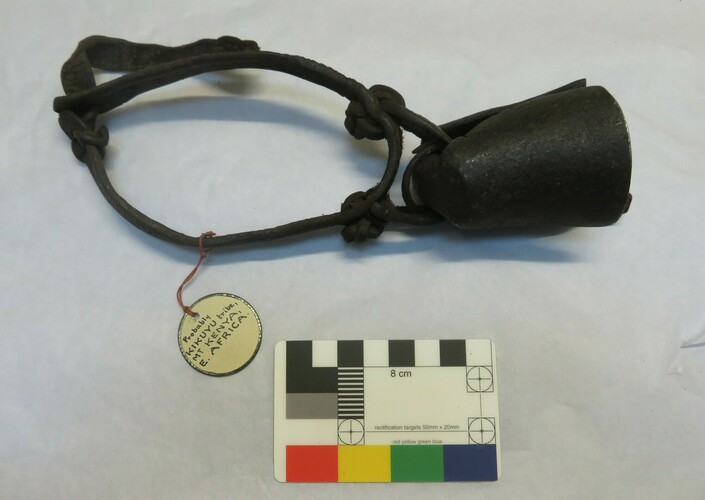 1942.13.1019Iron bell strung on leather strap collar. [JID 30/1/2020]1942.13.1019
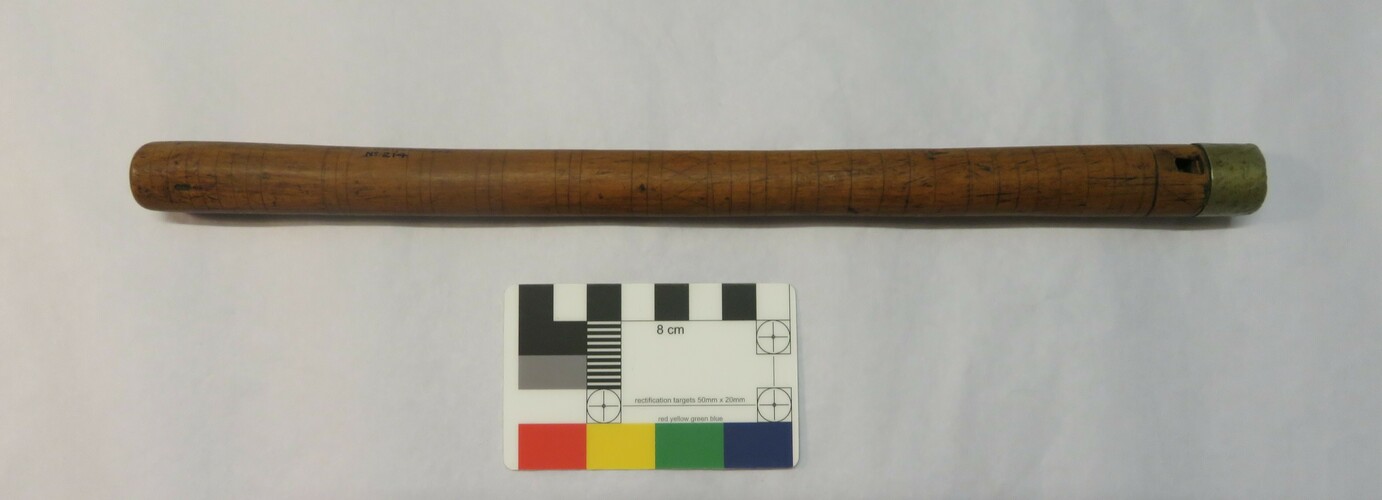 1938.34.214Duct-flute or flageolet, of wood, 6 finger holes; slit and sound hole on lower side. Finger holes very worn. Lightly scratched parallel lines around instrument for its complete length. Metal strip covers proximal end above sound hole.1938.34.214
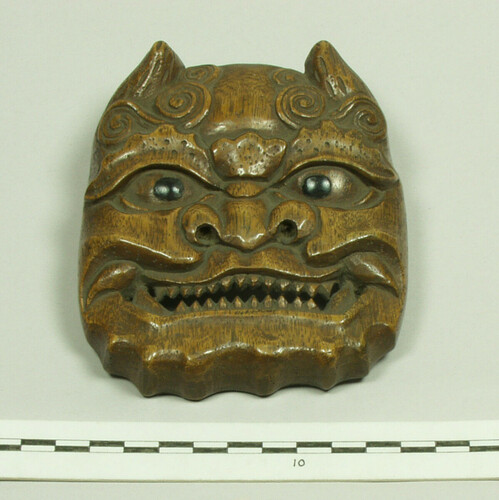 1980.34.2526A large wood toggle representing a mask with inlaid ebony eyes.1980.34.2526
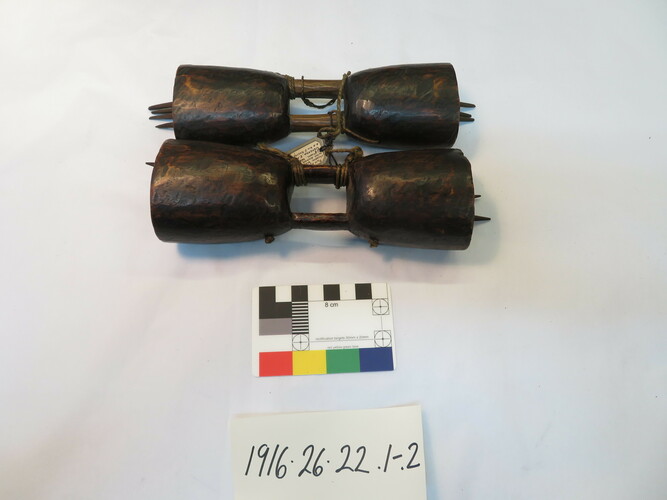 1916.26.22.2Clapper-bell. Associated with sibling object .1 [PB 31/1/2020]1916.26.22.2
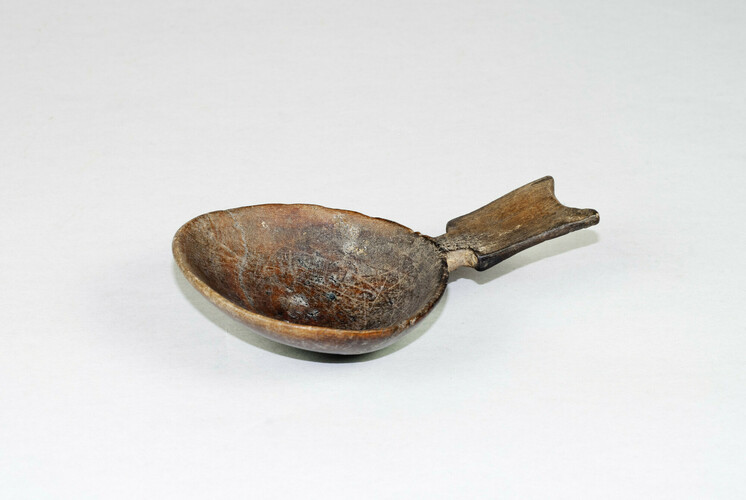 1915.50.60.2Spoon of horn with large bowl and small handle. [El.B 'DCF 2004-2006 What's Upstairs?' 2/3/2006]1915.50.60.2
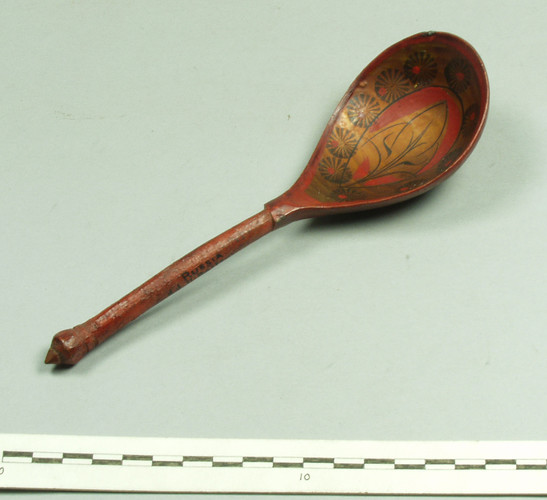 1912.36.30Wooden spoon painted in black, gold & red, with flower designs. [EC 'DCF 2004-2006 What's Upstairs?' 24/2/2006]1912.36.30
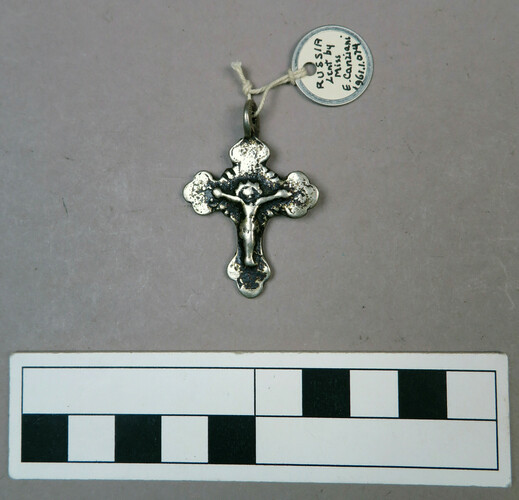 1961.1.074Silver crucifix.1961.1.074
 1915.50.94Saddle bag made from animal hide with panels of white fur. [FB 27/10/2014]1915.50.94