
- Collection type
- Object
- Description
- Piece of bone engraved with very early Chinese characters, Han period.
- Geographical reference
- Date / Period
- Date made: 206 BC - AD 220 Archaeological period: Han Dynasty
- Date collected
- 1922
- Acquisition information
- Donated: 1923
- Dimensions
- Length: max 53 mm
- Object numbers
- Accession number: 1923.20.2
- Research and responses
A note from Peichao Qin, PhD student in the Faculty of Asian and Middle Eastern Studies at the University of Cambridge: I can confirm without a doubt that these are indeed oracle bones (ca. 1250 - 1050 B.C.E, late Shang dynasty). The two bones are both ox scapula fragments (from same or different scapula). It's a bit difficult to tell which part of the scapula is the left bone from, but the right bone, is near the caudal or cranial side of the scapula, whose right edge is also the natural edge of the bone.
As for the inscriptions, the left bone reads:
1). ...𪭑... (piercing/puncturing through)
2). ...[unknown character], 㞢羊,[其]... (provide offerings of sheep to)
, where there are two inscription units (or possibly just one without knowing the context), in which it mainly records an you-ritual to offer some shape to one of their ancestors.
The right bone reads:
貞:乎子央㞢于母己.
, which means "Tested: Commands Ziyang to provide offerings to Ancestress Ji."
Interesting enough, these two bones seem to have not been published before. In 1985, a team of researchers has investigated all known 11 collections in UK, both public and private, and published rubbings of a total of 2674 oracle bones as a book named Oracle Bone Collections In Great Britain. But the Pitt Rivers Museum is not one of them (only the 33 pieces in Ashmolean Museum is included).
Note: the information on the display box shows a discrepancy in the period/date for these fragments, ie Sang Period, c.1000-1500 B.C.
Search terms: Writing, Specimen, Animalia, Inscription, Bone, Animal Part
Further items to explore
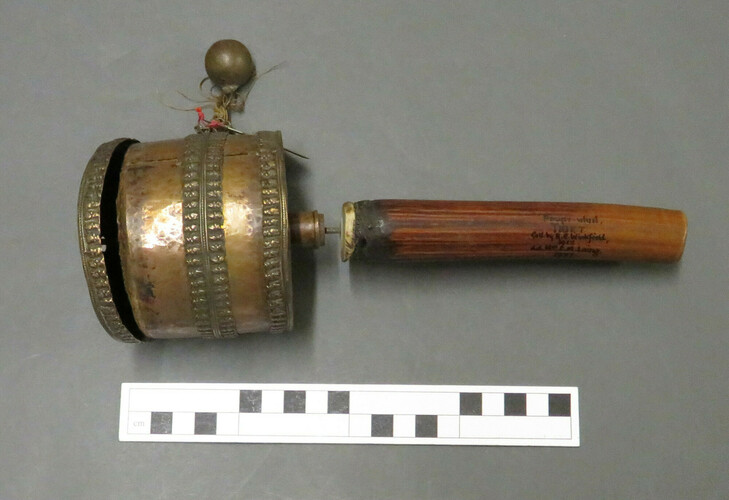 1937.3.1Prayer wheel. Copper and brass cylinder, with four decorated bands. [AF [OPS Move] 31/3/2017]1937.3.1
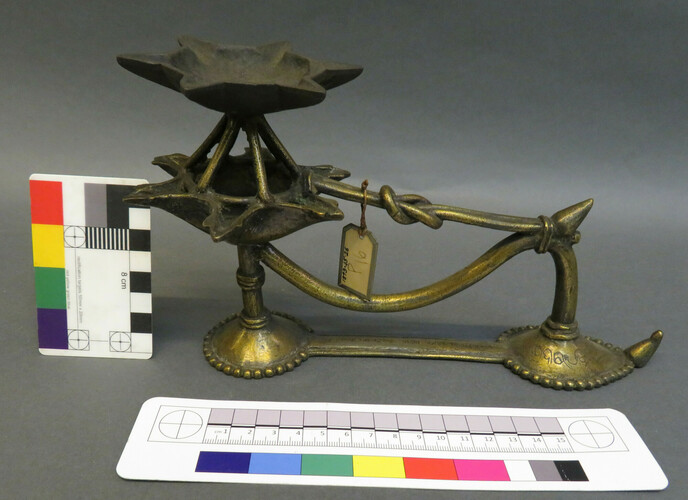 1893.45.26Brass lamp. Double saucer lamp, stacked on top of each other. The top lamp is open and has six pointed wick nozzles. This is supported by six cylinders which join at the centre of its underside where it is ?screwed on. The bottom lamp is slightly large in diameter and the wick nozzles have volute style decoration on either side. This is sat atop a pedestal foot. There is a long double handle extending to a second pedestal foot which mirrors the first. There is an inscription around the second foot. [MOBB [OPS move] 16/3/2017]1893.45.26
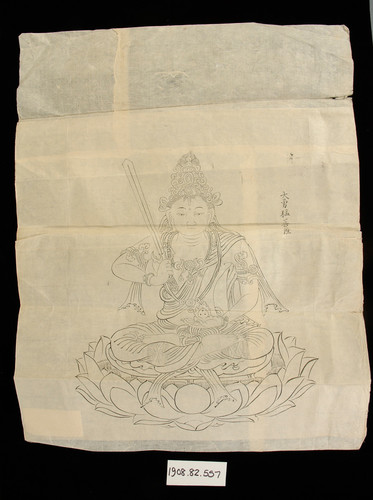 1908.82.557Buddhist picture of figure sitting in cross-legged on a lotus flower, holding a sword, representing courage. [SM 26/09/2008]1908.82.557
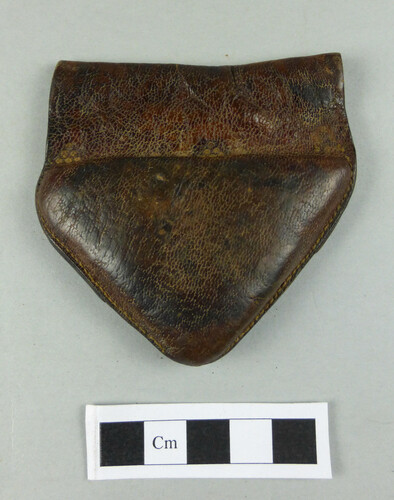 2002.51.5Muslim charm for humans and/or animals. A triangular leather case, supposedly with verses from the Qur'an stitched inside, with a wide loop of leather sewn on the top. [CF 31/7/2002]2002.51.5
 2024.20.40Hanainaie, porcelain sherd, originally part of a plate.2024.20.40
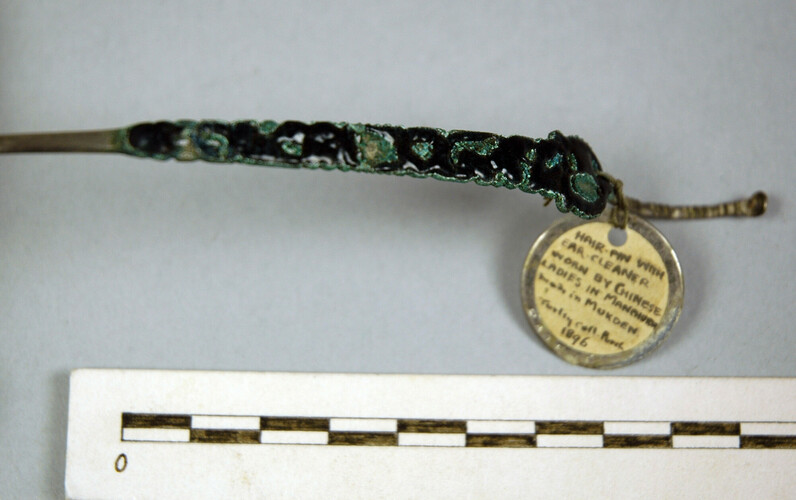 1896.62.129Woman's combined metal hair pin and ear scoop with turquoise enamel. [JP 30/10/2001]1896.62.129
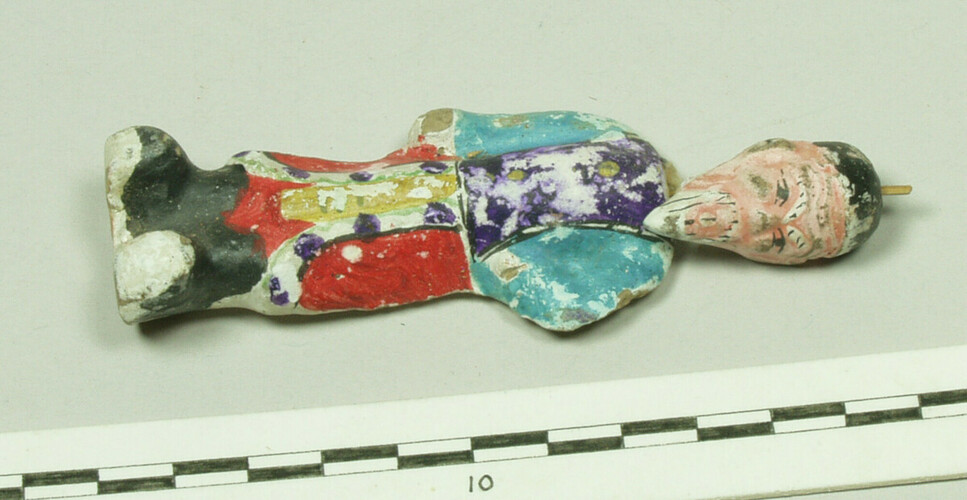 1945.10.88Toy figure of a bearded man with movable head. [E.S-R 'DCF 2004-2006 What's Upstairs?' 31/1/2005]1945.10.88
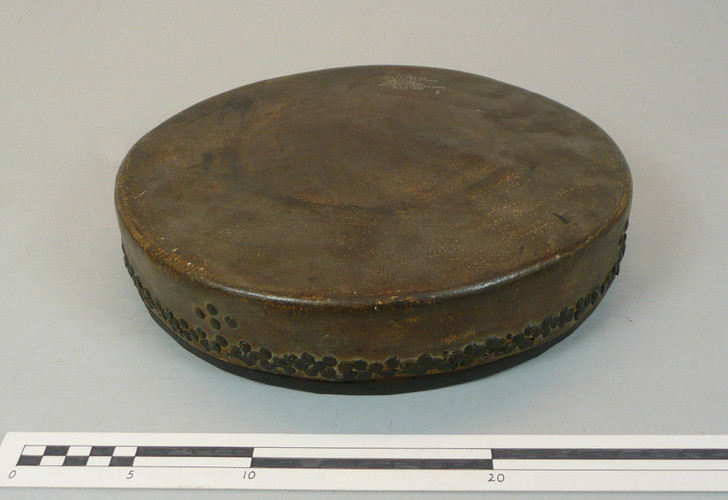 1899.74.25.10Deep small circular single membrane drum. [FC 9/9/2008]1899.74.25.10